
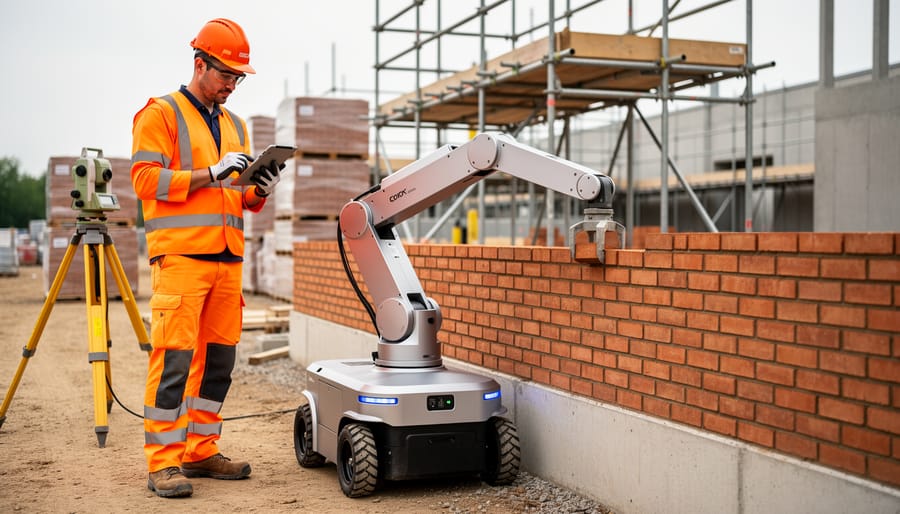
Construction robots are no longer science fiction reserved for mega-projects. Today’s job sites increasingly feature robotic bricklayers that can place 3,000 bricks in eight hours, autonomous excavators that grade sites with millimeter precision, and exoskeleton suits that reduce worker fatigue by 40 percent. These machines tackle repetitive tasks like concrete finishing, rebar tying, and material transport, freeing human workers for skilled decision-making roles.
The technology has evolved from experimental prototypes to rental-ready equipment available at major tool centers. Robotic total stations now cost less per day than specialized scaffolding, while semi-autonomous demolition robots handle hazardous tasks without putting workers at risk. Professional contractors report 20-30 percent productivity gains on specific tasks, though the learning curve varies by equipment type.
Understanding which robotic tools solve your specific construction challenges requires examining real-world applications, rental costs, and operator training requirements. This guide explores currently available robotic construction equipment, comparing hands-on user experiences with manufacturer claims. Whether you’re a general contractor evaluating efficiency improvements or a DIY builder curious about emerging technology, knowing what works today versus tomorrow matters more than futuristic promises.
Why Construction Robotics Stopped Being Just for Big Companies
Construction robotics used to mean massive investments reserved for large-scale commercial projects, but that landscape has changed dramatically. Today, smaller contractors and even ambitious DIYers can access robotic tools through rental programs, fundamentally shifting who gets to benefit from automation technology.
The rental model has been the game-changer. Major equipment rental chains now stock robotic systems alongside traditional machinery, letting you rent a bricklaying robot or autonomous concrete screeding machine for the duration of your project. This eliminates the prohibitive upfront costs that once kept these tools out of reach. Instead of investing tens of thousands in equipment you might use occasionally, you can rent for a few hundred dollars per day.
Modular designs have also opened doors. Modern construction robots often feature plug-and-play components that adapt to different tasks. A robotic lifting system might swap attachments to handle drywall installation one day and painting the next. This versatility means you’re not locked into single-purpose equipment, making the investment practical for varied project types.
User interfaces have become remarkably intuitive. Manufacturers recognized that construction professionals needed controls as straightforward as operating a tablet. Many systems now use familiar touchscreens with visual guides, eliminating the need for specialized programming knowledge. Some even feature voice commands or simple gesture controls, similar to AI-powered diagnostic tools you might already use.
The economic equation has shifted too. Labor shortages and rising wages mean that robotic assistance can actually reduce project costs, even factoring in rental fees. For a medium-sized renovation, renting a robotic tiling system might cost less than hiring additional workers while completing the job faster and with consistent quality.
Community feedback through online platforms has helped demystify these tools, with real users sharing honest reviews about learning curves, reliability, and actual time savings on typical residential and commercial projects.
Robotic Tools You Can Actually Hire Right Now
Robotic Total Stations and Layout Bots
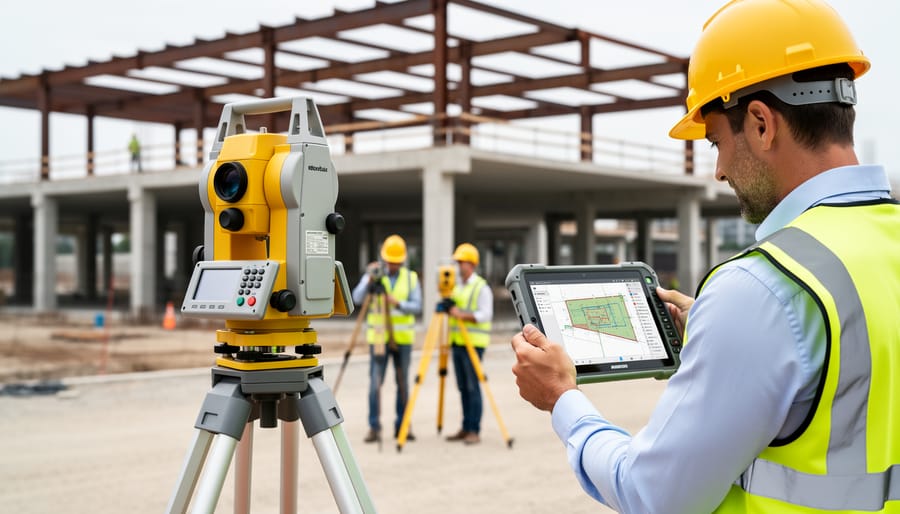
Robotic total stations and layout bots are transforming how construction sites handle measuring and marking tasks. These automated surveying tools combine traditional surveying equipment with robotic precision, eliminating the need for multiple crew members to mark reference points across large areas.
A robotic total station uses motorized heads and laser technology to track a prism held by a single operator, automatically recording measurements and angles with millimeter-level accuracy. Layout bots take this further by autonomously moving across floors to mark exact locations for walls, electrical boxes, and plumbing fixtures directly onto surfaces. This precision reduces costly rework from human measuring errors and speeds up layout processes by up to 70 percent compared to chalk lines and tape measures.
Rental costs typically range from $300 to $600 per week for robotic total stations, while advanced layout bots run $800 to $1,200 weekly. The investment makes sense for projects requiring repeated precise measurements, like multi-unit residential builds, commercial fit-outs, or any job with complex floor plans.
These tools pair well with augmented reality training systems that help operators quickly learn the interface. Most rental companies provide basic training sessions, and many contractors report achieving proficiency within a single day, making this technology increasingly accessible beyond large commercial operations.
Autonomous Demolition and Breaking Equipment
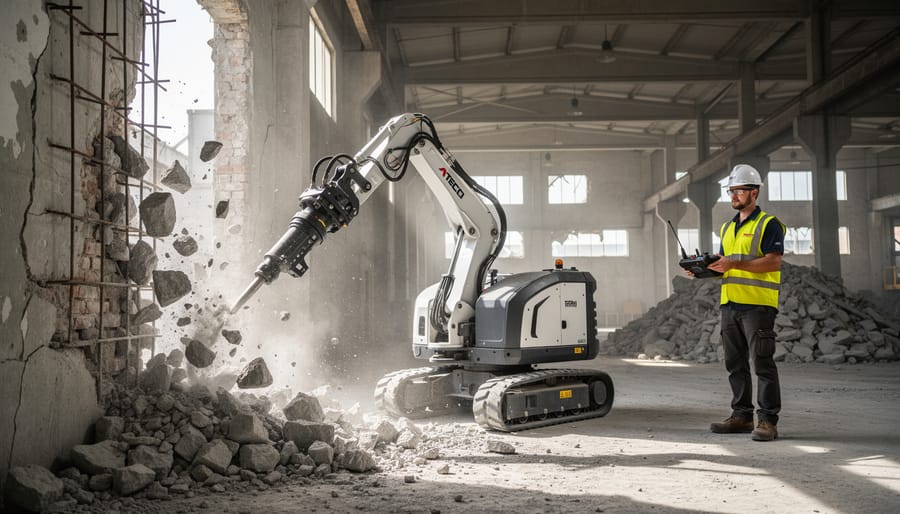
Demolition work has traditionally been one of construction’s most hazardous tasks, but remote-controlled demolition robots are changing that reality. These machines allow operators to break concrete, remove walls, and demolish structures from a safe distance, keeping workers away from falling debris, unstable structures, and hazardous dust.
Remote-controlled demolition robots come in various sizes, from compact units that fit through standard doorways to heavy-duty machines for industrial applications. Most feature interchangeable attachments including hydraulic breakers, crushers, and grapples, making them versatile for different breaking tasks. The operator controls the robot using a wireless remote, typically from 50-300 feet away depending on the model.
The safety advantages are substantial. Workers avoid exposure to vibration injuries common with handheld jackhammers, reduce silica dust inhalation risks, and stay clear of collapse zones. Many rental centers now stock these robots, with daily rates ranging from $300-800 depending on size and power.
Productivity gains are equally impressive. Users report that demolition robots can work continuously without fatigue, maintaining consistent breaking force that often completes jobs 30-50% faster than manual methods. The precision control also minimizes collateral damage to surrounding structures, reducing repair costs.
For those considering rental, start with smaller projects to understand the learning curve. Most operators become proficient within a few hours, though complex demolition still requires experienced supervision.
Robotic Lifting and Material Handling
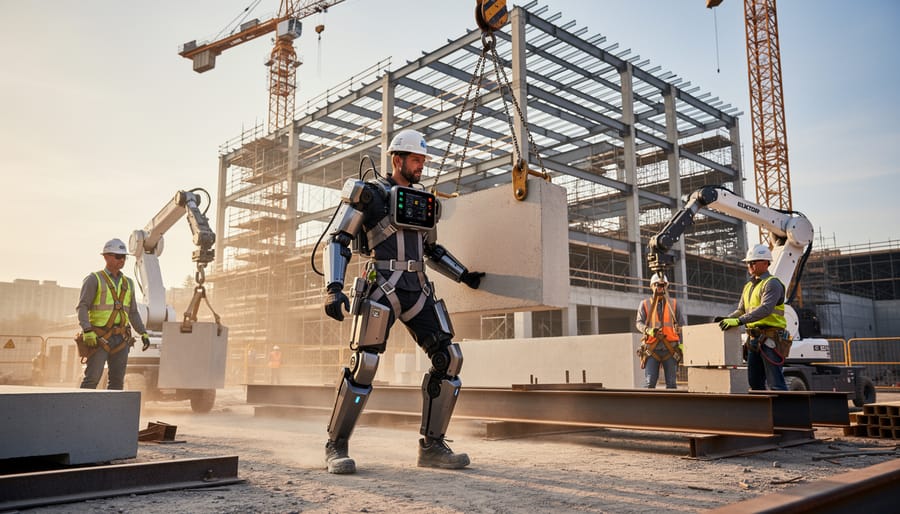
Robotic lifting and material handling systems are transforming how workers move heavy loads on construction sites, significantly reducing injury risks and physical strain. These technologies range from wearable solutions to autonomous transport systems, many of which are becoming available through equipment rental services.
Exoskeletons represent the most accessible entry point into robotic lifting. These wearable devices support the back, shoulders, and legs during lifting tasks. Passive exoskeletons use springs and counterbalances to reduce strain, supporting 20-40 pounds of lift assistance without power. Active exoskeletons incorporate motors and batteries, providing 50-200 pounds of lifting support. Workers commonly use them for overhead work, repetitive lifting, and extended material handling tasks. Rental costs typically range from $150-400 per week depending on the model.
Robotic carriers and autonomous carts handle heavier loads. These self-propelled units follow workers or navigate pre-programmed routes, carrying 500-2,000 pounds of materials. They’re particularly useful for moving drywall, lumber bundles, and masonry supplies across job sites. Some models feature load-leveling technology to prevent material damage during transport.
Automated lifting systems, including vacuum lifters and powered hoists, handle awkward materials like glass panels and metal sheets. Weight capacities range from 150 pounds for handheld units to 1,500 pounds for industrial models. User feedback consistently highlights reduced worker fatigue and fewer back injuries as primary benefits, though learning curves for proper operation vary by system complexity.
Automated Painting and Finishing Robots
Robotic painting and finishing systems bring industrial precision to construction projects, delivering consistent coats without drips, overspray, or human error. These machines use programmable spray patterns and sensors to maintain optimal distance from surfaces, ensuring even coverage on walls, ceilings, and trim work.
Most automated painting robots operate on wheeled bases or track systems, allowing them to navigate rooms independently. They’re equipped with multiple nozzles that adjust spray width and pressure based on surface texture. Advanced models include built-in masking detection to avoid windows, outlets, and fixtures without manual taping.
Setup typically requires 30-60 minutes to program room dimensions and configure paint viscosity settings. You’ll need adequate ventilation and power supply, plus compatible low-VOC paints that flow properly through robotic sprayers. The learning curve is moderate—expect a few practice runs before achieving professional results.
Rental makes economic sense for projects exceeding 2,000 square feet or multi-room repaints where consistency matters. Daily rental rates range from $150-$400 depending on capabilities, with weekend packages offering better value. Professional painters report 40-60% time savings on large residential jobs, though smaller rooms under 200 square feet don’t justify the setup investment.
Community reviews emphasize proper surface preparation remains essential—robots can’t fix underlying imperfections. Users recommend testing paint flow rates before starting and keeping manual equipment handy for touch-ups around complex architectural details.
What It Actually Costs (And When It’s Worth It)
Let’s talk real numbers. Renting a robotic total station typically runs between $400-$800 per week, compared to $150-$250 for a standard surveying tool. At first glance, that premium seems steep. But here’s where the math gets interesting: a robotic total station operated by one person can complete layout work that traditionally requires a two-person crew, saving roughly $300-$500 per day in labor costs alone.
For concrete finishing, robotic screeds rent for approximately $500-$900 weekly versus $100-$200 for manual screeds. The break-even point usually hits around day three on medium-sized pours when you factor in faster completion times and reduced rework. One contractor from Arizona reported finishing a 5,000 square foot commercial slab in six hours instead of the typical twelve, allowing his crew to move to the next job the same day.
Demolition robots present the clearest cost justification. Weekly rentals range from $1,500-$3,000 depending on size, but they eliminate the need for multiple workers in hazardous conditions. A small demolition robot can do the work of three to four laborers while keeping your team safely outside danger zones. The hidden savings compound quickly: fewer workers’ compensation claims, reduced fatigue-related errors, and dramatically faster debris processing.
The break-even calculation depends on project scale and duration. For single-day residential jobs, traditional methods usually win. But multi-day commercial projects or jobs requiring precision repeatedly show cost advantages by day two or three. Don’t forget the less obvious savings: robotic tools virtually eliminate do-overs from measurement errors, reduce material waste through precise application, and keep your crew fresh by handling the most physically demanding tasks. Many rental centers now offer weekend rates or multi-week discounts, further improving the value proposition for longer projects.
The Learning Curve: Easier Than You Think
If you’re worried that operating construction robots requires an engineering degree, here’s the good news: most rental-ready robotic tools are designed with everyday users in mind. Manufacturers understand that contractors and DIY enthusiasts need equipment they can master quickly, not systems that require weeks of specialized training.
Most basic robotic construction tools, like automated layout systems and robotic saws, can be learned in 2-4 hours. Many rental companies include brief tutorial sessions with your rental agreement, walking you through setup, operation, and safety protocols. These aren’t complex programming interfaces—modern systems typically use tablet-based controls with intuitive touchscreens, similar to smart technology solutions you might already use in other areas.
Online resources have made learning even easier. YouTube channels, manufacturer websites, and community forums offer step-by-step guides created by actual users. According to feedback from our rental community, the biggest learning curve isn’t operating the robot itself—it’s understanding how to integrate it into your existing workflow.
Start with rental equipment that includes training support. Test during a smaller project to build confidence before tackling larger jobs. Most users report feeling comfortable with basic operations after their first day, with proficiency developing over 2-3 rental periods.
The key takeaway: if you can operate a modern power tool or smartphone, you can learn to work with construction robotics. The technology has evolved to meet you where you are, not the other way around.
Real Users Share What Works (And What Doesn’t)
We asked contractors, DIY enthusiasts, and site managers about their hands-on experiences with construction robotics, and the feedback reveals both exciting wins and honest reality checks.
Mike, a Queensland bricklayer, tested a semi-automated bricklaying system on three projects. “The precision is incredible for straight runs, but corners and custom work? I’m still faster by hand,” he explains. His team found the setup time—roughly 45 minutes per site—ate into efficiency gains on smaller jobs. Maintenance proved trickier than expected, requiring weekly calibration checks.
Sarah, who manages equipment rentals for residential builds, shares mixed results with robotic total stations. “They’ve transformed our layout accuracy, but you need someone comfortable with modern training technologies to operate them effectively.” She notes that while AR training systems help crews get up to speed, the learning curve can delay smaller projects.
Several users praised robotic demolition equipment for hazardous work. “Worth every dollar when you’re dealing with unstable structures,” notes James, a demolition specialist. However, he cautions that rental costs—often $800-1200 daily—only make sense for specific scenarios.
The consensus on autonomous site vehicles? Great for large-scale earthmoving, overkill for residential work. Traditional equipment remains more practical for tight spaces and varied terrain.
Common limitations mentioned include weather sensitivity, the need for level surfaces, and battery life constraints. Most users recommend starting with rentals to test whether robotic solutions genuinely improve your specific workflow before considering purchase. The technology works brilliantly in its sweet spot but hasn’t replaced traditional methods across the board.
Safety Considerations You Can’t Ignore
Before operating any construction robot, you need to establish clear safety zones around the work area. Keep at least a 10-foot perimeter free of personnel when robots are active, and use high-visibility barriers or tape to mark boundaries. This applies whether you’re working with automated bricklaying systems or robotic demolition equipment.
Operator training isn’t optional. Most rental facilities require completion of their safety certification before you can take robotic equipment off-site. These sessions typically cover emergency stop procedures, proper startup sequences, and troubleshooting common malfunctions. Even experienced tradespeople should attend these briefings since each system operates differently.
Always conduct pre-operation inspections. Check sensor functionality, verify all safety guards are secured, and test emergency stop buttons before beginning work. Construction robots rely on sensors to navigate and avoid obstacles, so any malfunction could create hazardous situations.
Keep your emergency response plan simple: know where the emergency stop button is located, maintain clear communication channels with your team, and never bypass safety features to speed up work. According to user feedback from rental customers, most incidents occur when operators skip standard safety protocols to meet tight deadlines. Your project timeline matters less than everyone going home safely.
Making the Rental Decision: Your Practical Checklist
Before committing to a robotic tool rental, evaluate your project systematically. Start by assessing project size: robotic solutions typically become cost-effective for jobs exceeding three days or covering areas larger than 5,000 square feet. For smaller projects, traditional equipment often remains the practical choice.
Consider complexity factors that favor robotics. Does your job involve repetitive tasks like extensive concrete finishing, multiple layout measurements, or prolonged material handling? Robotic tools excel in these scenarios by reducing physical strain and improving consistency. Projects requiring precision positioning or operating in challenging environments (tight spaces, uneven terrain) also benefit from robotic assistance.
Ask rental providers these essential questions:
What training or certification is required to operate this equipment? Most robotic tools need 1-2 hours of orientation, which some providers include free with rental.
What happens if the equipment malfunctions? Clarify support availability, replacement timelines, and whether downtime affects your rental cost.
Can I test the equipment before committing to a full rental period? Many providers offer demo periods or first-day trial rates.
What insurance coverage do I need? Robotic equipment often carries higher replacement values than traditional tools.
Are software updates or connectivity requirements included? Some robotic systems need ongoing digital support.
Finally, compare your project timeline against learning curves. If you’re working solo on a tight deadline, traditional tools you already know might be safer. For team projects with flexible schedules, robotic rentals offer opportunities to learn new capabilities while improving efficiency. Community reviews from other renters provide invaluable real-world perspective on whether specific robotic tools delivered promised benefits.
Construction robotics have moved beyond industrial job sites and into the realm of everyday projects. Whether you’re a professional tradesperson looking to boost efficiency or a DIY enthusiast tackling a challenging home renovation, robotic tools are now genuinely accessible through rental models. The key is starting small—you don’t need to overhaul your entire workflow overnight. Consider renting a robotic demolition tool for your next concrete removal project, or test out automated bricklaying assistance for a straightforward wall installation. Tap into community-driven reviews and user-generated content to learn from others who’ve already navigated the learning curve. These shared experiences reveal which applications deliver real value and which situations are better suited to traditional methods. As rental networks expand and costs continue to decrease, the barrier to entry keeps shrinking. Next time you’re planning a project that involves repetitive tasks, heavy lifting, or precision placement, take a moment to explore robotic options at your local rental center. The technology is here, it’s practical, and it might just transform how you work.
Related Posts


Post a Comment