
Understand that sharpening safety razor blades is technically possible but rarely worth the effort compared to blade replacement costs. Modern double-edge blades cost pennies each and are engineered with precision coatings that home sharpening methods cannot replicate. If you choose to attempt sharpening, recognize you’re extending blade life by perhaps 2-3 shaves maximum while risking uneven edges that cause nicks, irritation, and increased infection risk from improper handling.
The stropping method offers the safest approach: run the blade backwards along denim fabric or leather 15-20 times per side to realign the microscopic edge without removing metal. Avoid abrasive sharpening methods like sandpaper or grinding wheels, which create rough, dangerous edges and remove protective coatings. Glass or ceramic stropping requires extreme caution as one wrong angle creates burrs that will tear skin.
Weigh your time investment against replacement economics. A quality blade costs $0.10-0.25 and delivers 5-7 comfortable shaves. Sharpening takes 5-10 minutes per blade and voids any guarantee of edge quality. For those committed to sustainability over convenience, understand that even successfully sharpened blades lose their factory geometry and anti-corrosion properties, making proper disinfection between uses absolutely essential to prevent bacterial growth in microscopic edge damage.
Understanding Safety Razor Blades and Why People Try to Sharpen Them
The Cost Factor
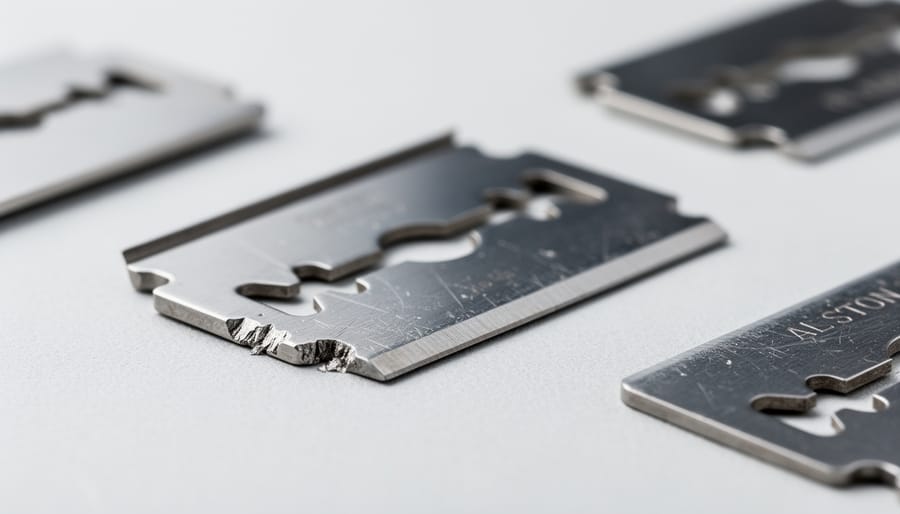
Safety razor blades are remarkably inexpensive when purchased in bulk, typically costing between 10 to 25 cents per blade. A single blade can last anywhere from five to ten shaves with proper care, making replacement the most straightforward and cost-effective option for most users. The motivation to sharpen blades usually stems from situations where replacement isn’t immediately available, such as during travel or supply shortages, rather than significant cost savings. When you factor in the time investment required to sharpen a blade, the potential safety risks, and the inconsistent results, the minimal financial savings rarely justify the effort. For context, a year’s supply of quality blades costs roughly the same as a single premium coffee. Community feedback consistently shows that users who attempt sharpening for purely economic reasons often abandon the practice once they calculate the actual pennies saved versus the convenience and safety of using fresh blades.
Environmental Concerns
Extending the life of safety razor blades addresses significant environmental concerns in our throwaway culture. Americans dispose of approximately two billion disposable razors and cartridges annually, creating substantial landfill waste. While traditional safety razor blades are recyclable metal, frequent replacement still contributes to resource consumption and manufacturing emissions.
Sharpening blades, when done safely and effectively, reduces this waste stream by extending each blade’s useful life. However, it’s important to balance sustainability goals with practical safety. A blade sharpened beyond its safe usable life poses injury risks that outweigh environmental benefits. Many in the shaving community recommend a middle-ground approach: sharpen blades once or twice to double their lifespan, then recycle them properly through designated blade banks or metal recycling programs. This strategy reduces waste while maintaining the safety and performance standards that make safety razors a sustainable choice compared to disposable alternatives.
The Real Safety Risks of Sharpening Safety Razor Blades
Laceration Risks During Handling
The sharpening process fundamentally changes your relationship with the blade. Unlike normal handling where the razor protects you through its safety bar design, sharpening requires direct manipulation of the exposed cutting edge. You’ll hold the blade at various angles, apply pressure, and repeatedly draw it across abrasive surfaces—each action bringing your fingers dangerously close to the sharpened edge.
Many DIY enthusiasts report that freshly sharpened blades are actually more prone to causing cuts than factory edges because the sharpening process can create microscopic burrs or inconsistent angles along the cutting surface. These irregularities catch skin more easily than the precision-ground factory edge.
The repetitive nature of sharpening compounds the risk. Professional tradespeople know that fatigue leads to accidents, and blade sharpening demands sustained concentration. One moment of distraction while adjusting your grip or checking the edge can result in deep lacerations. Community-driven reviews consistently highlight hand injuries as the most common consequence of home sharpening attempts, with many users admitting the practice simply isn’t worth the risk given the low cost of replacement blades.
Blade Integrity Concerns
Improper sharpening techniques can compromise blade integrity in ways that aren’t immediately visible but pose significant risks. When you attempt to sharpen safety razor blades using makeshift methods, you may create microscopic burrs—tiny metal fragments that project from the cutting edge. These burrs can snag skin and cause painful tears rather than clean cuts. Additionally, uneven sharpening pressure creates weak points along the blade edge where the metal becomes thinner in some spots than others. These weakened areas are prone to chipping or breaking during use, potentially leaving metal fragments embedded in skin.
Following proper tool safety practices means understanding that razor blades are precision-manufactured to exacting tolerances. Home sharpening methods—whether using denim, leather strops, or abrasive materials—lack the controlled environment needed to maintain these tolerances. The altered blade geometry can also affect how the blade sits in your razor, changing the angle and pressure during shaving. This misalignment increases the likelihood of nicks and cuts, defeating the purpose of extending blade life.
Microscopic Damage You Can’t See
Even if a blade looks sharper after DIY sharpening, the naked eye can’t detect microstructural damage that occurs during the process. Honing methods can create invisible stress fractures, irregular edge geometry, or remove protective coatings that prevent corrosion. These hidden flaws lead to inconsistent shaving results, increased skin irritation, and unpredictable blade failure. Professional manufacturers use precision grinding at specific angles under controlled conditions—something impossible to replicate at home. What feels sharp initially may have microscopic teeth or burrs that actually tear rather than cut cleanly, compromising both performance and safety without obvious visual indicators.
Common Sharpening Methods (And Why They’re Problematic)
The Denim/Leather Stropping Method
This old-school technique involves stropping the blade against denim fabric or leather, similar to how barbers sharpen straight razors. The theory is that running the blade backwards along the material realigns the microscopic edge. To attempt this method, lay a piece of denim or leather flat on a hard surface, then carefully push the blade away from you along the material 10-15 times per side, moving only in the opposite direction of how you would shave.
However, we need to be honest about its effectiveness. Modern safety razor blades are factory-honed to incredibly precise tolerances that home stropping simply cannot replicate. While stropping works well for thick straight razor blades, disposable safety razor blades are too thin and flexible to benefit meaningfully from this approach. Most users report minimal improvement, if any.
Safety is another concern. Handling exposed blades increases cut risk significantly, and improper stropping can actually damage the edge further by creating uneven wear patterns or microscopic chips. Given that replacement blades cost just pennies each, the minimal potential benefit rarely justifies the safety risks involved.
Using Sharpening Stones
Sharpening stones, while excellent for kitchen knives and woodworking tools, present significant challenges when used on safety razor blades. The primary issue stems from the blade’s thinness—typically just 0.1mm thick. Unlike sturdier knife blades, safety razors lack the structural integrity to withstand the pressure and angle control required during stone sharpening.
When users attempt this traditional method, they frequently create uneven edges because maintaining consistent angle and pressure across such a thin, flexible blade is extremely difficult, even for experienced sharpeners. The result is often a blade with microscopic irregularities that cause painful nicks and irritation during shaving.
Additionally, sharpening stones work through abrasion, removing metal from the blade surface. With safety razors already being so thin, this material removal compromises the blade’s structural integrity. Many DIY enthusiasts in our community forums report that stone-sharpened blades feel “grabby” or “rough” rather than smooth.
The risk-to-benefit ratio simply doesn’t favor this method. Given that replacement blades cost mere pennies, the time investment and potential for injury make sharpening stones an impractical choice for safety razor maintenance.
Glass or Ceramic Cup Methods
The glass or ceramic cup method has gained popularity online as a free sharpening solution, but it delivers questionable results with notable downsides. This technique involves running the blade along the unglazed rim at the bottom of a ceramic mug or glass tumbler, supposedly realigning the edge through friction.
In practice, community feedback reveals this method produces inconsistent outcomes. Some users report one or two additional shaves, while others notice no improvement whatsoever. The unglazed ceramic provides minimal abrasive action, meaning you’re more likely stropping the blade than truly sharpening it.
The primary concern is safety. Holding a razor blade at the correct angle against a slippery surface creates significant risk for hand injuries. The curved rim makes maintaining consistent pressure nearly impossible, and any slip can result in cuts. Additionally, repeatedly pressing against delicate glassware can cause chipping or breakage, introducing additional hazards.
If you choose to attempt this method despite the risks, work slowly over a padded surface, use stable mugs without cracks, and wear cut-resistant gloves. However, given the marginal results and injury potential, investing in proper replacement blades remains the safer, more effective choice.
Essential Safety Protocols If You Choose to Sharpen
Personal Protective Equipment Requirements
Before attempting to sharpen safety razor blades, assembling the proper protective equipment is essential to prevent injuries from these extremely sharp implements.
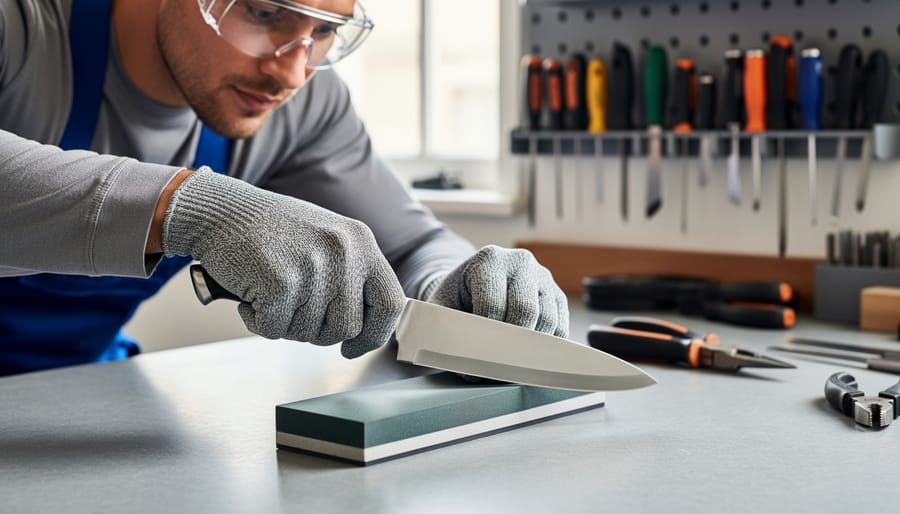
Cut-resistant gloves rated Level 3 or higher provide crucial hand protection when handling razor blades. These specialized gloves feature tightly woven fibers that resist blade penetration while maintaining dexterity for precise work. Standard work gloves offer insufficient protection against razor-sharp edges.
Safety glasses or protective eyewear shield your eyes from metal particles that may dislodge during sharpening. Even microscopic fragments can cause serious eye injuries, making this non-negotiable safety gear.
Your workspace requires proper setup with adequate lighting, a stable work surface, and organized tool placement. Secure all materials on a non-slip mat to prevent unexpected movement. Keep a first aid kit within reach, including sterile gauze and antiseptic for treating minor cuts.
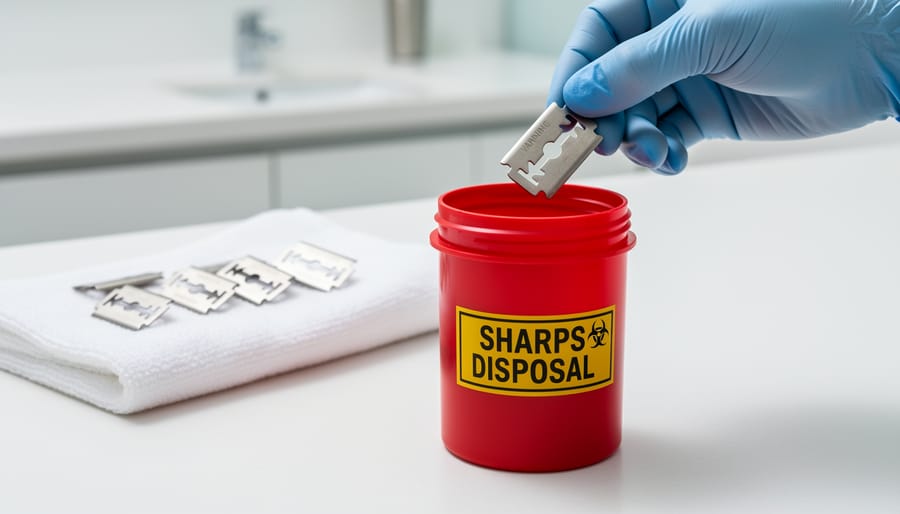
Work in a clutter-free area away from distractions, and never rush the process. Dispose of damaged or excessively worn blades in puncture-proof sharps containers rather than attempting to restore them.
Safe Handling Techniques
Before attempting to sharpen any razor blade, proper handling is essential to prevent cuts and injuries. Always work in a well-lit area with a stable, flat surface. Start by washing and drying your hands thoroughly to ensure a secure grip.
When handling the blade, grip it by the blunt edges only, never touching the sharp cutting edge. Hold the blade between your thumb and forefinger along the top edge, keeping your other fingers clear of the blade path. If the blade feels slippery, use a clean, dry cloth to improve your grip rather than handling it bare-handed.
Position the blade flat against your sharpening surface, maintaining consistent light pressure throughout the process. Move the blade away from your body in smooth, controlled strokes. Never pull the blade toward yourself or make quick, jerky movements.
Consider wearing cut-resistant gloves designed for handling sharp objects, especially if you’re new to blade maintenance. Keep a first-aid kit nearby as a precaution. If at any point you feel uncomfortable or the blade seems damaged or unstable, stop immediately and replace it instead. Community feedback consistently emphasizes that safety should always take priority over cost savings.
Testing Sharpened Blades Safely
Never test blade sharpness by running your finger along the edge. Instead, use the paper test: hold a piece of standard printer paper vertically and gently draw the blade across it at a slight angle. A sharp blade will slice cleanly without tearing or dragging. If the blade snags, tears the paper unevenly, or requires pressure, it hasn’t achieved proper sharpness.
Another safe method is the hair test. Hold a single strand of hair taut and touch the blade to it lightly. A truly sharp edge will cut the hair with minimal contact. If the blade pushes the hair aside or requires sawing motion, it needs more work.
Look for warning signs of compromised blades: visible nicks or chips along the edge, rust spots, uneven discoloration, or bending. These indicate the blade should be discarded immediately, as further sharpening won’t restore safe cutting performance. Community members consistently report that blades showing these defects perform poorly and increase injury risk, regardless of sharpening attempts.
When Replacement Makes More Sense Than Sharpening
Cost-Benefit Analysis
Let’s break down the real costs of sharpening versus replacement. A quality safety razor blade costs between $0.10 and $0.50, while sharpening takes 5-10 minutes per blade using materials like denim, leather strops, or glass. The time investment adds up quickly, especially when considering that even successful sharpening typically extends blade life by only 2-4 additional shaves.
The effectiveness varies dramatically. Most DIY methods produce inconsistent results, with some users reporting marginal improvement while others see no benefit or even worse performance. Professional blade reconditioning services exist but often cost more than new blades.
Risk factors include uneven sharpening leading to nicks and cuts, potential contamination from handling, and the frustration of unreliable results. When you factor in your time at even modest hourly rates, the math rarely favors sharpening. For most users, the convenience, consistency, and safety of fresh blades outweigh any minimal savings from sharpening attempts.
Signs a Blade Is Beyond Sharpening
Even with careful technique, safety razor blades eventually reach their end of life. Watch for visible rust or corrosion spots, which indicate the blade has oxidized beyond safe use. Chips or cracks along the cutting edge mean the blade’s structural integrity is compromised and sharpening won’t restore it. If you notice the blade bending or flexing more than when new, the metal has fatigued and won’t hold a proper edge. Persistent tugging or pulling during shaving, even after attempted sharpening, signals the blade can’t achieve adequate sharpness anymore. Black or dark discoloration often indicates metal breakdown rather than simple tarnish. Finally, if a blade has been sharpened multiple times already, the diminishing returns on effort make replacement the smarter choice. Remember, fresh blades cost pennies compared to the risk of cuts from compromised ones.
Safe Blade Disposal and Recycling Options
Whether you’re sharpening old blades or replacing them regularly, proper disposal is essential for safety and environmental responsibility. Used razor blades pose serious injury risks and shouldn’t go directly into household trash where they can harm sanitation workers.
The safest disposal method is using a dedicated blade bank—a puncture-resistant container specifically designed for collecting used blades. You can purchase metal blade banks at most pharmacies, or create a DIY version using a sealed metal can (like a soup can) with a coin-slot opening cut in the plastic lid. Clearly label your container as “Sharps—Do Not Open.”
Once your blade bank is full, check with your local waste management facility about proper disposal procedures. Many municipalities accept sealed blade banks with household hazardous waste or offer sharps collection programs at pharmacies and community centers.
For recycling options, some manufacturers and specialty retailers operate mail-back programs for used blades. Community members have reported success with companies that accept steel blades for metal recycling, though you’ll need to verify acceptance in your area. Stainless steel blades are recyclable, but they must be contained safely.
Never attempt to recycle loose blades in curbside bins—this creates dangerous situations for recycling facility workers. Taking a few minutes to dispose of blades properly protects people and keeps hazardous materials out of landfills.
While sharpening safety razor blades can extend their life temporarily, remember that your safety matters more than saving a few cents per blade. New blades are inexpensive and provide reliable, predictable performance without the risks associated with makeshift sharpening methods. If you choose to sharpen, always inspect blades carefully for damage, handle them with extreme care, and replace them at the first sign of wear or irregular performance. Never attempt to sharpen blades that show rust, chips, or bending. Keep sharpened blades clearly marked and separate from new ones to avoid confusion. We’d love to hear about your experiences with blade maintenance in our community section below. Whether you’ve found success with certain methods or learned lessons the hard way, your feedback helps others make informed decisions. Have questions about blade safety or alternative approaches? Share them with our community of DIY enthusiasts and tradespeople who prioritize both practicality and safety.
Related Posts