


A Work Breakdown Structure (WBS) transforms overwhelming projects into manageable pieces by breaking them down into smaller, clearly defined tasks. Think of it as a project family tree: your complete renovation sits at the top, then branches into major phases like demolition, electrical, and plumbing, which further divide into specific tasks like “remove kitchen cabinets” or “install recessed lighting.” This hierarchical system isn’t just organizational theory—it directly impacts your ability to estimate costs, schedule equipment rentals, and identify exactly which tools you need when.
Without a WBS, you’re guessing at timelines and budgets. With one, you can pinpoint that your bathroom remodel requires a concrete breaker for three days during week one, a tile saw for five days in week three, and a paint sprayer for two days at the end. Each work package in your WBS becomes a mini-project with its own scope, duration, and resource requirements. The result? Accurate estimates, realistic schedules, and the confidence that you’ve thought through every task before you pick up a single tool.
What Exactly Is a WBS (Work Breakdown Structure)?

Breaking Down the Breakdown: How WBS Actually Works
Let’s walk through how a Work Breakdown Structure actually works using a practical example: renovating your bathroom.
Imagine you’re tackling a complete bathroom renovation. Without a WBS, you’d have one massive, overwhelming task. With a WBS, you break it down systematically.
Start at the top level: “Bathroom Renovation Project.” This is your entire project in one package.
Next, divide it into major deliverables or phases. For our bathroom, these might be: demolition, plumbing, electrical, tiling, fixtures installation, and painting. Each of these becomes a second-level component.
Now, break those down further. Take “tiling” as an example. This splits into: preparing surfaces, waterproofing, cutting tiles, laying floor tiles, installing wall tiles, and grouting. Each task is specific and manageable.
Continue breaking down until each component represents a clear, achievable task that one person or team can complete. The “laying floor tiles” task might include: measuring and marking layout, mixing adhesive, applying adhesive, placing tiles, using spacers, and allowing to set.
This hierarchical breakdown serves multiple purposes. First, it makes predicting project costs significantly easier because you can estimate time and materials for each specific task. Second, it helps you identify exactly which tools you’ll need and when. Third, nothing gets forgotten because every element is documented.
The key is breaking things down until tasks become concrete actions with clear start and end points.
The Critical Link Between WBS and Scope Definition
What Gets Measured Gets Done (and Estimated Correctly)
Here’s the reality: you can’t estimate what you can’t see. This is where the WBS becomes your best friend in project planning. By breaking your project into smaller, visible pieces, you transform vague guesses into concrete numbers backed by actual data.
Think of it this way: if someone asks you to estimate the cost of “renovating a bathroom,” you’re shooting in the dark. But when your WBS breaks it down into demolition, plumbing rough-in, electrical work, tiling, fixture installation, and finishing, you can suddenly attach real numbers to real tasks. Each work package becomes a line item you can research, quote, and track.
This visibility does something crucial: it reveals the hidden costs that sink projects. When you list out every task, you notice things like: “We need scaffolding access for three days, not one” or “The concrete pour requires both a mixer and a vibrator.” These details only surface when you force yourself to document every single work package.
The quantifiable aspect matters too. Once you’ve identified all work packages, you can assign duration, labour hours, and material quantities to each. Your WBS becomes a checklist where nothing gets forgotten. Community feedback from contractors consistently shows that detailed WBS structures reduce estimate errors by 30-40% compared to top-level guessing.
Bottom line: visibility equals accuracy. If it’s in your WBS, it gets counted. If it gets counted, it gets budgeted correctly.
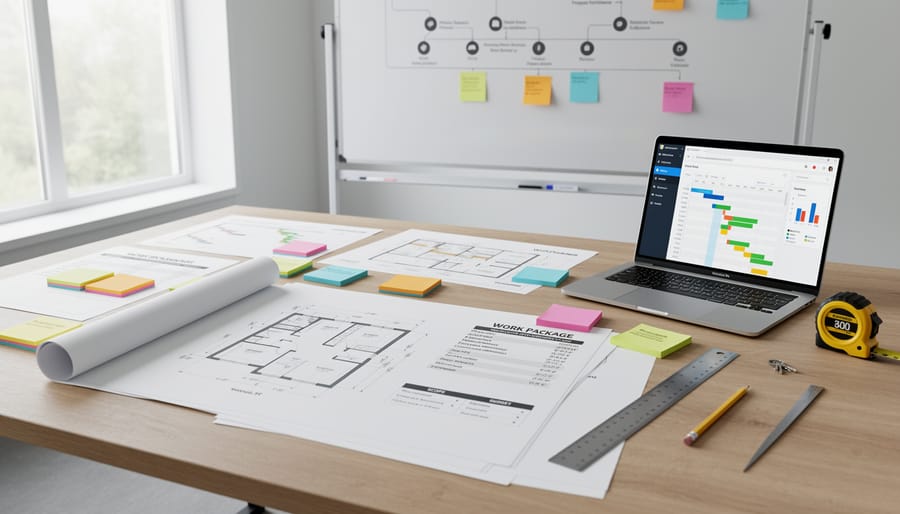
Building Your First WBS: A Practical Walkthrough
The Three Levels Every WBS Needs
Every effective WBS follows a three-tier structure that breaks your project into manageable pieces. Think of it as zooming in from the big picture to the smallest tasks.
The project level sits at the top and represents your entire goal. For example, “Kitchen Renovation” is your complete project. This gives everyone a single, clear understanding of what you’re accomplishing.
Below that, the deliverable level breaks down the major components or phases. In our kitchen renovation, these might be “Demolition,” “Plumbing and Electrical,” “Cabinetry Installation,” and “Flooring.” Each deliverable represents a significant chunk of work that produces a tangible result.
At the bottom, the work package level contains the specific tasks needed to complete each deliverable. Under “Flooring,” you’d list individual activities like “Remove existing flooring,” “Level subfloor,” “Install underlayment,” and “Lay new flooring material.” These work packages are small enough to estimate time, costs, and required tools accurately.
This hierarchy helps you understand exactly what equipment you’ll need when. Rather than guessing you might need a demolition hammer “sometime during the project,” you’ll know precisely which week to schedule it based on your work packages.
Common Mistakes That Ruin Your WBS (and Your Estimate)
Even experienced project planners stumble when creating a Work Breakdown Structure. Here are the most common mistakes and how to fix them.
Going too granular is perhaps the biggest pitfall. Breaking down tasks into tiny steps like “pick up hammer” or “measure twice” creates unnecessary complexity. Your WBS becomes unmanageable, and you spend more time updating it than actually working. The fix: Stop at the level where you can reasonably estimate time and cost. For a deck renovation, “install decking boards” is sufficient detail rather than breaking it into dozens of micro-tasks.
Missing work packages leaves gaps in your estimate. Many DIYers forget about prep work, cleanup, or disposal when planning projects. You might remember “demolish old bathroom tile” but overlook “rent dumpster for debris removal” or “repair damaged substrate.” The fix: Use a community-driven checklist or ask experienced contractors what hidden tasks they’ve encountered. Review past project feedback to catch commonly overlooked items.
Overlapping categories creates confusion and duplicate costs. For example, listing “painting supplies” under both “materials” and “finishing work” means you might count them twice in your estimate. The fix: Ensure each work package appears only once in your structure. If you’re unsure where something belongs, ask yourself which parent category directly controls that task.
Remember, your WBS should clarify your project, not complicate it. Start simple, test it against real estimates, and adjust based on what actually happens during execution.
How WBS Makes Estimating Actually Reliable
From WBS to Budget: The Estimating Process
Once you’ve broken your project down into work packages, the real magic happens: transforming that structure into actionable budget estimates. Each work package becomes a mini-project that you can quantify and cost out.
Start by examining each work package individually. For a deck building project, your “Install deck boards” work package translates into specific resource requirements: the number of boards needed based on your deck’s square footage, the fasteners to secure them, and the specialized tools like a nail gun or circular saw. Document everything in a simple list format that anyone on your team can understand.
Next, calculate labor hours. How long will it take to complete each work package? Consider your skill level honestly. A professional might install deck boards in four hours, while a DIY enthusiast might need eight. This realistic assessment prevents budget overruns and scheduling headaches.
Material costs follow naturally from your quantities. With your list of required boards, fasteners, and finishes, you can visit suppliers or search online for current prices. Don’t forget consumables like saw blades or sandpaper that wear out during the job.
Finally, add equipment rental costs. Your work package list reveals which tools you’ll need and for how long. Renting a power washer for deck prep or a compound miter saw for precise cuts becomes a line item you can budget for accurately. This methodical approach ensures nothing gets overlooked.
Tools and Equipment Planning Through WBS
When you break down your project using a Work Breakdown Structure, you’re essentially creating a roadmap that reveals exactly which tools you’ll need at each stage. This precision planning prevents common scenarios where you’re paying rental fees for equipment sitting idle on-site, or worse, facing project delays because you don’t have the right tool when you need it.
For example, if your WBS shows “Install decking” as a work package, you can drill down to identify you’ll need a circular saw, drill driver, and level for three specific days. This means you hire these tools only for that window, rather than keeping them for weeks “just in case.” Similarly, specialized equipment like concrete mixers or post hole diggers can be scheduled for precise delivery and collection times.
The WBS also helps you spot opportunities to batch similar tasks. If multiple work packages require the same tool, you can reorganize your schedule to complete them consecutively, minimizing rental periods. Many community members report saving 30-40% on tool hire costs simply by using WBS to eliminate overlap and idle time.
Real-World Example: Kitchen Renovation WBS Breakdown
Let’s walk through how a Work Breakdown Structure transforms a kitchen renovation from an overwhelming project into manageable, estimable tasks.
Imagine you’re planning to renovate your kitchen. Without a WBS, you might think “I need to redo my kitchen” and guess it’ll cost around $15,000 and take three weeks. But that’s not estimating—that’s hoping.
Here’s how a proper WBS breaks it down:
Level 1: Kitchen Renovation Project
Level 2 (Major Deliverables):
– Demolition and Preparation
– Plumbing Work
– Electrical Work
– Cabinetry and Storage
– Countertops and Surfaces
– Flooring
– Appliances and Fixtures
– Finishing and Cleanup
Level 3 (Work Packages for Demolition and Preparation):
– Remove existing cabinets
– Remove old countertops
– Remove appliances
– Strip old flooring
– Protect adjacent rooms
– Arrange waste removal
Now you can estimate accurately. Removing cabinets requires a reciprocating saw rental for one day, two people for four hours, and a dumpster rental. That’s concrete costs you can research and price out. The same specificity applies to every work package.
Notice what this reveals about scope: You probably didn’t initially think about protecting adjacent rooms or the specific tools needed for each task. The WBS forces you to think through every deliverable, preventing those “oh, I forgot about that” moments that blow budgets.
This breakdown also shows dependencies. You can’t install new cabinets before demolition completes. You can’t tile the floor until plumbing rough-in finishes. These insights help you schedule tool rentals efficiently—no paying for equipment sitting idle.
For community review purposes, this level of detail lets other renovators give you meaningful feedback. Instead of “looks good,” they can say “you forgot to include outlet relocation in your electrical work package” or “consider adding cabinet painting as an alternative to replacement.”
The WBS transforms your kitchen renovation from a vague goal into a project you can realistically estimate, schedule, and execute.
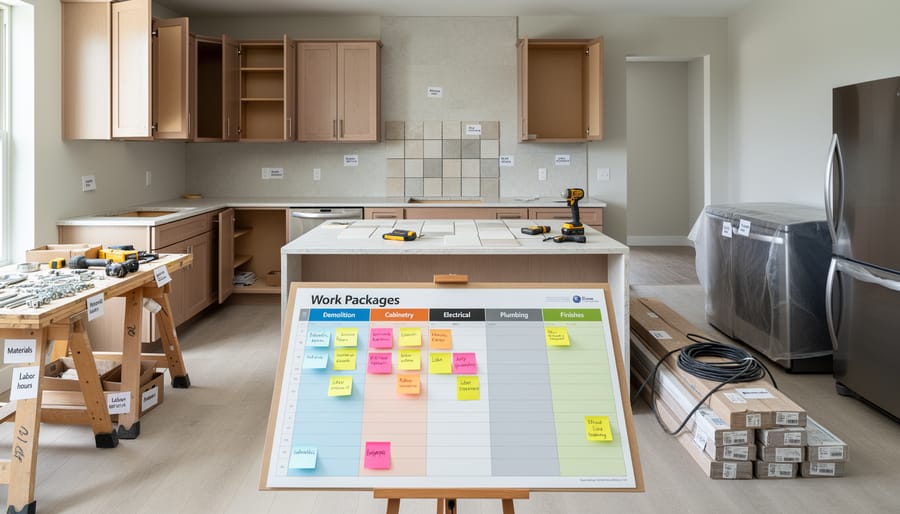
Breaking down your project with a Work Breakdown Structure isn’t just good practice—it’s your best defense against project chaos, blown budgets, and those dreaded mid-project surprises. Whether you’re planning a kitchen renovation, building a deck, or managing a commercial installation, a WBS transforms overwhelming projects into manageable tasks that you can actually estimate, schedule, and execute with confidence.
The beauty of WBS is that it forces you to think through every detail before you pick up a hammer or rent your first piece of equipment. This upfront planning reveals hidden tasks, prevents duplicate work, and helps you identify exactly which tools and materials you’ll need at each stage. The result? More accurate estimates, better resource allocation, and far fewer emergency runs to the hardware store.
Ready to tackle your next project with clarity and control? Start by creating a simple WBS for your upcoming work—even a basic breakdown on paper will reveal insights you might have missed. And when it comes time to identify the tools you’ll need for each work package, explore rental options that match your project timeline. Smart planning combined with the right equipment at the right time is your recipe for project success. What will you build with your newfound structure?
Related Posts


Post a Comment