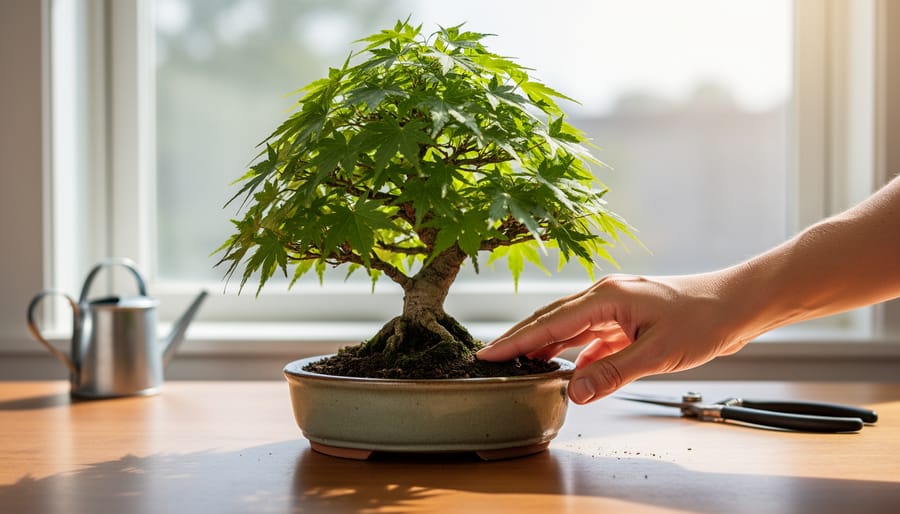
Check your bonsai’s soil moisture daily by inserting your finger one inch deep—watering only when the soil feels barely damp prevents the root rot that kills most beginner trees. Position your tree where it receives 5-6 hours of indirect sunlight near an east or west-facing window, as insufficient light causes the weak, leggy growth that makes bonsai look unhealthy within weeks.
Prune new growth back to 2-3 leaves once shoots extend beyond the tree’s silhouette, using clean, sharp scissors to maintain shape without the stress of major cutbacks. Most bonsai failures stem from three correctable mistakes: overwatering from anxiety, underwatering from neglect, and keeping outdoor species like junipers and maples indoors where they cannot enter dormancy.
Feed your bonsai every two weeks during the growing season with half-strength liquid fertilizer, stopping in winter when growth naturally slows. Repot every 2-3 years in spring before new growth emerges, trimming one-third of the root mass to prevent the tree from becoming root-bound in its shallow container.
The difference between a thriving bonsai and a struggling one rarely comes down to artistic skill—it depends on mastering these fundamental care routines that keep your tree healthy enough to train. Unlike full-sized trees that tolerate neglect, bonsai require consistent attention because their small containers create an artificial environment where you control every variable. Success means understanding that bonsai care is less about ancient secrets and more about developing reliable daily habits that address your specific tree’s needs for water, light, nutrients, and seasonal dormancy.
Understanding Your Bonsai: It’s Still a Real Tree
Indoor vs. Outdoor Bonsai Species
Understanding whether your bonsai belongs indoors or outdoors is perhaps the single most important factor in keeping it alive. This isn’t about preference—it’s about biology.
Outdoor bonsai species are temperate trees that require seasonal changes to survive. They need winter dormancy, experiencing cold temperatures that trigger their natural growth cycle. These include juniper, pine, maple, and elm varieties. Keeping an outdoor species inside year-round will eventually kill it, as the tree cannot complete its life cycle without proper cold exposure. Think of these as miniature versions of trees you’d find in your garden—they need the same conditions.
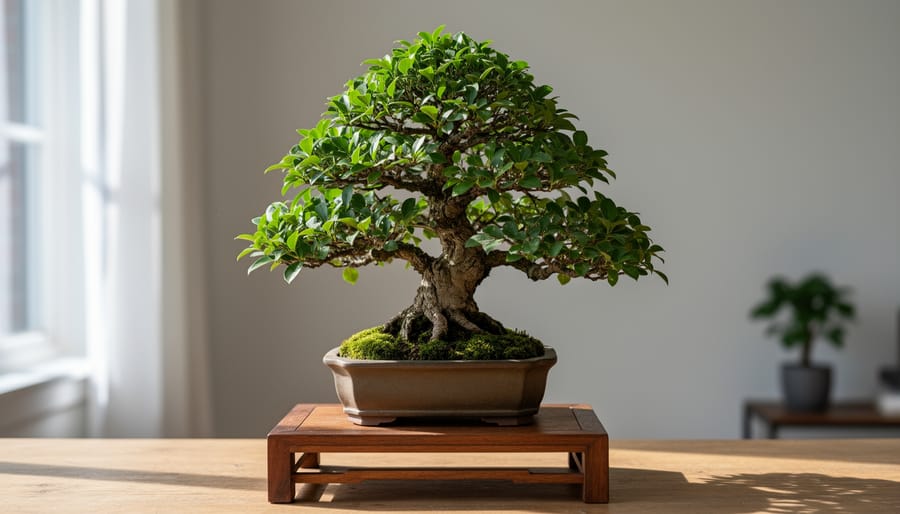
Indoor bonsai species are typically tropical or subtropical plants that cannot tolerate freezing temperatures. Popular choices include ficus, jade, Chinese elm (which can adapt to indoor conditions), and schefflera. These thrive in the stable temperatures found inside homes but still require adequate light, preferably near a south-facing window.
For beginners, ficus trees make excellent indoor choices due to their forgiving nature and adaptability to lower light conditions. If you have outdoor space, juniper bonsai are remarkably hardy and tolerate occasional neglect better than most species.
The most common mistake new owners make is purchasing a juniper or other outdoor species at a mall kiosk, assuming it will live happily on their coffee table. Within months, the tree declines despite their best efforts. Always verify your species requirements before bringing a bonsai home, and choose based on where you can realistically provide proper conditions.
The Five Pillars of Bonsai Care
Watering: The Make-or-Break Factor
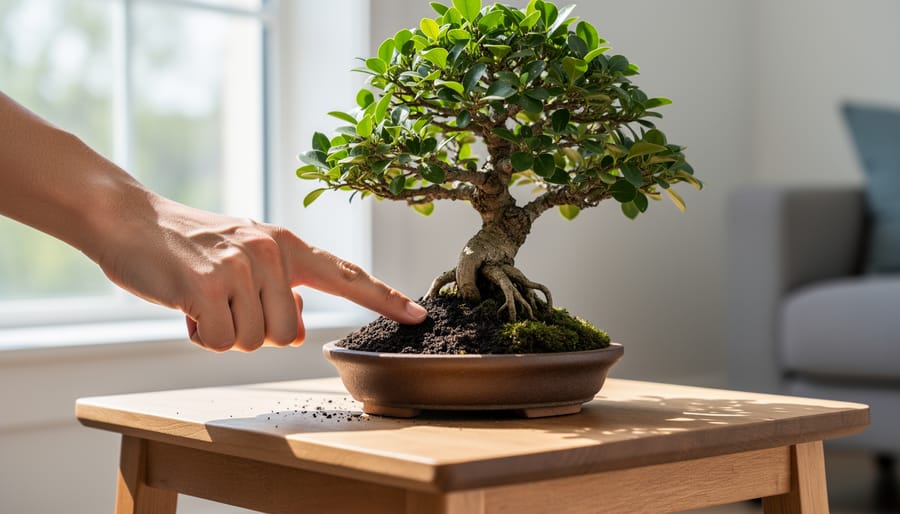
Watering kills more bonsai trees than any other factor, but it’s also the easiest skill to master once you understand the basics. The golden rule is simple: water thoroughly when the soil surface begins to dry, not on a fixed schedule.
The finger test is your most reliable method. Push your finger about half an inch into the soil. If it feels dry at that depth, it’s time to water. If it’s still moist, wait another day and check again. This hands-on approach beats guessing every time, and it takes just seconds to perform.
When you do water, be thorough. Use a watering can with a fine rose or a gentle spray attachment to avoid disturbing the soil. Water until you see it flowing freely from the drainage holes at the bottom of the pot. This ensures the entire root system gets moisture, not just the surface layer. Wait a few minutes, then water again to guarantee complete saturation.
Many beginners make the mistake of giving their bonsai small sips of water daily. This creates a shallow root system and leaves the lower soil bone-dry. Having proper watering tools makes this process much easier and more consistent.
Seasonal adjustments are crucial. During summer’s heat, you might water twice daily. In winter, some trees only need watering every few days. Indoor heating can dry out trees quickly, so location matters as much as season.
The weight test offers another practical check. Lift your bonsai pot after thorough watering to feel its weight. When it becomes noticeably lighter, it’s time to water again. This method becomes intuitive with practice.
Never let your bonsai sit in a water-filled tray for extended periods. This leads to root rot, a death sentence for most trees. Humidity trays should have pebbles or mesh keeping the pot above standing water.
Community feedback consistently highlights that beginners underwater more often than overwater, despite fearing the opposite. Trust the finger test, water thoroughly, and your bonsai will thrive.
Light Requirements: Finding the Sweet Spot
Getting the light right is one of the most common stumbling blocks for bonsai owners, but understanding your tree’s needs makes all the difference. Think of light as your bonsai’s food source—without the right amount, it simply can’t thrive.
Different species have vastly different requirements. Outdoor bonsai like junipers, pines, and maples need full sun for at least 5-6 hours daily and won’t survive long indoors. Indoor varieties such as ficus, jade, and Chinese elm prefer bright, indirect light near south or west-facing windows. If you’re just starting out, knowing your species is step one—check the label or ask when purchasing.
Position your bonsai where it receives consistent light throughout the day. For indoor trees, place them within three feet of a window, rotating them weekly to ensure even growth. Outdoor bonsai should sit where they’re protected from harsh afternoon sun in summer but receive maximum exposure in cooler months. Many beginners don’t realize that light intensity changes dramatically with seasons—a perfect winter spot may become too shaded when trees outside leaf out in spring.
Watch for warning signs your tree is struggling. Insufficient light causes leggy growth with long spaces between leaves, pale or yellowing foliage, and leaves dropping from inner branches. Your tree is essentially stretching toward any available light. Excessive light shows up as scorched, brown leaf tips, bleached or faded foliage, and crispy, dry leaves despite regular watering.
If natural light is inadequate, especially during winter months, consider using supplemental grow lights positioned 6-12 inches above your tree for 12-14 hours daily. This simple adjustment can mean the difference between a struggling tree and a thriving one.
Soil and Fertilization Essentials
Regular potting soil is your bonsai’s enemy. While it works fine for typical houseplants, it retains too much moisture and compacts easily in shallow bonsai pots, suffocating roots and causing rot. This is one of the most common reasons beginners lose their trees.
Bonsai soil needs three key properties: excellent drainage, adequate aeration, and sufficient water retention. The ideal mix contains inorganic components like akadama (a clay-like Japanese soil), pumice, and lava rock in roughly equal parts. These materials create air pockets while preventing waterlogging. You can purchase pre-mixed bonsai soil from specialty suppliers, which takes the guesswork out for beginners. Different tree species have slightly different requirements, but a standard mix works well for most varieties while you’re learning.
Think of fertilizing as regular meals for your tree. Since bonsai pots hold minimal soil, nutrients deplete quickly. During the growing season (spring through early fall), feed your tree every two weeks using a balanced liquid fertilizer diluted to half strength. Look for products with equal nitrogen, phosphorus, and potassium ratios, often labeled as 10-10-10 or 20-20-20.
Reduce feeding frequency in late fall, and stop entirely during winter dormancy for outdoor species. Indoor tropical bonsai can continue light feeding year-round since they don’t enter dormancy. Slow-release fertilizer pellets offer a convenient alternative, sitting on the soil surface and gradually releasing nutrients with each watering.
Apply fertilizer only to moist soil, never dry, as concentrated nutrients can burn roots. Many experienced growers recommend the “weekly, weakly” approach: fertilizing every week at quarter strength rather than bi-weekly at half strength. This provides consistent nutrition without overwhelming the tree.
Watch your tree’s response. Pale leaves might indicate nitrogen deficiency, while overfertilizing causes excessive, leggy growth that’s difficult to style. Community forums are invaluable for troubleshooting these issues, as experienced growers freely share their feeding schedules and product recommendations based on real results.
Temperature and Humidity Control
Getting the climate conditions right is essential for bonsai survival. Most beginners don’t realize that indoor and outdoor bonsai species have vastly different temperature and humidity needs.
Outdoor bonsai species like junipers, maples, and pines require winter dormancy to stay healthy. These trees need exposure to cold temperatures, typically between 0-10°C, for several months each year. Without this dormant period, they’ll weaken and eventually die. Never bring outdoor species inside permanently, even during harsh weather. Instead, protect them with frost cloth or move them to an unheated shed during extreme cold snaps below -5°C. Understanding how seasonal changes affect trees helps you provide appropriate care throughout the year.
Indoor tropical species like ficus, jade, and Chinese elm need consistent warmth year-round, ideally 15-25°C. Keep them away from heating vents, air conditioners, and drafty windows that create temperature fluctuations. These sudden changes stress your bonsai and cause leaf drop.
Humidity presents a major challenge indoors, especially during winter heating. Most indoor bonsai need 40-60% humidity, but typical homes sit around 20-30%. Simple solutions include placing your bonsai on humidity trays filled with water and pebbles, ensuring the pot sits above the waterline. Group multiple plants together to create a microclimate, or use a small room humidifier nearby.
Monitor conditions with an inexpensive thermometer-hygrometer combo. This single tool helps you identify problems before your tree suffers, making the difference between thriving bonsai and constant frustration.
Pruning and Shaping Fundamentals
Regular pruning keeps your bonsai healthy and compact, but knowing when and how to trim makes all the difference between thriving trees and damaged plants. For maintenance pruning, focus on removing dead branches, excess growth, and shoots that disrupt your tree’s basic shape rather than attempting complex artistic styling.
Most bonsai species benefit from maintenance pruning during their active growing season, typically spring through early autumn. During this period, trees recover quickly from cuts. Avoid heavy pruning in winter when growth slows, as wounds heal poorly and stress increases. Watch for overgrown shoots extending beyond your tree’s silhouette, yellowing leaves, and crossing branches that rub together creating wounds.
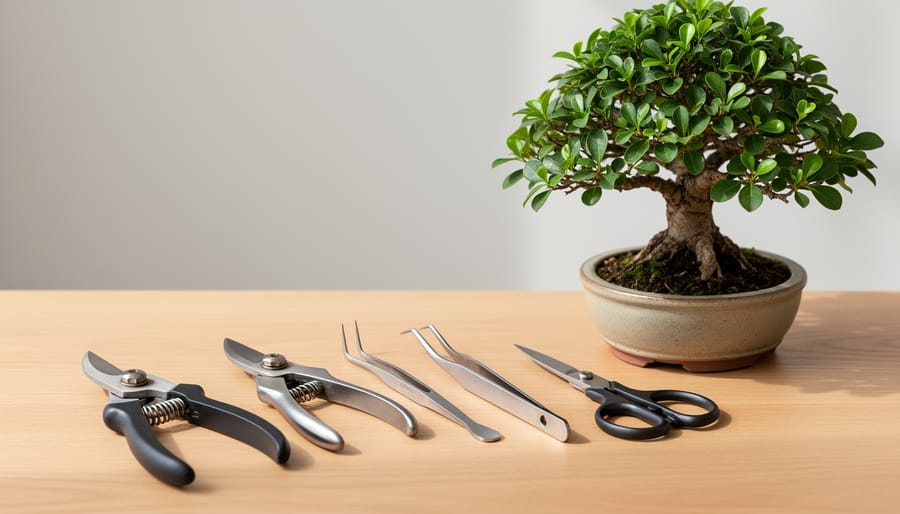
The essential tools you’ll need include sharp bypass pruners for branches up to 1cm thick, concave cutters for flush cuts that heal cleanly, and small scissors for pinching new growth and leaves. Quality tools make cleaner cuts that reduce infection risk. Many tree pruning fundamentals apply to bonsai work, though the scale differs significantly. Consider hiring professional-grade tools for occasional major work rather than purchasing expensive equipment you’ll use infrequently.
To avoid damaging your tree, always use sharp, clean tools sterilized with rubbing alcohol between cuts. Make cuts at a 45-degree angle just above a node or bud, never leaving stubs that invite disease. Remove no more than one-third of foliage at once, as excessive pruning shocks the tree and weakens its ability to photosynthesize. Cut back to healthy wood with no tears or crushing.
Start conservatively, stepping back frequently to assess your progress. You can always remove more growth, but you cannot reattach branches. Focus on maintaining your tree’s health rather than achieving perfect aesthetics immediately. Watch how your tree responds over several weeks, noting which cuts heal well and where new growth emerges, building your confidence through observation and practice.
Essential Tools and Equipment for Bonsai Maintenance
Starting your bonsai journey doesn’t require breaking the bank on expensive equipment. Understanding which tools are essential versus nice-to-have helps you invest wisely and avoid unnecessary purchases.
For beginners, three core tools will handle 90% of your maintenance needs. First, a quality pair of bonsai shears or scissors is non-negotiable. These specialized essential pruning tools make clean cuts that heal quickly, unlike regular household scissors which can crush delicate stems. Second, invest in a small pruning saw for removing thicker branches. Third, get a basic wire cutter, which you’ll need when shaping your tree with training wire.
Beyond these basics, a concave cutter becomes valuable as your skills progress. This tool creates hollow cuts that heal more naturally, leaving minimal scarring on your tree. Root hooks and rakes are helpful during repotting, though a chopstick works surprisingly well as a budget alternative for loosening roots.
Consider hiring or borrowing specialized equipment before purchasing. Items like knob cutters, jin pliers, and professional-grade turntables are expensive tools you might only need occasionally. Many local bonsai clubs organize tool-sharing programs, and some nurseries offer equipment hire for specific tasks like major styling work or root work during repotting season.
Quality matters more than quantity. One sharp, well-maintained pair of shears outperforms a drawer full of cheap tools. Look for stainless steel or carbon steel options that can be sharpened and will last years with proper care. Clean your tools after each use with rubbing alcohol to prevent disease transmission between plants, and oil metal parts regularly to prevent rust.
Common Problems and How to Solve Them
Even experienced bonsai enthusiasts face challenges. Here’s how to diagnose and fix the most common problems before they become serious.
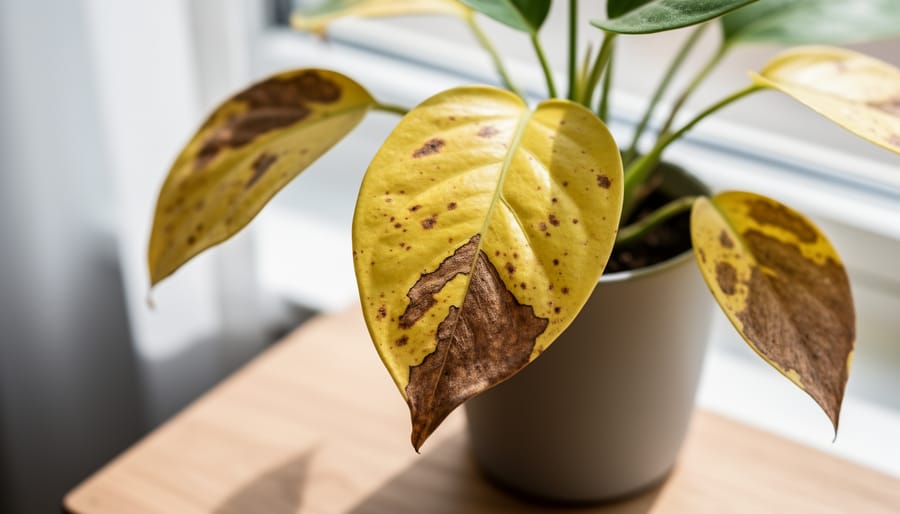
Yellowing leaves usually indicate watering issues. Check the soil moisture by inserting your finger an inch deep. If it’s waterlogged, you’re overwatering—reduce frequency and ensure your pot has proper drainage holes. If the soil feels bone dry, increase watering and consider whether your tree needs repotting. Yellowing can also signal nutrient deficiency, especially if older leaves turn yellow first. Apply a balanced liquid fertilizer at half strength every two weeks during the growing season.
Sudden leaf drop often means your tree is stressed. Indoor bonsai experiencing drafts, temperature fluctuations, or relocations may shed leaves. Move your tree to a stable environment away from heating vents and air conditioners. For outdoor varieties, this might be a natural seasonal response. However, if accompanied by wilting, check for root rot by gently lifting the tree from its pot. Healthy roots appear white or tan, while rotted roots look brown and mushy.
Pest infestations require quick action. Spider mites leave fine webbing and cause stippled leaves—spray affected areas with water daily and apply insecticidal soap. Scale insects appear as small brown bumps on branches and leaves. Remove them manually with a cotton swab dipped in rubbing alcohol. Aphids cluster on new growth and can be dislodged with a strong water spray. For persistent infestations, neem oil provides an effective organic solution. Always isolate infected trees to prevent spread.
Root problems become visible when growth slows despite proper care. If water runs straight through the pot without absorbing, roots have likely become pot-bound. This happens when the tree outgrows its container. Repotting during the dormant season, typically early spring, resolves this issue. Trim congested roots carefully and refresh the soil completely.
Branch dieback starts with browning tips and works backward. Test branches by gently scratching the bark—green underneath means it’s alive, brown indicates death. Prune dead sections back to healthy wood using clean, sharp tools. Dieback often results from inadequate light, so relocate your tree to a brighter spot. Consistent underwatering also causes this problem, so review your watering schedule and adjust accordingly.
Seasonal Maintenance Calendar
Understanding your bonsai’s seasonal needs is essential for keeping it healthy year-round. Just like broader seasonal garden maintenance, bonsai care follows nature’s rhythms.
Spring (September-November) marks the most active period for your tree. This is prime repotting time, ideally done before new growth emerges. Plan to repot younger trees annually and mature specimens every 2-3 years. Begin fertilizing fortnightly once new leaves appear, using a balanced liquid fertilizer diluted to half strength. Increase watering frequency as temperatures rise and growth accelerates.
Summer (December-February) demands vigilance with hydration. Check soil moisture daily, sometimes twice during heat waves. Continue regular fertilization but watch for signs of heat stress. Position trees where they receive morning sun but afternoon shade during extreme heat. This is not the time for major pruning or repotting, as stress can harm your tree.
Autumn (March-May) requires adjusting your routine as growth slows. Gradually reduce fertilization frequency to monthly, then stop by late May. Continue monitoring water needs, though frequency will decrease. This season offers a second window for light maintenance pruning and wiring before winter dormancy.
Winter (June-August) brings rest for most species. Stop fertilizing completely. Reduce watering significantly, allowing soil to approach dryness between waterings, but never let it completely dry out. Protect sensitive species from frost by moving them to sheltered locations. Avoid repotting or major styling work during this dormant period.
Keep a simple calendar or smartphone reminder system to track these seasonal transitions, adjusting based on your local climate variations and specific species requirements.
Successful bonsai care isn’t about mastering complex techniques right away. It’s about showing up consistently with the basics: proper watering, appropriate light, regular feeding, and timely pruning. Most bonsai failures happen not from lack of advanced knowledge, but from inconsistent attention to these fundamental practices.
Start where you are. If you’re just beginning, focus on establishing a reliable watering routine and understanding your tree’s specific light requirements. As you build confidence with these essentials, you’ll naturally develop the skills and intuition for more advanced care. Remember that even experienced bonsai enthusiasts return to these fundamentals daily because they work.
The tools you need don’t have to break the bank either. Basic pruning shears and wire cutters will serve you well as you learn, and you can always explore tool rental options for specialized equipment as your skills progress.
We’d love to hear about your bonsai journey. What challenges have you overcome? Which maintenance tasks do you find most rewarding? Share your experiences in the comments below, and don’t hesitate to ask questions. The bonsai community thrives on shared learning, and your insights might help someone else keep their tree thriving.
Related Posts