
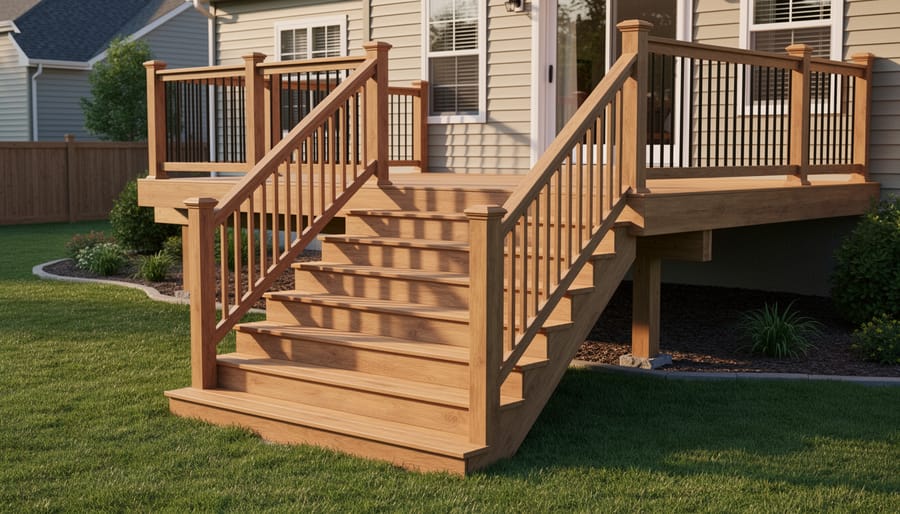
Verify your local building code before purchasing materials—deck stair requirements vary between the International Residential Code (IRC), which most U.S. jurisdictions follow, and local amendments that may impose stricter standards. Contact your municipal building department or visit their website to confirm which code version applies and whether permits are required for your project.
Measure your deck height to ground level precisely, as this determines the number of steps you’ll need and triggers specific code requirements. Stairs with more than two risers require handrails, and decks over 30 inches high need guardrails with balusters spaced no more than 4 inches apart to prevent child entrapment.
Calculate riser height by dividing total elevation by the number of steps, keeping each riser between 4 and 7.75 inches under IRC guidelines. Tread depth must be at least 10 inches, measured from the front edge of one step to the front edge of the next. Maximum variance between the tallest and shortest riser in your stairway cannot exceed 3/8 inch—inconsistent step heights are a leading cause of falls and inspection failures.
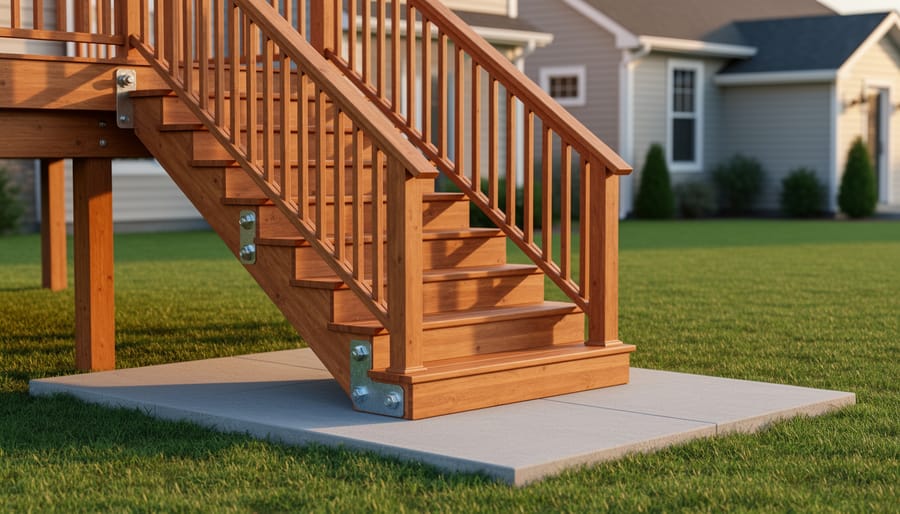
Install proper structural support using stringers rated for exterior use, spaced no more than 16 inches apart for standard lumber treads. Stringers must connect to the deck with approved hangers or through-bolts, not just nails or screws, and must rest on a concrete footer or landing pad that extends below frost line. Non-compliance with structural attachment requirements accounts for most deck collapse incidents and will result in inspection rejection.
Why Deck Stair Codes Matter (And What Happens If You Ignore Them)
Deck stair codes exist for one critical reason: preventing falls and injuries. According to the Consumer Product Safety Commission, thousands of people are injured each year in stair-related accidents, many of which could have been prevented with proper construction. Building codes set minimum standards for tread depth, riser height, handrail placement, and structural support because inconsistent dimensions cause people to misstep, especially when carrying items or navigating in low light.
Ignoring these codes creates serious legal and financial consequences. If an inspector discovers non-compliant stairs during a routine check or after a complaint, you’ll face stop-work orders and mandatory corrections at your expense. Many municipalities impose daily fines until violations are resolved, and you won’t receive a certificate of occupancy for new construction without passing inspection.
The liability issues extend beyond permits. If someone is injured on non-compliant stairs, your homeowner’s insurance may deny coverage since the accident occurred due to code violations. You could face personal liability for medical expenses, lost wages, and legal fees. This scenario becomes even more complicated if the injured party is a contractor, delivery person, or guest who decides to pursue legal action.
Home resale presents another major hurdle. During a pre-sale inspection, non-compliant stairs become negotiating leverage for buyers or deal-breakers entirely. You’ll need to bring everything up to code before closing, often under time pressure and at premium costs. Some buyers simply walk away rather than assume the risk, even if you offer price reductions.
The community also weighs in on code compliance. User feedback from contractors consistently emphasizes that cutting corners on stair codes costs more in the long run than doing it right initially. One builder shared that rebuilding non-compliant stairs cost three times the original project budget, not counting permit fines and lost time.
Understanding Which Building Code Applies to Your Project
Before you start building your exterior deck stairs, you need to know which building code applies to your project. This isn’t just about following rules—it’s about ensuring your stairs are safe and legally compliant.
The International Residential Code (IRC) serves as the foundation for residential construction standards across the United States. Most local jurisdictions adopt the IRC as their baseline, but here’s the important part: your local building department often modifies these standards to address regional concerns like climate, seismic activity, or snow loads. What’s code-compliant in Florida might not meet requirements in Minnesota.
To identify which code governs your project, start by contacting your local building department or visiting their website. Many municipalities now post their specific requirements online, including any amendments to the IRC. Ask specifically about exterior stair requirements—some areas have stricter rules for stairs higher than a certain elevation or those serving as primary exits.
Don’t assume neighboring cities follow identical codes. Municipal boundaries often mean different requirements, even within the same county. If you’re working near city limits, verify which jurisdiction has authority over your property.
Regional variations commonly affect frost line depths for footings, wind load requirements for railings, and acceptable materials for outdoor construction. Coastal areas typically have additional corrosion-resistance requirements, while regions with heavy snowfall may require stronger structural support.
Community forums and user reviews from local builders can provide practical insights about working with your specific building department, but always verify information directly with official sources before proceeding with construction.
Essential Stair Dimension Requirements
Tread Depth and Riser Height
Getting your tread depth and riser height right is absolutely critical for safe, code-compliant deck stairs. These measurements directly affect how comfortable and safe your stairs will be to use, which is why building codes are so specific about them.
Most residential building codes require a minimum tread depth of 10 inches, measured from the leading edge of one step to the leading edge of the next. The tread is the horizontal surface where you actually place your foot. Some codes allow 9 inches for certain applications, but 10 inches is the standard you should plan for. This measurement ensures adequate foot placement and reduces the risk of missteps.
For risers, which are the vertical portions between steps, the maximum height is typically 7.75 inches. Some jurisdictions allow up to 8 inches, but staying at or below 7.75 inches is your safest bet for code compliance. Lower risers mean easier climbing and descending, especially for children and elderly users.
Here’s where many DIYers run into trouble: consistency between steps is just as important as the measurements themselves. Building codes typically require that the greatest riser height not exceed the smallest by more than 3/8 inch. The same tolerance applies to tread depth. Even small variations can create a tripping hazard because people naturally develop a rhythm when climbing stairs.
Before starting your build, verify your local code requirements with your building department. Use a quality measuring tape and consider making a story pole to mark consistent measurements across all steps. This simple planning step prevents costly rebuilds during inspection.
Stairway Width and Headroom
Most building codes require exterior deck stairs to have a minimum width of 36 inches, measured between the inside edges of handrails or guards. This dimension ensures safe passage for users carrying items and allows emergency egress. Some jurisdictions may permit narrower stairs for specific applications, like secondary access points, but always verify your local requirements before construction begins.
Headroom clearance is equally important for safety and code compliance. The typical minimum is 6 feet 8 inches of vertical clearance, measured from the nosing of each tread to any overhead obstruction like a deck surface, beam, or doorway above. This standard prevents users from hitting their heads while ascending or descending the stairs.
When planning your stairway, account for these dimensions early in the design phase. A stairway that’s too narrow or lacks adequate headroom will fail inspection and require costly modifications. Measure carefully from the proposed bottom step location upward, checking for any obstacles like overhangs, joists, or structural members that might intrude into the required clearance zone.
Community feedback consistently highlights that overlooking headroom requirements ranks among the most common code violations. Double-check measurements at multiple points along the stair run, especially where the stairs meet the deck platform, as this transition area often presents clearance challenges.
Landing Requirements
Your deck stairs need proper landings at both the top and bottom to meet building codes and ensure safe transitions. At the top, the landing must be at least as wide as the stairway and extend at least 36 inches in the direction of travel. This provides adequate space to step onto the stairs safely. If your deck door swings outward over the landing, you’ll need the landing to extend the full width of the door swing plus an additional 12 inches beyond the door’s latch side.
Bottom landings require a minimum 36-inch square platform where the stairs meet the ground or another surface. Many builders opt for a concrete pad at the base, which provides a stable, weather-resistant foundation. When installing a concrete base, pay attention to concrete landing requirements including proper drainage slope and thickness specifications.
The transition between your deck and stairs must be smooth without lips or sudden height changes that could cause tripping. Keep the landing surface level, with a maximum slope of 2 percent for drainage. Both landings should use slip-resistant materials, especially important in wet conditions. Remember that handrails must extend continuously from the top landing to the bottom, providing uninterrupted support throughout the entire stair run.
The 7-11 Rule and Why It Matters
The 7-11 Rule is a time-tested formula that helps ensure your deck stairs are comfortable and safe to use. Simply put, the rule states that the sum of one tread depth (run) plus two riser heights should equal between 17 and 18 inches, with 17.5 being ideal.
Here’s how to calculate it: If your riser height is 7 inches, multiply that by 2 to get 14 inches. Then add your tread depth of 11 inches. The result is 25 inches total, but what matters is that 7 + 11 equals 18 inches, which falls within the comfortable range.
This formula works because it matches the natural stride of most people. When risers are too tall or treads too shallow, stairs become tiring and dangerous. While building codes set minimum and maximum requirements, the 7-11 Rule helps you design stairs that meet code while feeling natural to climb.
A practical example: with a 7.5-inch rise, your ideal tread depth would be about 10 inches (7.5 x 2 = 15, plus 10 = 25; or 7.5 + 10 = 17.5). Always verify your calculations meet local code minimums before cutting materials.
Handrail and Guardrail Code Requirements
When Handrails Are Required
Most building codes require handrails when your exterior deck stairs have four or more risers. This threshold exists because falls from greater heights present increased injury risk. If your stairs have three risers or fewer, handrails are typically optional, though adding them still improves safety.
When handrails are required, code dictates which sides need them based on stair width. For stairs less than 44 inches wide, you need one handrail on at least one side. Stairs 44 inches or wider generally require handrails on both sides. Some jurisdictions have stricter requirements, mandating dual handrails on all stairs regardless of width.
The handrail must be continuous along the entire stair run, from the top riser nose to the bottom riser nose. Interruptions are only permitted at landings or for newel posts. Remember that handrails differ from guardrails, which prevent falls from the sides of stairs and have separate height requirements.
Always verify your local building department’s specific thresholds, as some municipalities reduce the trigger to three risers or implement additional safety mandates for exterior applications exposed to weather conditions.
Handrail Height and Graspability
Handrails on exterior deck stairs must be installed between 34 and 38 inches above the stair nosing, measured vertically from the front edge of each tread. This range ensures users of varying heights can grip the rail comfortably while ascending or descending.
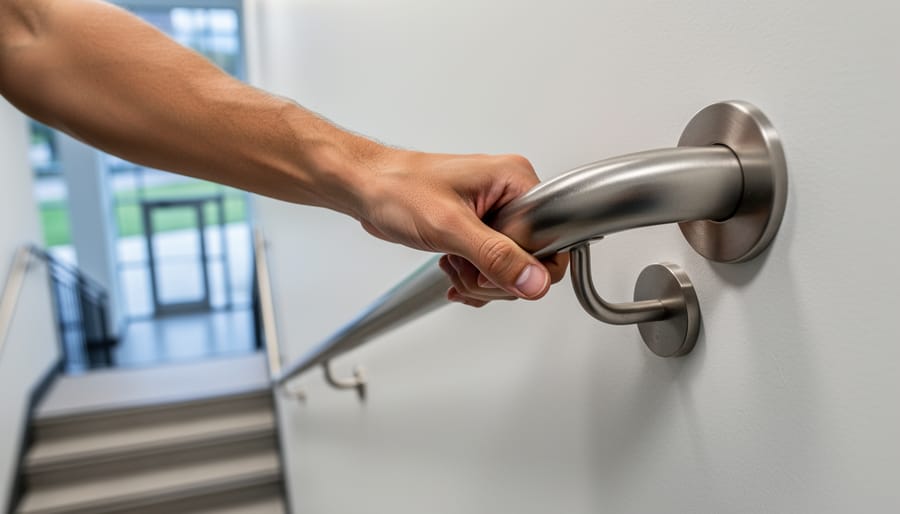
The graspability requirement is equally important for safety. Handrails must have a graspable profile, typically circular with a diameter between 1.25 and 2 inches, or non-circular shapes with a perimeter dimension between 4 and 6.25 inches. Your hand should be able to wrap around the rail completely for a secure grip during use.
Finger clearance is another critical code requirement. You must maintain at least 1.5 inches of clear space between the handrail and any adjacent wall or surface. This clearance prevents hand injuries and ensures users can maintain a proper grip without their knuckles scraping against the wall. Wall-mounted handrail brackets should be designed to preserve this minimum spacing.
Many DIYers appreciate that these measurements are straightforward to verify with a tape measure and diameter gauge. Community feedback consistently shows that proper handrail installation significantly improves stair safety, particularly in wet or icy conditions common with outdoor stairs. Always check your local amendments, as some jurisdictions may have stricter requirements than the base IRC standards.
Guardrail Height and Baluster Spacing
Guardrails on exterior deck stairs must meet specific height and spacing requirements to prevent falls and injuries. The minimum guardrail height is typically 36 inches measured vertically from the stair nosing, though some jurisdictions require 42 inches for elevated decks. Always verify your local code, as requirements can vary.
The most critical safety rule involves baluster spacing, known as the 4-inch sphere rule. This regulation states that no opening in your guardrail system can allow a 4-inch sphere to pass through. This measurement applies to the space between balusters, beneath the bottom rail, and any decorative infill patterns. The rule exists to prevent young children from slipping through or getting their heads caught between openings.
When planning your guardrail installation, you’ll typically space balusters no more than 3.5 inches apart to ensure compliance. Many builders use a 4-inch block as a quick spacing gauge during installation. Understanding guardrail safety standards is essential before beginning construction.
Infill options include traditional vertical balusters, horizontal cable systems, tempered glass panels, or decorative metal. Regardless of your choice, the 4-inch sphere rule still applies. Some municipalities have additional restrictions on horizontal rail designs due to climbing concerns, so confirm these details during your permit application process.
Return and Extension Requirements
Handrails must extend beyond the top and bottom stair nosings to provide secure grip points when entering or exiting. Most codes require handrails to extend at least 12 inches horizontally beyond the top riser, maintaining the same height as the handrail. At the bottom, the extension should continue beyond the bottom riser by the width of one tread, typically 10-12 inches.
These extensions cannot end abruptly, as protruding rails create snagging hazards. Code requires handrails to terminate by returning to the wall, post, or floor, or by turning downward in a smooth curve. Common compliant terminations include返ing the handrail 180 degrees back to the post (creating a volute or scroll) or angling it downward toward the ground or deck surface.
For deck stairs with open sides, some jurisdictions allow handrails to terminate at a newel post without extension if the post is substantial enough. However, the safest approach follows the extension requirements. When planning your handrail layout, factor in these extensions during material ordering to avoid shortages. Many DIYers overlook this detail and discover they need additional railing during installation, so measure carefully and add extra length for proper compliance and safety.
Structural Support and Fastening Standards
Stringer Specifications
Stair stringers are the angled supports that carry the weight of your deck stairs, making their strength absolutely critical. Most building codes require stringers to be cut from minimum 2×12 lumber to maintain adequate depth after notching. The maximum vertical cut (rise) into the stringer board typically cannot exceed 7.75 inches, and the remaining depth of material below the notch must be at least 5 inches, though 3.5 inches is the absolute minimum in some jurisdictions.
Stringer spacing depends on your tread material and local requirements, but 16 inches on center is standard for most residential applications. For wider stairs exceeding 36 inches, you’ll need at least three stringers, with additional support every 16 inches beyond that. Some builders add a center stringer even on narrower stairs for extra stability.
Understanding proper framing techniques ensures your stringers attach securely at both top and bottom. The connection points bear significant load, so metal stair brackets or properly secured ledger boards are essential. Never notch more than necessary, as each cut weakens the overall structure. When laying out your stringers, double-check calculations before cutting since errors here compromise the entire staircase integrity and code compliance.
Attachment and Connection Methods
Properly securing your deck stairs isn’t just about meeting code requirements—it’s about ensuring long-term safety and structural integrity. Building codes specify how stringers must attach to both the deck frame and landing point, with detailed fastener requirements that vary by jurisdiction.
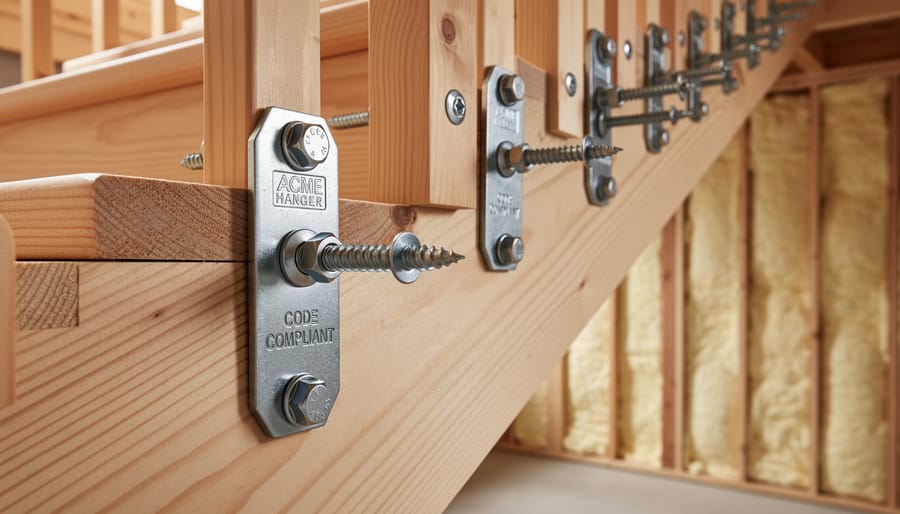
Most codes require stringers to connect using approved metal hangers or brackets rated for outdoor use. Simple toe-nailing is typically insufficient. Joist hangers designed specifically for stairs provide the necessary load-bearing capacity and must be attached with hot-dipped galvanized or stainless steel fasteners. Each hanger requires specific nails—usually 10d or 16d—driven through every pre-punched hole. Substituting screws for hanger nails is generally prohibited unless the manufacturer explicitly approves them.
For stringer-to-rim joist connections, codes often mandate through-bolts or lag screws rather than nails alone. A common specification requires minimum half-inch diameter galvanized bolts spaced according to engineer specifications. The rim joist itself must be adequately supported to handle the concentrated load from stair traffic.
At the landing or footer, stringers should rest on a concrete pad at least four inches thick that extends below the frost line in cold climates. Some jurisdictions require additional lateral bracing between stringers, particularly for wider stairs exceeding 36 inches.
Always use corrosion-resistant hardware rated for exterior exposure. Standard interior fasteners will rust and fail prematurely, compromising safety. Your local building inspector can clarify specific connection methods approved in your area before you begin construction.
Material Selection for Code Compliance
Choosing the right materials for your deck stairs isn’t just about aesthetics—it’s a code compliance issue that affects safety and longevity. Most building codes specify acceptable materials based on their ability to withstand outdoor conditions and support required loads.
Pressure-treated lumber remains the most popular choice for exterior deck stairs. Look for wood rated for ground contact (minimum 0.40 retention level) for stringers and any components within 6 inches of the ground. Above that height, above-ground rated lumber (0.25 retention level) is typically acceptable. The treatment protects against rot, insects, and moisture damage—critical for meeting code requirements over the structure’s lifespan.
Composite and PVC materials are increasingly code-approved alternatives for treads and decking, though you’ll need to verify they meet your local load-bearing requirements. These materials offer excellent durability and low maintenance but often require specific installation methods outlined by manufacturers. Always check that composite products carry ICC-ES (International Code Council Evaluation Service) approval, which indicates they’ve been tested for structural use.
For stair stringers and structural components, codes generally mandate dimensional lumber or engineered lumber products rather than composites. The structural integrity must support a minimum live load of 40 pounds per square foot, plus dead loads.
Fasteners matter too—use hot-dipped galvanized, stainless steel, or specially coated screws and bolts rated for exterior use. Standard hardware will corrode and compromise structural integrity, potentially failing inspection. When selecting materials, save your receipts and product specifications—inspectors may request documentation proving your materials meet code standards.
Common Code Violations to Avoid
Even experienced builders sometimes overlook critical code requirements that can halt a project during inspection. Understanding these common violations helps you avoid costly rework and potential safety hazards.
One of the most frequent violations involves inconsistent riser heights. Code requires that risers vary by no more than 3/8 inch within a single flight of stairs. Many DIYers measure and cut all risers identically without accounting for ground settlement or deck board thickness, creating dangerous tripping hazards. Always measure each riser location individually after accounting for the finished deck surface.
Improper tread depth is another inspector red flag. While building treads at 9 inches might seem adequate, most codes require a minimum of 10 inches measured horizontally. Some builders mistakenly measure along the angled stringer instead of using a level to measure the true horizontal depth.
Handrail violations top the list of failed inspections. Common mistakes include installing rails at 40 inches instead of the required 34-38 inch range, using 2x4s that exceed the maximum 2.25-inch grippable diameter, or terminating handrails abruptly rather than returning them to posts or walls. Many builders also forget that handrails must be continuous along the entire stairway without interruption.
Landing size violations frequently occur when builders create small platforms that don’t meet the minimum 36-inch depth requirement. Remember that landings must be as wide as the stairway itself and cannot be obstructed by doors swinging over them.
Finally, inadequate lateral bracing causes many structural failures. Stringers longer than 6 feet typically require mid-span blocking or bracing, yet builders often skip this step assuming the treads provide sufficient support. Using proper construction techniques and having the right equipment ensures your stairs meet code the first time.
Tools and Equipment You’ll Need for Code-Compliant Construction
Building code-compliant deck stairs requires the right tools for precise measurements and solid construction. Here’s what you’ll need to get the job done properly.
Essential measuring tools include a 25-foot tape measure, framing square, and a quality level (at least 48 inches). A speed square helps calculate stair angles and ensures accurate cuts. Digital levels with angle indicators provide extra precision when working with stringers.
For cutting and assembly, you’ll need a circular saw for cutting stringers and treads, plus a drill/driver for fasteners. A miter saw makes quick work of repetitive cuts, though this is an excellent candidate for rental rather than purchase if you won’t use it frequently. Impact drivers provide better torque for lag screws and structural connections.
Specialized tools worth renting include a post hole digger or auger for footings, concrete mixer if you’re pouring multiple piers, and a pneumatic framing nailer for faster assembly. These tools significantly speed up the work but don’t justify the purchase price for a single project.
Safety equipment is non-negotiable: wear safety glasses, work gloves, hearing protection, and a dust mask when cutting treated lumber. Keep a first aid kit nearby.
Consider renting higher-cost items for weekend projects. Many contractors and experienced DIYers recommend spending money on quality measuring tools since precision directly affects code compliance, while renting power equipment that you’ll only use occasionally. Check local tool rental platforms for availability and community reviews on which tools perform best for stair construction.
The Inspection Process: What to Expect
Understanding the inspection timeline helps you plan your deck stair project effectively. Most municipalities require you to schedule an inspection after completing the structural framing but before adding treads and risers. Some jurisdictions also mandate a final inspection once construction is complete. Contact your local building department early to understand their specific requirements and booking procedures, as inspection slots can fill up weeks in advance.
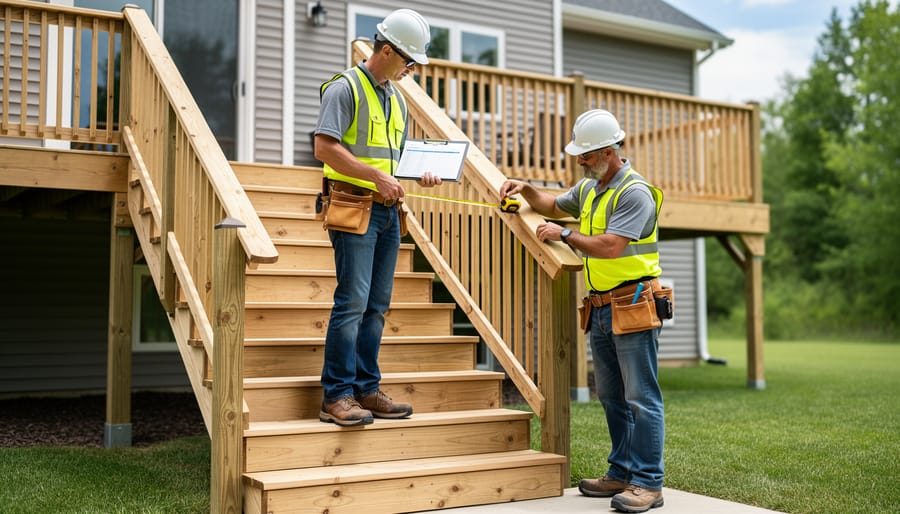
During the inspection, the officer will verify compliance with all applicable codes. They’ll measure riser heights and tread depths, checking for consistency throughout the stairway. Inspectors examine railing height, spacing between balusters, and the structural integrity of stringers and ledger board connections. They’ll also assess proper flashing installation, fastener types and spacing, and whether footings extend below the frost line. Bring your approved plans and keep them accessible, as inspectors often cross-reference the actual construction against submitted documents.
Proper inspection preparation significantly improves your chances of passing. Before the inspector arrives, double-check all measurements yourself using a quality tape measure and level. Ensure the work area is clean and accessible, with good lighting if needed. Remove any temporary bracing or materials that might obstruct the inspector’s view of critical structural elements. Have documentation ready, including receipts for pressure-treated lumber and hardware rated for outdoor use.
If your stairs fail inspection, don’t panic. The inspector will provide a written list of deficiencies requiring correction. Common failures include inconsistent riser heights, inadequate fastening, or missing structural hardware. Address each item methodically, then schedule a re-inspection. Most jurisdictions charge a modest fee for follow-up visits. Learn from the feedback and apply those lessons to future projects.
Building code-compliant exterior deck stairs isn’t just about following rules—it’s about creating a safe, durable structure that protects everyone who uses it. Throughout this guide, we’ve covered the essential requirements: 10-inch minimum tread depth, 7.75-inch maximum riser height, consistent measurements within 3/8-inch tolerance, proper railing height between 34 and 38 inches, and balusters spaced no more than 4 inches apart. These specifications exist because they’ve been proven to prevent accidents and injuries.
Before you begin your project, take time to verify your local building codes. While the International Residential Code provides the foundation, your municipality may have additional requirements or modifications. Contact your local building department early in the planning phase—many inspectors appreciate when homeowners reach out before construction begins and can offer valuable guidance that saves time and costly mistakes.
Proper measurement and planning are non-negotiable. Double-check every calculation, use quality materials, and don’t cut corners on structural elements like stringers and footings. Remember that building permits and inspections protect your investment and ensure your deck stairs will serve safely for decades.
The DIY community has shared countless experiences showing that patience and attention to detail during the planning phase make the actual construction much smoother. Gather feedback from others who’ve completed similar projects, rent the proper tools for professional results, and never hesitate to consult a professional when you’re uncertain. Safety always comes first, and code compliance is your roadmap to achieving it.
Related Posts


Post a Comment