
Transform your home’s energy efficiency with eco-friendly insulation materials that slash heating costs while embracing sustainable building practices. Natural fiber insulation options like sheep’s wool, recycled cotton, and cellulose deliver superior thermal performance while reducing environmental impact. These materials not only regulate indoor temperatures effectively but also sequester carbon and minimize off-gassing, creating healthier living spaces.
Modern green insulation solutions combine advanced technology with renewable resources, offering R-values comparable to traditional materials while shrinking your carbon footprint. Cork panels, hemp batts, and mycelium-based products represent the cutting edge of sustainable home improvement, providing exceptional moisture control and sound dampening properties without compromising durability.
Whether retrofitting an existing structure or planning new construction, green insulation materials adapt seamlessly to various installation methods while meeting strict building codes. These eco-conscious alternatives typically cost 10-30% more upfront but deliver long-term savings through reduced energy consumption and improved indoor air quality.
Nature-Inspired Insulation Materials Taking Over
Mushroom-Based Insulation
Mushroom-based insulation, also known as mycelium insulation, represents one of nature’s most innovative solutions for sustainable home construction. This revolutionary material is created by growing mushroom roots (mycelium) with agricultural waste like corn stalks or hemp hurds. The result is a naturally fire-resistant, highly insulative material that’s completely biodegradable.
The manufacturing process involves mixing mycelium spores with agricultural byproducts in molds. Over several days, the fungal network grows throughout the substrate, creating a solid, lightweight material. Once fully grown, the material is dried to stop the growth process, resulting in a stable insulation product.
What makes mushroom insulation particularly appealing is its impressive R-value of 3 per inch, comparable to traditional fiberglass insulation. It’s naturally moisture-resistant and acts as an effective sound barrier. Perhaps most importantly, it’s non-toxic and produces zero waste during manufacturing.
While currently less widely available than conventional options, mushroom insulation is gaining traction among eco-conscious builders and homeowners. The material typically costs more than traditional insulation but offers long-term environmental benefits and potential energy savings.

Hemp and Cotton Solutions
Hemp and cotton-based insulation materials represent some of the most sustainable options available for eco-conscious homeowners. Hemp insulation, made from the plant’s woody core fibers, offers excellent thermal resistance with an R-value of 3.5 per inch, comparable to traditional fiberglass. It naturally resists mold and pests while regulating humidity levels in your home.
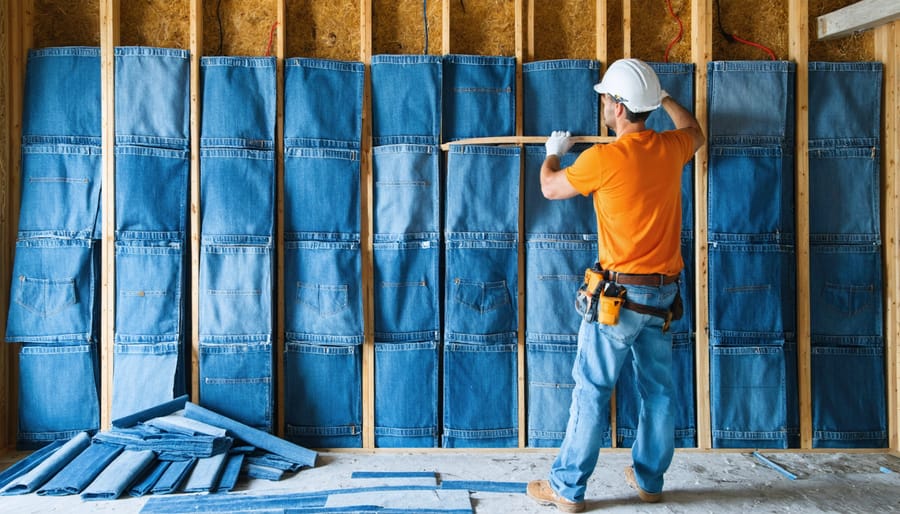
Cotton insulation, often manufactured from recycled denim, provides similar benefits and is particularly safe to handle during installation. With an R-value of 3.7-3.8 per inch, it performs slightly better than hemp while offering superior sound dampening properties. Both materials are fire-resistant when treated with natural borates, making them safe choices for residential use.
These plant-based solutions excel at moisture management, reducing the risk of structural damage and mold growth. They’re particularly effective in regions with varying humidity levels, as they can absorb and release moisture without losing insulating properties. Installation is straightforward for DIY enthusiasts, requiring standard safety equipment and basic tools. While the upfront costs may be 20-30% higher than conventional options, the long-term benefits include improved indoor air quality and reduced environmental impact.
Recycled Denim and Paper Products
Recycled denim and paper products offer an eco-friendly insulation alternative that gives new life to post-consumer materials. Shredded and treated blue jean scraps create a soft, cotton-based insulation that’s safe to handle and naturally fire-resistant. This material typically achieves an R-value of 3.5 per inch, comparable to traditional fiberglass. Similarly, recycled paper products are transformed into cellulose insulation through a process that treats the material with fire retardants and pest deterrents. Both options are particularly effective for filling wall cavities and attic spaces, while providing excellent sound dampening properties. These materials appeal to environmentally conscious homeowners because they divert waste from landfills and require less energy to manufacture than conventional insulation products. Installation can be performed as a DIY project, though professional installation ensures optimal coverage and performance.
Performance Metrics That Matter
R-Value and Thermal Performance
R-value measures an insulation material’s ability to resist heat flow, with higher numbers indicating better thermal performance. When choosing green insulation, understanding R-value helps ensure your home maintains optimal temperature control while supporting energy efficiency solutions.
Most eco-friendly insulation materials offer competitive R-values compared to traditional options. For example, cellulose insulation typically provides R-3.2 to R-3.8 per inch, while sheep’s wool delivers R-3.5 to R-3.8 per inch. Cotton batting achieves R-3.0 to R-3.7, making it another reliable choice for sustainable home insulation.
The thermal performance of green insulation also depends on proper installation and climate considerations. In colder regions, you might need higher R-values (R-38 to R-60) for attics, while warmer climates may require less (R-30 to R-49). Layer thickness plays a crucial role – doubling the thickness generally doubles the R-value.
To maximize effectiveness, consider factors like air sealing and moisture control alongside R-value ratings. Many green insulation materials offer additional benefits like sound dampening and natural moisture management, contributing to overall home comfort and efficiency.
Moisture Management and Durability
Proper moisture management is crucial for any insulation system, and green insulation options generally excel in this area. Natural materials like cellulose and sheep’s wool have inherent moisture-regulating properties that help maintain a healthy indoor environment. These materials can absorb and release moisture without compromising their insulating properties, preventing condensation and mold growth within your walls.
For example, sheep’s wool can absorb up to 30% of its weight in moisture without feeling wet or losing its insulating capabilities. Cellulose, treated with natural borates, resists moisture damage while providing excellent protection against mold and pests. Even recycled denim insulation includes moisture-wicking properties similar to your favorite pair of jeans.
When it comes to longevity, green insulation materials often outperform traditional options. Cork and hemp insulation can last 50+ years with proper installation, while cellulose typically maintains its effectiveness for 20-30 years. Many eco-friendly options also resist settling over time, maintaining their original thickness and R-value.
To maximize durability, proper installation and ventilation are essential. Consider using vapor barriers where appropriate and ensuring adequate airflow to prevent moisture accumulation in your insulated spaces.
Installation Considerations for DIY and Pros
Tools and Safety Equipment
Before starting any insulation project, ensure you have the following essential tools and safety equipment on hand. For personal protection, wear a NIOSH-approved respirator mask, safety goggles, work gloves, and long-sleeved clothing. A hard hat is recommended when working in confined spaces or attics.
Required tools include a utility knife with spare blades, measuring tape, straightedge, staple gun with plenty of staples, and a work light for dim areas. For cutting and fitting insulation, you’ll need a serrated knife or specialized insulation saw. A wheelbarrow or large container helps transport materials efficiently.
Additional safety equipment should include knee pads for comfort during installation, disposable coveralls to protect skin from irritants, and proper footwear with non-slip soles. Keep a first-aid kit nearby and ensure adequate ventilation in your work area.
For blown-in installations, rent or purchase a blowing machine from your local hardware store. Remember to have plastic sheeting available to protect surrounding areas and garbage bags for proper disposal of old materials and scraps.
Installation Best Practices
Before starting any insulation project, ensure proper protective equipment, including respirators, gloves, and eye protection. Begin by thoroughly inspecting your installation area for moisture issues or electrical concerns that need addressing beforehand.
For optimal results, start with a clean, dry surface. Remove any existing damaged insulation and seal air leaks around windows, doors, and other penetrations. This preparation is crucial for achieving maximum efficiency in your modern sustainable building project.
When installing batts or rolls:
– Cut pieces slightly larger than the cavity space
– Avoid compression, which reduces effectiveness
– Install with the vapor barrier facing the living space
– Ensure snug fits around electrical boxes and pipes
– Leave no gaps between pieces
For loose-fill installation:
– Calculate coverage area carefully
– Maintain consistent depth throughout
– Use depth markers every 4-6 feet
– Install ventilation baffles where needed
– Consider professional equipment rental for even distribution
For spray foam applications:
– Test spray pattern on scrap material first
– Apply in 1-inch layers to prevent heat buildup
– Allow each layer to cure before adding more
– Maintain proper temperature (65-85°F) during installation
– Ventilate area thoroughly during and after application
Remember to inspect your work regularly during installation, ensuring continuous coverage without gaps or compressions. For multi-layer installations, stagger the seams to maximize thermal resistance. Always follow manufacturer guidelines and local building codes for best results.

Cost Analysis and ROI
Initial Investment vs Traditional Materials
When comparing green insulation options with traditional materials, the initial investment typically runs 10-30% higher. For example, while fiberglass batts cost about $0.64-1.19 per square foot, recycled denim insulation averages $1.00-1.60 per square foot. Similarly, sheep’s wool insulation might cost $1.50-2.80 per square foot compared to conventional spray foam at $0.90-1.50.
However, this cost difference shouldn’t be viewed in isolation. Green insulation materials often offer superior R-values, meaning better insulation performance per inch of thickness. They also tend to last longer and require less frequent replacement, potentially saving money over time. For instance, sheep’s wool can last 50+ years compared to fiberglass’s typical 25-30 year lifespan.
Many regions offer tax incentives and rebates for installing eco-friendly insulation, which can significantly offset the higher upfront costs. Additionally, the improved energy efficiency typically results in lower utility bills, with homeowners reporting 20-30% reductions in their heating and cooling costs after installing green insulation materials. When calculating total costs, consider these long-term savings alongside the initial investment.
Energy Savings Calculator
To calculate your potential energy savings from green insulation, start by measuring your home’s total wall and ceiling area in square feet. Multiply this by your local energy rates and current insulation R-value to establish your baseline energy costs.
For example, if your monthly heating bill is $200 and your existing insulation is R-11, upgrading to R-30 green insulation could reduce your heating costs by up to 40%. This means potential savings of $80 per month during heating season.
Use this simple formula to estimate annual savings:
(Current monthly energy bill) × (Expected reduction percentage) × (Number of peak heating/cooling months) = Yearly savings
Don’t forget to factor in your climate zone and local utility rates. Most green insulation materials pay for themselves within 3-5 years through energy savings alone. Many utility companies offer online calculators or energy audit services to help you get more precise estimates.
To maximize your savings, consider combining insulation upgrades with other energy-efficient improvements like weatherstripping and proper ventilation. Keep track of your energy bills before and after installation to measure actual savings.
Available Tax Incentives and Rebates
Several government programs and tax incentives make green insulation more affordable for homeowners. The Federal Energy Efficiency Tax Credit allows you to claim up to 30% of insulation material costs, with a maximum of $1,200 per year. This credit applies to most eco-friendly insulation materials that meet Energy Star requirements.
Many states offer additional rebates through utility companies and energy efficiency programs. For example, some local utilities provide direct rebates of $0.50 to $1.00 per square foot of installed green insulation. These incentives are part of broader green building solutions initiatives aimed at reducing energy consumption.
Weatherization Assistance Programs (WAPs) are available for low-income households, covering up to 100% of insulation costs. Property tax exemptions exist in some jurisdictions for homes meeting specific energy efficiency standards through green insulation upgrades.
Remember to keep documentation of your insulation purchase and installation, including receipts and manufacturer certifications, as these are typically required for claiming incentives. Check with your local energy office or tax professional for the most current programs in your area.
The future of green insulation is bright, with ongoing innovations making sustainable options increasingly accessible and effective. As environmental awareness grows and building codes evolve to prioritize energy efficiency, we can expect to see more widespread adoption of eco-friendly insulation materials. Manufacturers are continuously developing new products that combine superior thermal performance with minimal environmental impact, while researchers are exploring novel materials like mycelium-based insulation and advanced recycling techniques.
For homeowners considering green insulation today, the key takeaways are clear. First, sustainable insulation options now rival or exceed traditional materials in performance while offering additional benefits like improved indoor air quality and reduced environmental impact. Second, while initial costs may be higher for some green alternatives, the long-term energy savings and potential tax incentives make them financially attractive investments.
When planning your insulation project, consider starting with an energy audit to identify your home’s specific needs. Choose materials that align with both your environmental goals and practical requirements, such as climate conditions and local building codes. Remember that proper installation is crucial for maximizing efficiency, so whether you’re tackling the project yourself or hiring professionals, ensure proper guidelines are followed.
By embracing green insulation solutions, you’re not just creating a more comfortable and energy-efficient home – you’re contributing to a more sustainable future for generations to come.
Related Posts

Post a Comment