

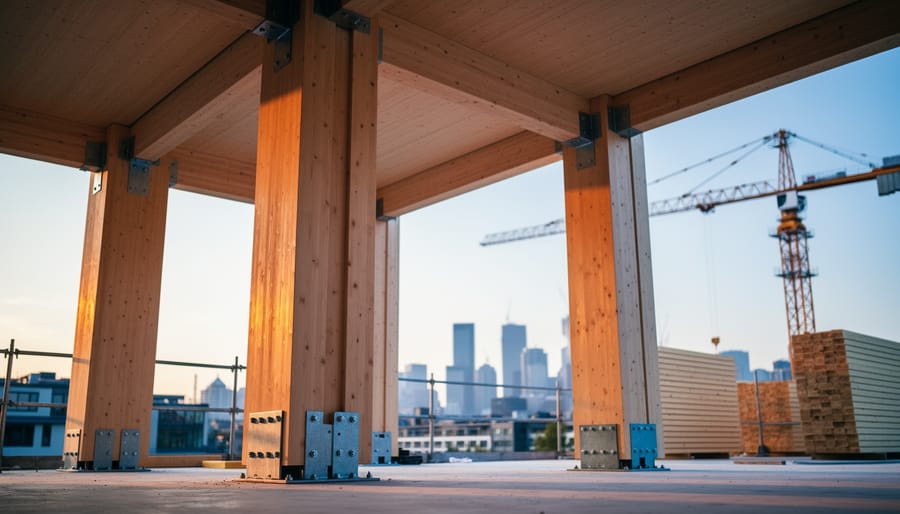
Mass timber construction is revolutionizing how we build, offering architects and builders a structural alternative that rivals steel and concrete while slashing carbon footprints by up to 75%. These engineered wood products—including cross-laminated timber (CLT), glue-laminated timber (glulam), and nail-laminated timber (NLT)—stack layers of dimension lumber into panels and beams strong enough to support multi-story buildings.
From Google’s mass timber office in Sunnyvale to the 18-story Brock Commons student residence in Vancouver, projects worldwide prove this technology delivers on both performance and sustainability. The construction method prefabricates building components off-site, cutting installation time by 25% compared to traditional methods while reducing noise and site disruption.
What makes mass timber particularly appealing is its accessibility. Unlike specialized construction systems requiring extensive retraining, tradespeople can adapt existing carpentry skills with proper equipment and safety protocols. The material stores carbon rather than emitting it during production, positioning it among the most effective sustainable building materials available today.
Whether you’re a contractor evaluating options for your next commercial project or a developer seeking LEED certification, understanding mass timber’s applications, costs, and equipment requirements helps you make informed decisions. This guide breaks down real-world examples, essential tools for installation, and honest cost comparisons to help you determine if mass timber fits your building goals.
What Exactly Is Mass Timber?
The Main Types of Mass Timber Products
Mass timber isn’t just one product—it’s a family of engineered wood systems, each with distinct characteristics and applications. Understanding these differences helps you choose the right material for your project and anticipate the tools you’ll need.
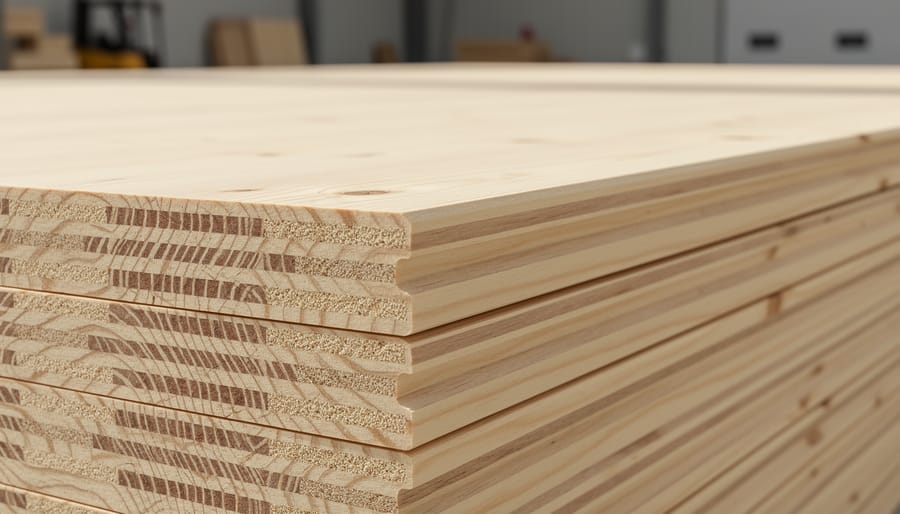
Cross-Laminated Timber (CLT) consists of multiple layers of dimensional lumber stacked perpendicular to each other and glued under pressure. Think of it like plywood, but much thicker and stronger. CLT panels can span large distances and work as floors, walls, or roofs in multi-story buildings. You’ll commonly see CLT in apartment complexes, office buildings, and even schools where fire-rated assemblies are required. The panels arrive pre-cut from the factory, reducing on-site cutting and waste.
Glue-Laminated Timber (Glulam) bonds layers of lumber together with all grain running in the same direction, creating beams and columns with impressive strength-to-weight ratios. Glulam appears frequently in structures requiring long spans without intermediate supports—like community centers, churches, and commercial buildings. These beams can curve gracefully, making them popular for architecturally striking projects.
Nail-Laminated Timber (NLT) fastens lumber boards together side-by-side using nails rather than adhesives. This traditional method creates solid timber decks and panels, often used for floors and roofs in low-rise construction. NLT appeals to builders who prefer mechanical fasteners and straightforward assembly methods.
Dowel-Laminated Timber (DLT) takes a similar approach but uses hardwood dowels instead of metal fasteners or glue, creating an entirely wood-based system. DLT panels work well for floor and roof applications where builders prioritize sustainability and avoiding adhesives.
Each type requires specific handling equipment and installation techniques, which we’ll explore in the practical application sections ahead.
Real-World Mass Timber Projects Making Waves
Commercial and Public Buildings
Mass timber is transforming how we build commercial and public spaces, with impressive projects popping up worldwide that showcase the material’s versatility and strength. Let’s look at some standout examples that demonstrate what’s possible.
The Brock Commons Tallwood House at the University of British Columbia made headlines as an 18-storey student residence when completed in 2017. What makes it innovative? The entire structure was assembled in just 66 days using prefabricated cross-laminated timber (CLT) panels and glulam columns. This project proved that mass timber could compete with concrete and steel in tall building construction while significantly reducing carbon emissions.
In Norway, the Mjøstårnet tower currently holds the record as the world’s tallest timber building at 85.4 metres. This mixed-use structure houses apartments, a hotel, offices, and a restaurant, demonstrating mass timber’s flexibility for different building types.
For schools, the Patcham High School in Brighton, UK, utilized CLT construction to create bright, naturally lit learning spaces. The exposed timber interiors provide excellent acoustics and create a warm, welcoming environment that traditional materials struggle to match.
The T3 office building in Minneapolis represents another commercial success story. This seven-storey structure uses nail-laminated timber and was specifically designed to appeal to tech companies seeking sustainable, attractive workspaces. The visible timber elements create a distinctive aesthetic that tenants appreciate.
These projects share common benefits: faster construction times, lower environmental impact, and healthier indoor environments that occupants genuinely enjoy.
Residential Applications
Mass timber isn’t just for large commercial buildings anymore. Homeowners and residential contractors are discovering its advantages for projects closer to home, making sustainable construction more accessible than ever.
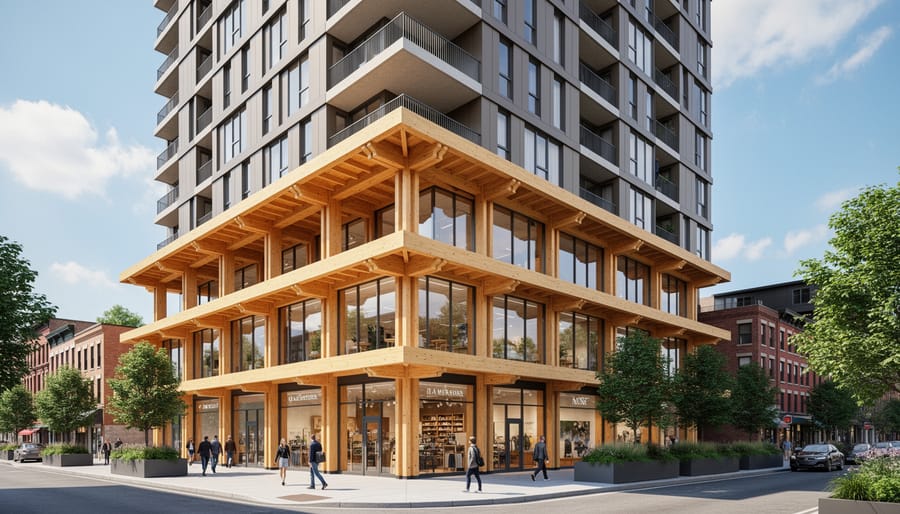
In multi-family housing, developers are choosing mass timber for apartment complexes and townhomes because it speeds up construction timelines significantly. Cross-laminated timber (CLT) panels arrive pre-cut and ready to install, reducing on-site labour and weather delays. These buildings often feature exposed timber ceilings and walls that residents love, eliminating the need for additional finishes while providing natural warmth and character.
Custom home builders are embracing mass timber for its design flexibility and environmental credentials. Homeowners seeking unique, eco-friendly properties can work with architects to create open-plan living spaces with fewer load-bearing walls, thanks to timber’s impressive strength-to-weight ratio. The material performs exceptionally well in both modern minimalist designs and traditional architectural styles.
Renovation projects present another growing opportunity. Homeowners are adding mass timber extensions, garden rooms, and garage conversions. The lightweight nature of these materials means less foundation work compared to traditional masonry, often making projects more cost-effective and faster to complete.
For contractors new to mass timber, the learning curve is manageable. Standard carpentry skills transfer well, though you’ll need familiarity with specialized fasteners and connection details. The precision-cut panels mean less waste on site and cleaner working conditions. Safety remains paramount—always follow manufacturer guidelines for handling and installation, and ensure proper moisture protection during construction to maintain the material’s structural integrity and longevity.
The Sustainability Advantage: Why Builders Are Making the Switch
Carbon Storage That Lasts Decades
Trees naturally absorb carbon dioxide from the atmosphere as they grow, storing it within their wood fibers. When timber is harvested and transformed into mass timber products like cross-laminated timber (CLT) or glued laminated timber (glue-lam), that carbon remains locked inside the building material for the structure’s lifetime, often 50 years or more. This makes mass timber an effective tool for reducing carbon footprint in construction.
Here’s the real difference: producing one tonne of steel releases approximately 1.8 tonnes of carbon dioxide, while concrete production generates about 0.9 tonnes per tonne of material. In contrast, one cubic meter of mass timber stores roughly one tonne of carbon dioxide that would otherwise remain in the atmosphere.
Think of mass timber buildings as carbon warehouses. A typical five-story mass timber building can store the equivalent carbon of taking 500 cars off the road for a year. For builders and DIYers exploring sustainable construction options, this carbon storage capability represents a practical advantage beyond just using renewable materials.
Less Waste, Faster Build Times
Mass timber components arrive at your job site pre-cut, pre-drilled, and ready to assemble—much like high-quality furniture, but on a building scale. This prefabrication approach dramatically reduces on-site waste compared to traditional timber framing, where you might find yourself with piles of offcuts and scraps at day’s end. Factory-controlled manufacturing means precise measurements and minimal material loss, with some projects reporting up to 90% less waste than conventional builds.
The speed advantage is equally impressive. Because panels and beams slot together using predetermined connection points, installation moves quickly. Projects that might take months with traditional methods can be completed in weeks. You’ll need fewer workers on-site for shorter periods, which translates to lower labour costs and reduced site disruption. One tradesperson we spoke with mentioned completing a three-storey commercial framework in just six days using cross-laminated timber panels.
This efficiency also means less time coordinating equipment rentals and managing site logistics. The reducing construction waste benefits extend beyond materials—you’ll spend less on skip bins, disposal fees, and clean-up crews, making mass timber an economically attractive option for time-sensitive projects.
Tools and Equipment You’ll Need for Mass Timber Work
Heavy-Duty Lifting and Positioning Equipment
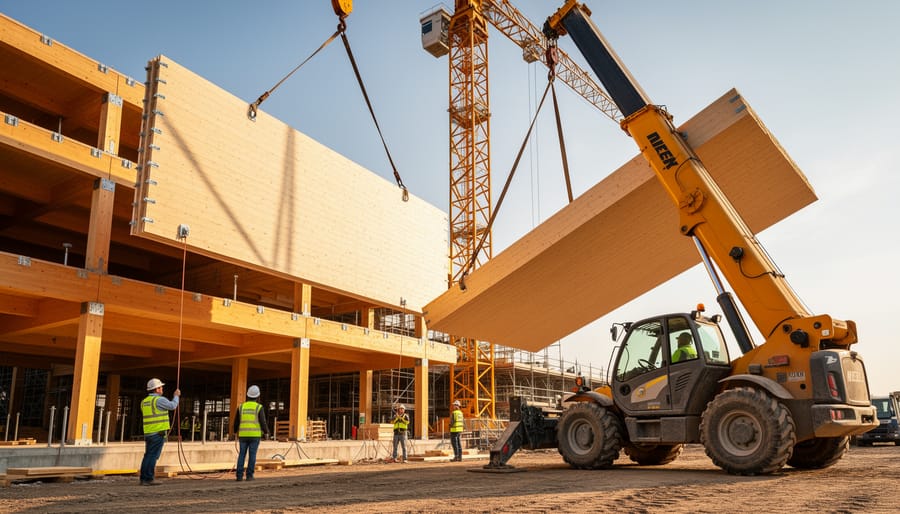
Mass timber construction demands specialized lifting equipment to handle prefabricated panels and beams that often weigh several tonnes. Mobile cranes remain the workhorse of mass timber projects, with capacity requirements typically ranging from 20 to 100 tonnes depending on component size and building height. Telehandlers offer excellent maneuverability on tighter sites, particularly useful for moving materials short distances or working in confined areas where crane access is limited.
Proper rigging equipment is essential for safe handling. Soft lifting slings protect timber surfaces from damage while distributing weight evenly across panels. Never use chains or steel cables directly against timber surfaces, as these can cause crushing or surface damage that compromises structural integrity.
Safety considerations are paramount when working with oversized components. Always verify load weights against equipment capacity, leaving adequate safety margins. Establish clear exclusion zones beneath suspended loads, and ensure all team members understand hand signals and communication protocols. Wind speeds above 25 mph can make large panel handling dangerous, so monitor weather conditions closely.
Community feedback from construction professionals emphasizes the importance of experienced crane operators familiar with mass timber’s unique characteristics. Many contractors recommend scheduling lifts during early morning hours when wind conditions are typically calmer and site traffic is minimal.
Cutting, Fastening, and Finishing Tools
Working with mass timber requires specialized equipment that differs significantly from standard lumber projects. The dense, engineered nature of materials like cross-laminated timber (CLT) and glued laminated timber (glulam) demands tools capable of handling larger dimensions and greater structural integrity.
For cutting operations, professionals typically rely on track saws with extended guide rails and CNC routers for precision work on large panels. These computer-controlled machines ensure accurate cuts and openings for windows, doors, and mechanical systems. DIYers tackling smaller mass timber elements might manage with a quality circular saw fitted with carbide-tipped blades designed for engineered wood, though rental equipment often proves more cost-effective for one-off projects.
Fastening tools include heavy-duty pneumatic nailers and specialized screw guns capable of driving long structural screws through thick timber sections. Self-tapping screws are commonly used in mass timber assembly, requiring high-torque drivers that most homeowners don’t keep in their toolbox. Many professionals also use hydraulic jacking systems for positioning heavy panels during installation.
Finishing work demands belt sanders, orbital sanders, and edge trimming tools to smooth connections and prepare surfaces. Since mass timber often remains exposed as a design feature, finishing quality matters considerably.
For DIY enthusiasts, renting equipment makes practical sense. Most mass timber projects happen at scales where purchasing industrial-grade tools isn’t justified. Professional contractors, however, invest in durable equipment given the growing demand for mass timber construction. Always prioritize safety equipment including dust collection systems, as fine wood particles from engineered timber require proper ventilation and respiratory protection.
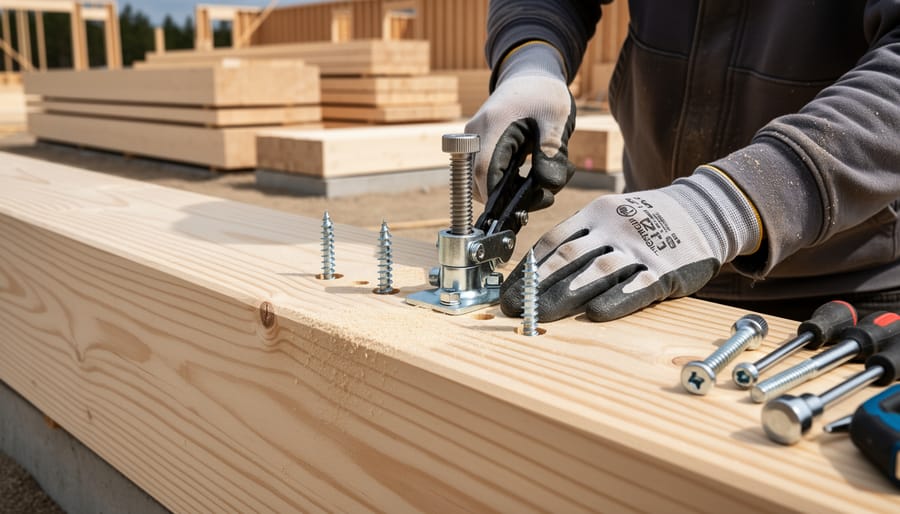
Working Safely with Mass Timber: What Tradespeople Should Know
Working with mass timber requires specific safety protocols that differ from traditional construction methods. These engineered wood panels and beams are incredibly heavy—a single cross-laminated timber (CLT) panel can weigh several thousand pounds—making proper handling techniques absolutely essential.
Before starting any mass timber project, ensure your team has appropriate lifting equipment rated for the panel weights you’ll be handling. This typically includes cranes, forklifts, or telehandlers with sufficient capacity. Never attempt to move mass timber elements without proper mechanical assistance, as the weight far exceeds what manual lifting can safely manage. Workers should maintain clear communication during lifts and establish exclusion zones beneath suspended panels.
Personal protective equipment requirements mirror standard construction sites but deserve particular attention. Hard hats, steel-toed boots, high-visibility clothing, and work gloves are mandatory. Eye protection becomes especially important when cutting or drilling into mass timber, as these operations create significant wood dust. Respiratory protection is recommended during sustained cutting operations to prevent inhalation of wood particles.
Fire safety considerations are crucial despite mass timber’s surprising fire resistance. The thick panels char on the outside during fire exposure, creating a protective layer that slows burning. However, during construction before protective finishes are applied, keep the site free of ignition sources and maintain fire extinguishers nearby. Follow your project’s fire safety plan, which should address temporary protection measures during the build phase.
Edge protection and fall prevention require special attention since mass timber installations often progress quickly, creating elevated work surfaces rapidly. Install guardrails and safety nets promptly as floors are completed. When working on upper levels, use proper fall arrest systems and ensure anchor points are correctly installed in the mass timber elements.
Store mass timber panels flat and protected from moisture until installation. Wet conditions can affect the wood’s structural properties and dimensional stability, so covering materials and maintaining proper site drainage prevents costly problems. Always inspect panels before installation for any damage sustained during transport or storage.
Cost Considerations: Is Mass Timber Right for Your Project?
Initial Investment vs. Long-Term Savings
Mass timber projects typically require higher upfront investment compared to conventional construction methods. The specialized engineered panels cost more to manufacture and transport, and builders may need specific equipment for handling large components. However, these initial costs should be weighed against substantial long-term savings that accumulate over the building’s lifecycle.
The energy efficiency benefits of mass timber buildings deliver significant reductions in heating and cooling expenses. Wood’s natural insulation properties help maintain comfortable interior temperatures year-round, cutting utility bills by up to 30% compared to steel or concrete structures. Additionally, mass timber’s proven durability means lower maintenance costs over decades, with proper treatment ensuring resistance to moisture, fire, and pests.
From a resale perspective, mass timber buildings increasingly attract premium valuations as sustainability becomes a priority for buyers and tenants. The material’s carbon-storing properties and renewable nature appeal to environmentally conscious markets. Many builders report that while projects may cost 5-10% more initially, reduced construction time, lower foundation expenses due to lighter weight, and minimal waste generation help offset the investment, creating positive returns within the first decade of ownership.
Common Challenges and How Professionals Overcome Them
Working with mass timber presents unique challenges that differ from traditional construction methods, but understanding these obstacles helps teams plan effectively and deliver successful projects.
Moisture management tops the list of concerns. Cross-laminated timber (CLT) and glulam panels can be damaged by prolonged water exposure during construction. Professional contractors consistently recommend covering deliveries immediately with breathable tarps and scheduling installations during favorable weather. Community feedback from recent projects emphasizes storing panels off the ground on blocking and maintaining job site drainage to prevent water pooling. Some teams use moisture meters to verify panels stay within acceptable ranges, typically 12-16% moisture content, before enclosing the structure.
Acoustic performance challenges arise because timber transmits sound differently than concrete. To meet building code requirements for sound insulation between units in multi-family buildings, professionals add acoustic underlayments, resilient channels, or additional layers of drywall with sound-dampening insulation. Real-world installers report that addressing acoustics during design rather than retrofitting saves significant time and money.
Connection details require careful planning since mass timber connections handle loads differently than steel or concrete. Field crews note that pre-drilling holes for fasteners prevents splitting and ensures structural integrity. Many professionals use templates and jigs to maintain precision, especially for repetitive connections. Heavy-duty cordless drills with appropriate torque settings help achieve consistent results without over-tightening.
Building code navigation remains complex as jurisdictions adapt regulations for mass timber. Experienced project managers advise early engagement with local building officials and using ICC-certified products when possible. Many jurisdictions now accept mass timber up to 18 stories with proper fire protection strategies.
The construction community continues sharing solutions through online forums and trade organizations, helping newcomers avoid common pitfalls. This collaborative approach accelerates problem-solving and builds confidence in mass timber methods across the industry.
Mass timber is genuinely transforming how we approach construction, offering a compelling alternative that combines strength, sustainability, and surprising versatility. As we’ve explored, this material isn’t just for commercial developers—it’s increasingly accessible for residential projects, renovations, and specialized builds where environmental impact matters. Whether you’re a professional tradesperson considering your first mass timber project or a homeowner exploring greener building options, understanding the tools, techniques, and real costs involved puts you in a strong position to make informed decisions.
The beauty of mass timber lies in its alignment with broader sustainable building practices while remaining practical to work with using familiar equipment and methods. We’d love to hear from our community: Have you worked on mass timber projects? What challenges did you encounter, and what tools made the biggest difference? Your experiences help others navigate this evolving field, so please share your insights, questions, or project stories in the comments below. Together, we can build a knowledge base that supports smarter, more sustainable construction choices for everyone.
Related Posts


Post a Comment