

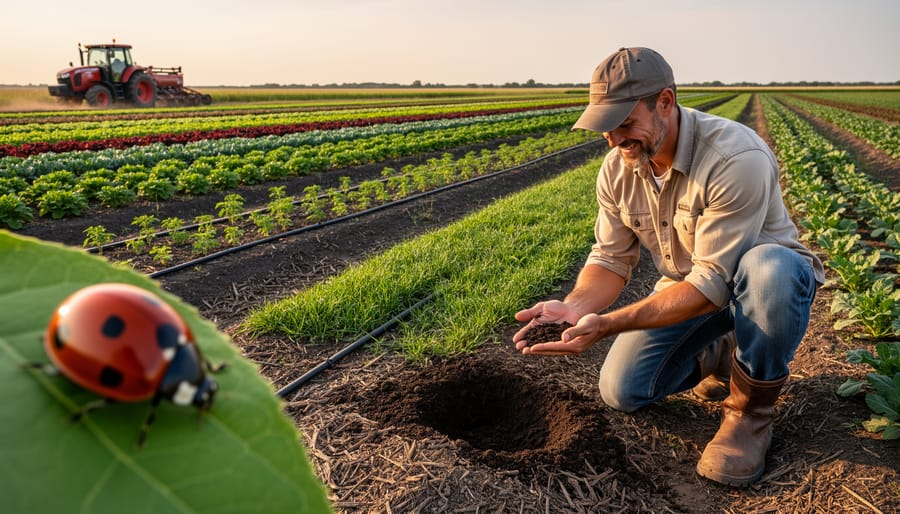
Sustainable farming practices deliver measurable efficiency gains that directly impact your bottom line, contradicting the outdated belief that environmental methods sacrifice productivity. Modern farming insights reveal these systems reduce input costs by 20-35% while maintaining or increasing yields through smarter resource allocation rather than expensive chemical dependencies.
The efficiency argument centers on three quantifiable advantages. First, sustainable methods like crop rotation and cover cropping rebuild soil health naturally, cutting fertilizer expenses by up to 40% within three growing seasons while improving water retention by 25-50%. Second, integrated pest management reduces pesticide costs by 60-80% compared to conventional spraying schedules, as beneficial insects handle pest control without recurring chemical purchases. Third, reduced tillage systems lower fuel consumption by 50-70% and decrease labor hours by 30%, directly addressing operational overhead.
Water efficiency alone justifies the transition for most operations. Drip irrigation combined with mulching reduces water use by 40-60% compared to traditional flooding methods, while precision agriculture tools identify exactly where moisture is needed. These targeted approaches eliminate waste without compromising plant health.
Risk mitigation provides another efficiency layer often overlooked in traditional cost analyses. Diversified cropping systems and polyculture designs protect against total crop failure, spreading risk across multiple revenue streams. When one crop underperforms due to weather or market fluctuations, others compensate, stabilizing annual income more effectively than monoculture approaches.
The data consistently shows that sustainable farming isn’t just environmentally responsible; it’s economically smarter for long-term operation viability.
Sustainable Farming Cuts Your Input Costs Dramatically
Natural Soil Fertility Eliminates Fertilizer Dependence
Building healthy soil naturally can dramatically cut or eliminate fertilizer costs while boosting long-term productivity. Three proven methods stand out for their effectiveness and low cost.
Composting transforms kitchen scraps, yard waste, and plant material into nutrient-rich soil amendments at essentially zero cost. A simple compost system returns nitrogen, phosphorus, and potassium to your soil without purchasing chemical inputs. The process requires minimal equipment—just space and time—making it accessible whether you’re growing vegetables in DIY planter boxes or managing larger plots.
Cover cropping involves planting specific crops like clover, rye, or vetch during off-seasons. These plants fix nitrogen from the air into the soil, prevent erosion, and suppress weeds. When tilled under, they become green manure that feeds the next crop. The seed cost is minimal compared to synthetic fertilizers, and many farmers report yield increases of 10-20 percent.
Crop rotation means changing what you plant in each area seasonally. This practice naturally replenishes soil nutrients as different crops use and return varying nutrient combinations. Legumes add nitrogen, deep-rooted crops bring up minerals, and rotating families prevents nutrient depletion. Together, these methods create a self-sustaining fertility cycle that reduces external input costs by 50-90 percent.
Biological Pest Control Slashes Chemical Spending
Biological pest control represents one of the most cost-effective strategies in sustainable farming, delivering measurable savings while maintaining or improving crop yields. Instead of purchasing expensive chemical pesticides season after season, farmers leverage natural predators and ecosystem balance to manage pest populations at a fraction of the cost.
Beneficial insects like ladybugs, lacewings, and parasitic wasps act as free labor, targeting aphids, caterpillars, and other crop-damaging pests. A single ladybug can consume up to 5,000 aphids in its lifetime, providing continuous pest management without recurring chemical expenses. Many farmers report reducing pesticide spending by 40-70% within two years of implementing biological controls.
Companion planting amplifies these savings by creating natural pest barriers. Planting marigolds near tomatoes deters nematodes, while basil repels thrips and mosquitoes. These plant partnerships eliminate the need for targeted pesticides while often improving overall crop health. The initial investment involves only seed costs, making it accessible for operations of any size.
Biodiversity enhancement through hedgerows, wildflower strips, and diverse crop rotations establishes permanent pest control infrastructure. These habitats attract and sustain beneficial insect populations year-round, creating a self-regulating system that reduces intervention needs. Farmers who maintain diverse field margins report 60% fewer pest outbreaks compared to monoculture operations.
The economic advantage compounds over time as healthy soil ecosystems develop resilience against pest pressure. This approach eliminates the pesticide treadmill where pests develop resistance, requiring increasingly expensive chemical solutions. Community feedback consistently highlights reduced input costs as the primary financial benefit of biological pest management.
Better Soil Health Means Higher Yields Per Acre
The Science Behind Soil Carbon and Productivity
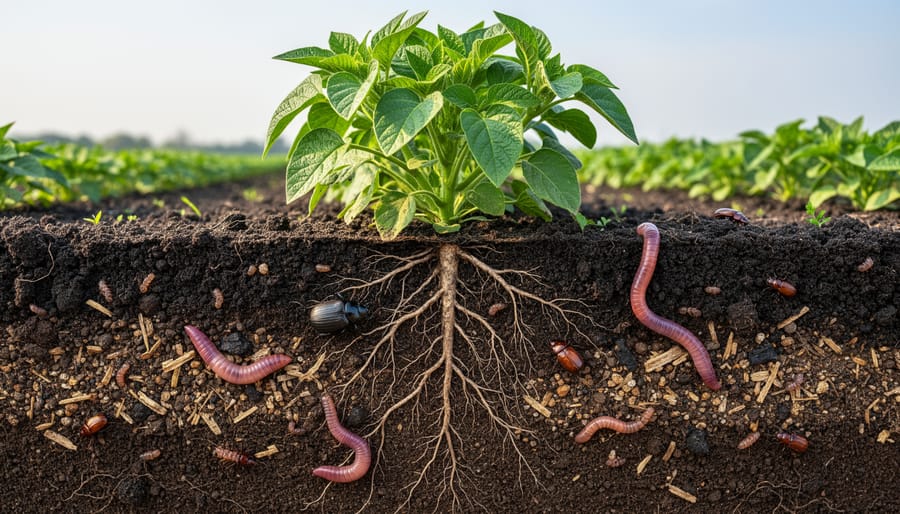
Here’s the practical breakdown: soil carbon directly translates to farming efficiency through improved organic matter. When you add compost, cover crops, or other organic materials to soil, you’re essentially building a natural fertilizer factory. This organic matter breaks down slowly, releasing nutrients like nitrogen, phosphorus, and potassium exactly when plants need them—reducing your fertilizer costs by up to 30% in many cases.
The process works because organic matter acts like a sponge. It holds both nutrients and water in the root zone, which means less irrigation and fewer fertilizer applications. For every 1% increase in soil organic matter, soil can hold approximately 20,000 additional gallons of water per acre.
Root development improves dramatically in carbon-rich soil because the structure becomes looser and more porous. Think of it like upgrading from compacted clay to quality potting mix. Roots penetrate deeper, accessing water and nutrients that shallow roots miss. This deeper root system makes plants more drought-resistant and less dependent on frequent watering.
The efficiency gains are measurable: farmers typically see 10-25% yield increases within three to five years of building soil carbon, while simultaneously cutting input costs. This double benefit—higher output with lower investment—is what makes the science economically compelling for skeptics.
Real-World Yield Comparisons
Real farms transitioning to sustainable methods are seeing measurable improvements in both yield and profitability. A five-year study tracking Midwestern grain farms found that operations implementing crop rotation and cover cropping maintained yields within 5% of conventional farms while reducing input costs by 25-30%. These farms reported better soil moisture retention, meaning less irrigation equipment needed during dry spells.
In California’s Central Valley, vineyards adopting integrated pest management saw grape yields increase by 12% over three seasons compared to conventional neighbors. The key difference? They reduced pesticide applications by 60%, cutting chemical costs significantly while beneficial insects naturally controlled pests.
Dairy operations using rotational grazing provide compelling evidence too. Wisconsin farms following managed grazing systems produced milk at 35% lower feed costs per cow. These farmers invested in portable fencing and water systems initially, but recovered costs within two growing seasons through reduced feed purchases and improved pasture productivity.
Small-scale vegetable growers using composting and natural fertilizers consistently report 15-20% higher market prices for certified organic produce. While transition periods typically show temporary yield dips of 10-15%, most operations reach yield parity with conventional methods by year three while maintaining premium pricing advantages.
Water Efficiency That Protects Your Bottom Line
Tools and Equipment for Water-Smart Farming
Making the switch to water-smart farming doesn’t require a complete overhaul of your equipment. Several practical tools can significantly reduce water waste while improving crop yields, and many are available through rental programs if you want to test before investing.
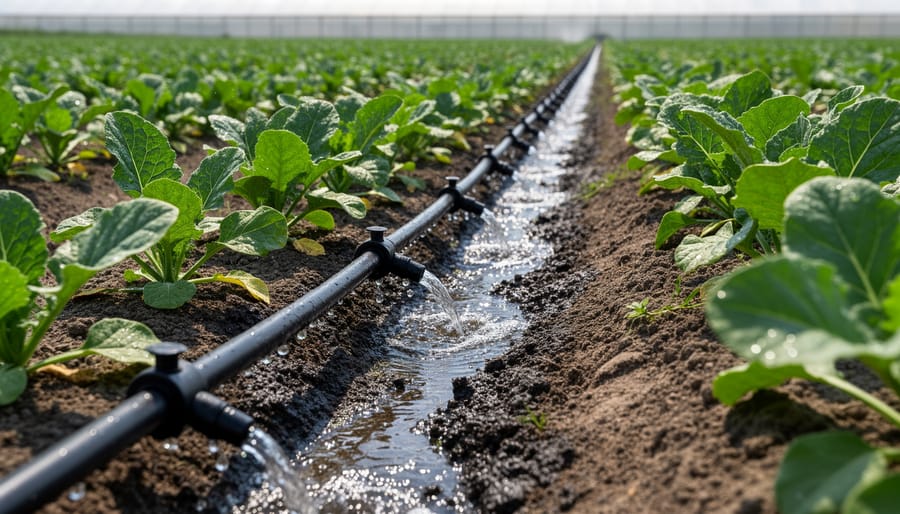
Drip irrigation systems are game-changers for efficiency, delivering water directly to plant roots and reducing evaporation by up to 60% compared to traditional sprinklers. Basic kits start around $50 for small gardens, while professional-grade systems scale up for larger operations. Many hardware stores now offer rental options for seasonal trials.
Rain barrels and collection systems capture free water from your roof, with 1,000 square feet of roofing yielding approximately 600 gallons per inch of rainfall. Look for food-grade barrels with overflow valves and mosquito screens. Users consistently report 30-40% reductions in municipal water use during growing seasons.
Soil moisture monitors take the guesswork out of watering schedules. Digital models with probe sensors cost $20-150 and measure moisture levels at root depth, preventing both overwatering and drought stress. According to community reviews, farmers using these monitors report 25% less water usage while maintaining healthier plants.
For larger operations, consider renting soil augers to assess drainage patterns or moisture meters with data logging capabilities. These tools help identify problem areas before investing in permanent infrastructure, saving both water and money long-term.
Labor Efficiency Through Smart System Design
One of the most compelling efficiency arguments for sustainable farming is the dramatic reduction in ongoing labor requirements once systems are properly established. Unlike conventional farming that demands constant intervention—tilling, planting annuals, heavy weeding, and repeated applications of inputs—sustainable methods work with natural systems to minimize daily maintenance.
Permaculture design principles create self-maintaining landscapes by positioning plants strategically. For example, nitrogen-fixing plants naturally fertilize neighboring crops, reducing the need for manual fertilization. Companion planting naturally deters pests, cutting down on monitoring and treatment time. Many farmers report labor reductions of 40-60% after the initial three-year establishment period, as beneficial insects, soil microbes, and plant relationships take over tasks previously done manually.
No-till farming eliminates one of agriculture’s most labor-intensive activities. Traditional tillage requires operating heavy equipment multiple times per season, consuming both fuel and operator hours. No-till systems use cover crops and mulching instead, allowing farmers to skip this step entirely. Studies show no-till operations can reduce labor requirements by 30-50% during planting seasons while improving soil structure naturally. The initial investment in learning proper mulching techniques pays dividends in reduced physical work year after year.
Perennial crop systems offer perhaps the greatest labor efficiency gains. While annual crops require complete replanting each season—soil preparation, seeding, and establishment care—perennials return year after year from the same root systems. Fruit trees, berry bushes, asparagus, and perennial grains like kernza dramatically cut planting labor. Even vertical garden systems using perennial herbs reduce maintenance compared to annual vegetable gardens.
The key insight: sustainable systems require more planning and setup effort initially but significantly less ongoing intervention. This front-loaded investment in smart design pays back through years of reduced labor, making these approaches more efficient for time-constrained farmers and homesteaders alike.
Energy Savings That Add Up Fast
Energy costs represent one of the largest expenses in conventional farming, but sustainable practices dramatically reduce this burden through smart efficiency measures.
Synthetic fertilizer production alone consumes approximately 1-2% of global energy supply. By switching to composting and natural soil amendments, sustainable farms eliminate this energy-intensive input entirely. The numbers speak for themselves: producing one kilogram of nitrogen fertilizer requires about 40 megajoules of energy, while composting uses virtually none.
Reduced tillage practices deliver another significant win. Traditional plowing can burn 15-30 liters of diesel per hectare. No-till and minimal tillage methods cut fuel consumption by up to 70%, translating to direct cost savings of $30-60 per hectare annually. These practices also reduce equipment wear, lowering maintenance expenses.
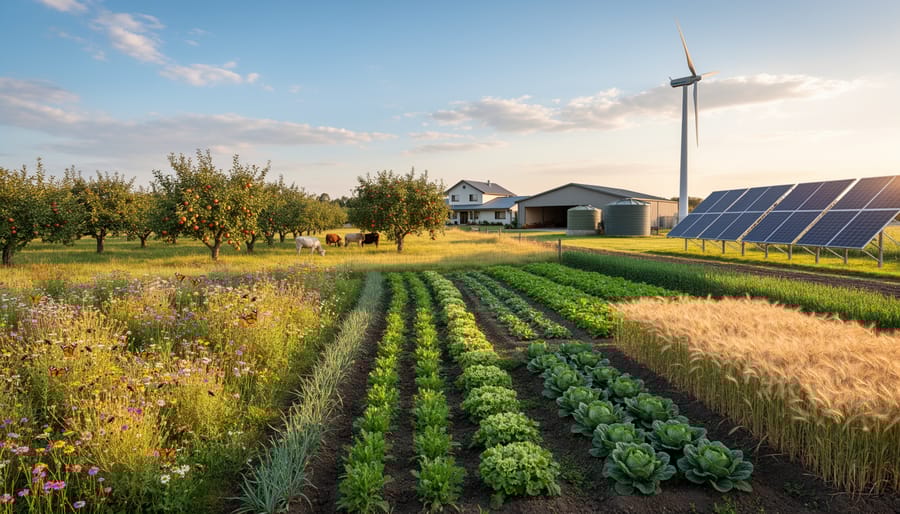
Many sustainable farms now incorporate renewable energy installation for irrigation pumps, grain dryers, and facility operations. Solar panels and small wind turbines provide predictable, inflation-proof energy costs. Farms report 40-80% reductions in electricity bills within the first year of installation.
The cumulative effect is substantial. Studies show sustainable operations reduce overall energy consumption by 30-50% compared to conventional farms of similar size. This efficiency gain directly improves profit margins while insulating farmers from volatile fuel prices. For operations spending $20,000 annually on energy, sustainable practices could save $6,000-10,000 each year—money that flows straight to the bottom line while reducing environmental impact.
Risk Reduction as an Efficiency Multiplier
Think of risk reduction as insurance that actually pays dividends. When farms diversify their operations and build resilient systems, they’re not just protecting against disaster—they’re actively improving their bottom line through reduced vulnerability.
Diversification works like a balanced investment portfolio. Farms growing multiple crop varieties or integrating livestock alongside crops create multiple revenue streams that cushion against market swings. When tomato prices drop unexpectedly, pepper sales might compensate. This approach proved its worth during recent supply chain disruptions, when farms with diverse products maintained steady income while monoculture operations faced total loss scenarios.
Healthy soil systems act as a built-in buffer against climate extremes. Soil rich in organic matter holds 20,000 gallons more water per acre than degraded soil, meaning crops survive drought conditions that devastate conventional fields. During heavy rains, that same soil structure prevents erosion and nutrient loss. These characteristics translate directly to yield stability—you’re not gambling on perfect weather conditions every season.
Reducing chemical dependence protects farms from regulatory shifts and input price volatility. When fertilizer costs doubled in recent years, chemically-dependent farms saw profit margins collapse. Meanwhile, operations using compost, cover crops, and natural pest management maintained consistent input costs. They’re also positioned ahead of increasingly strict environmental regulations rather than scrambling to adapt.
This risk reduction compounds over time. Each year without catastrophic loss allows reinvestment in infrastructure and soil health. Each regulatory change avoided saves costly retrofitting. The farm becomes progressively more efficient not despite its sustainable practices, but because those practices create operational stability that conventional methods simply cannot match. It’s protection that actively generates value.
Getting Started: Tools and Equipment You’ll Need
Transitioning to sustainable farming doesn’t require breaking the bank on specialized equipment. Many essential tools are available through rental services, making sustainable practices financially accessible and efficient from day one.
For composting operations, a chipper-shredder transforms yard waste and crop residues into nutrient-rich mulch. These machines typically cost $2,000-$5,000 to purchase, but renting equipment like this for $80-$150 per day lets you process large volumes seasonally without the upfront investment. This aligns perfectly with sustainable efficiency—you’re recycling organic matter while avoiding unnecessary capital expenditure.
A broadfork is essential for no-till farming, aerating soil without disrupting its structure or beneficial organisms. This hand tool costs $150-$300 but lasts decades. Unlike powered tillers, it requires no fuel and preserves soil carbon, demonstrating both economic and environmental efficiency.
Soil testing kits are non-negotiable for sustainable farming success. Digital pH meters and NPK test kits (starting around $30-$100) provide data-driven insights into your soil’s needs, preventing over-fertilization and reducing input costs by 20-30%. Professional laboratory testing services offer comprehensive analysis for $50-$150 annually.
Additional practical tools include a quality garden fork for turning compost, irrigation timers for water efficiency (programmable models around $40-$80), and rain gauges to track natural water inputs. A moisture meter ($15-$50) helps optimize irrigation schedules, cutting water use significantly.
Community tool libraries and equipment rental centers increasingly stock sustainable farming tools based on user demand. Check local reviews and availability before purchasing—many farmers find that renting specialized equipment quarterly proves more cost-effective than ownership, freeing capital for other efficiency improvements while maintaining access to well-maintained, professional-grade tools.
The efficiency of sustainable farming practices becomes undeniable when you consider how the benefits compound over time. While improved soil health reduces fertilizer costs, it simultaneously increases water retention, which lowers irrigation expenses. Better pest management through biodiversity decreases pesticide spending while improving pollination and yields. These interconnected advantages create a multiplying effect that conventional methods simply cannot match.
Let’s be realistic about the transition timeline. You won’t see every benefit in your first season. Most farmers report that soil health improvements become measurable within 18-24 months, while significant cost reductions typically appear in years two through three. The initial investment in knowledge, equipment, and practice changes requires patience, but the efficiency gains accelerate as your system matures and you refine your approach based on what works for your specific conditions.
The key is starting small and building systematically. Choose one practice that addresses your biggest efficiency challenge right now. If water costs concern you, begin with drip irrigation or mulching. If labor represents your largest expense, explore no-till methods. Master that single change, measure the results, and let your success guide the next step.
Community experience proves invaluable during this transition. Connect with other farmers who have implemented these practices, learn from their mistakes, and adapt their solutions to your situation. Many discover that sustainable methods not only improve efficiency but also make farming more manageable and resilient against unpredictable challenges like weather extremes or market fluctuations.
Related Posts


Post a Comment