

Understanding truss deflection is essential before embarking on any structural project, whether you’re designing a roof framework or reinforcing an existing structure. The unit load method offers a proven mathematical approach to calculate how much a truss will bend or deflect under specific loads—critical information that directly impacts safety and structural integrity.
This analytical technique works by applying a hypothetical “unit load” of one unit at the point where you need to measure deflection, then calculating the resulting internal forces throughout the truss members. By comparing these forces with those created by actual working loads, you can determine precise deflection values using the principle of virtual work. The method applies universally to statically determinate trusses, making it invaluable for both simple garden structures and complex building frameworks.
For DIY enthusiasts planning smaller projects like carports or pergolas, grasping this concept helps you communicate effectively with building inspectors and understand engineering specifications. Professional tradespeople use these calculations daily to verify structural designs meet Australian building codes and safety standards. The unit load method connects directly to broader construction load handling techniques, ensuring you understand not just what loads your structure can support, but how it will behave under those loads.
This guide breaks down the unit load method into practical steps, explains when professional engineering consultation becomes necessary, and demonstrates real-world applications that bridge the gap between classroom theory and worksite reality.
What Is the Unit Load Method for Truss Analysis?
The unit load method is a calculation technique that helps predict how much a truss will deflect, or bend, when weight is applied to it. Think of deflection as the amount a structure sags or moves from its original position when you load it up with materials, equipment, or other forces.
At its core, a truss is a framework of connected beams arranged in triangular patterns. You’ve likely seen them supporting roofs, bridges, or even tower cranes. The unit load method specifically uses the principle of virtual work to calculate deflection without needing complex computer software.
Here’s the straightforward explanation: you apply an imaginary “unit load” of 1 (whether that’s 1 pound, 1 kilogram, or 1 kilonewton) at the exact point where you want to measure deflection. This virtual or pretend load helps you calculate the internal forces in each truss member. Then, using a formula that accounts for these forces, the actual loads, and the material properties of your truss members, you determine how much that point will move.
What makes this method particularly valuable is its precision for specific points. Unlike methods that give you general stress patterns across an entire structure, the unit load method zeroes in on exactly where you need information. For someone planning a project, this means you can check whether a particular junction will sag too much before you start building.
The method differs from direct measurement approaches because it’s predictive rather than reactive. Instead of building something and measuring deflection afterwards, you calculate it beforehand. This saves materials, time, and potential safety issues. For DIY builders and professionals alike, understanding expected deflection helps you choose appropriate materials and design trusses that perform safely under real-world conditions.
When You Actually Need This Calculation Method
Understanding when you actually need the unit load method helps you determine whether simple estimations will suffice or if more rigorous analysis is required. This calculation method becomes essential in several practical scenarios where precision directly impacts safety and structural integrity.
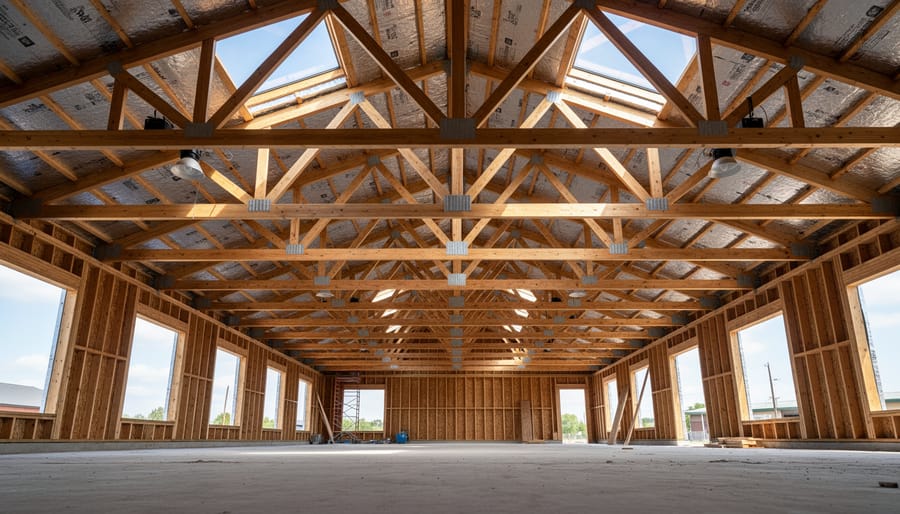
For professional roof truss installations, particularly on commercial buildings or residential homes with complex roof designs, the unit load method helps engineers verify that each truss member can handle expected loads from roofing materials, snow, wind, and maintenance workers. This analysis prevents catastrophic failures that could endanger lives and property.
Bridge construction projects, even smaller pedestrian bridges, require this level of detailed deflection analysis to ensure the structure remains stable under varying loads while maintaining acceptable movement limits. Similarly, temporary structures like scaffolding systems supporting heavy equipment or construction platforms need verification that deflections won’t compromise worker safety or the supported equipment.
You’ll also need this method when designing support structures for heavy machinery, overhead cranes, or equipment platforms where excessive deflection could damage sensitive equipment or create dangerous working conditions.
For typical DIY projects like garden sheds or basic deck framing, this calculation method is often unnecessary, as building codes provide standard sizing tables. However, if you’re planning anything that supports significant weight, spans large distances, or involves public safety, consulting with a structural engineer who can perform these calculations is the responsible approach. When in doubt about your project’s complexity, professional assessment always provides peace of mind.
The Core Principle: How It Works in Simple Terms
Understanding Virtual Work
The unit load method might sound abstract, but it’s based on a simple idea: to find how much a truss deflects under real loads, we apply an imaginary one-unit force where we want to measure deflection. Think of it as a clever mathematical trick that produces genuine, measurable results.
Here’s why this works: when you apply this fictional unit load (typically 1 kN or 1 kip) at the point of interest, you create a pattern of internal forces throughout the truss members. These imaginary forces, when combined with the actual forces from real loads, let you calculate the exact deflection through a mathematical relationship known as virtual work.
The beauty of this approach is that it doesn’t matter that the unit load isn’t physically there. The calculation compares how the structure would respond to both the imaginary and real scenarios simultaneously. Each truss member experiences two sets of forces: one from your actual load (like snow, wind, or building materials) and one from the hypothetical unit load. By multiplying these forces together for each member and accounting for member properties like length and stiffness, you get the total deflection at your chosen point.
This theoretical framework gives real-world accuracy because the underlying physics remains consistent whether loads are real or imagined in the calculation process.
Member Forces and How They Add Up
Understanding how member forces contribute to deflection is key to mastering the unit load method. Think of your truss as a team where every member plays a role in the final result.
Each truss member experiences either tension or compression under real loads. When you apply that imaginary unit load, each member also experiences a force. The deflection calculation multiplies these two forces together for every single member, then divides by the member’s stiffness (its cross-sectional area times the material’s elastic modulus). This gives you each member’s individual contribution to the overall deflection.
Here’s why every piece matters: even a short diagonal member with seemingly small forces can significantly affect deflection if it has a small cross-section. Conversely, long bottom chord members typically contribute heavily because their length amplifies their flexibility. The beauty of this method is that it accounts for every contribution systematically.
The formula sums all these individual contributions: deflection equals the sum of (real force times unit load force times member length) divided by (area times elastic modulus) for all members. Miss one member in your calculation, and your answer will be incomplete. This systematic accounting ensures accuracy, whether you’re analyzing a simple roof truss or a complex bridge structure.
Calculating Truss Deflection: The Practical Process
Understanding the unit load method calculation process doesn’t require an engineering degree, though knowing when to call in a professional is equally important. Let’s break down the practical steps.
First, gather your essential information. You’ll need a clear diagram of your truss showing all members and joints, the actual loads the truss will carry (in pounds or kilonewtons), the length of each member, and the material properties, specifically the modulus of elasticity (E) and cross-sectional area (A) for each member. For common materials like steel, E is typically 29,000 ksi, while for wood it varies between 1,000-2,000 ksi depending on the species.
The core formula for deflection is straightforward: deflection equals the sum of (force in member under real load × force in same member under unit load × member length) divided by (area × modulus of elasticity). In mathematical terms, that’s Σ(F×f×L)/(A×E), where you calculate this for every single member and add them together.
Here’s a practical walkthrough. Imagine a simple triangular roof truss with a load at the peak. Step one: analyze the truss under actual loads to find forces in each member. Step two: apply a single unit load (typically 1 pound or 1 kilonewton) at the exact point where you want to know the deflection. Step three: reanalyze the truss to find member forces under this imaginary unit load. Step four: for each member, multiply its real force by its unit load force by its length, then divide by its area and elasticity. Step five: sum all these values, and you’ve got your deflection.
Interpreting results requires context. Residential roof trusses typically shouldn’t deflect more than span divided by 240 under live loads. A 20-foot span means maximum deflection of one inch. Anything exceeding this warrants professional review.
When should you hire an engineer? Always for permanent structures, occupied buildings, or anything supporting significant weight. For temporary workshop projects, garden structures, or understanding existing truss behavior, these calculations provide valuable insight. However, building codes universally require stamped engineering drawings for permitted construction. Safety isn’t negotiable, and community feedback consistently emphasizes that professional consultation prevents costly, dangerous mistakes.
Tools and Resources That Make the Job Easier
Modern technology has simplified unit load method calculations considerably. Whether you’re a student learning structural analysis or a professional verifying truss deflections, several digital tools can streamline the process.
For beginners, free online structural analysis calculators like SkyCiv’s Truss Calculator and WebStructural offer straightforward interfaces where you can input truss geometry and loads. These web-based tools automatically generate deflection results without requiring software installation. Many engineering students rely on these during their coursework, and the community feedback consistently highlights their accuracy for standard configurations.
Mobile apps such as Truss Calculator Pro and Structural Analysis Assistant bring computational power to job sites. These apps typically cost between $5-15 and work offline, making them practical when you’re away from a desktop computer.
Professional-grade software like SAP2000, STAAD.Pro, and RISA provides comprehensive analysis capabilities for complex projects. While these programs require significant investment and training, many firms find the precision worthwhile for commercial work. Some universities and tool hire services offer temporary access, allowing you to tackle specific projects without long-term financial commitment.
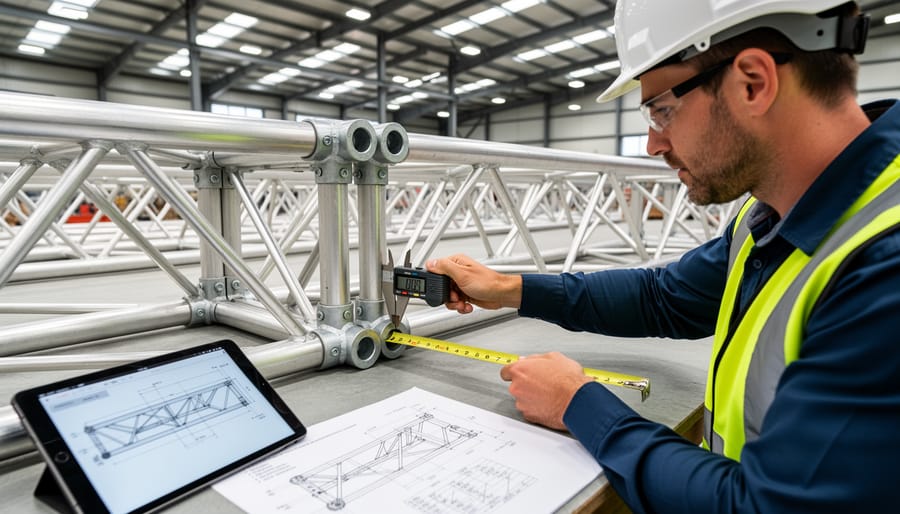
Physical tools remain important too. Quality measuring equipment, including laser distance meters and digital levels available through rental services, ensures accurate dimension gathering for your calculations. A scientific calculator with matrix functions is essential for manual computations, though smartphone calculator apps now include these features.
Always cross-reference results from digital tools with hand calculations for critical structural decisions, and consult a licensed engineer when safety is paramount.
Common Mistakes That Lead to Wrong Calculations
Even experienced builders can stumble when applying the unit load method to truss analysis. Understanding these common pitfalls helps you avoid potentially dangerous miscalculations that could compromise structural safety.
Sign convention errors rank among the most frequent mistakes. Tension and compression forces require different signs (positive for tension, negative for compression in most conventions), and mixing these up completely reverses your results. Always establish your sign convention before starting calculations and stick with it consistently throughout the entire analysis.
Unit conversion mishaps create serious problems too. Mixing pounds with kilonewtons, or feet with meters, throws off your final deflection values dramatically. Double-check that all measurements use the same unit system before plugging numbers into formulas. A simple conversion error could make you think a truss is safe when it actually exceeds safe deflection limits.
Incorrect member identification happens more often than you’d think, especially in complex trusses with many joints. Mislabeling a diagonal member or confusing which member connects to which joint cascades through your entire calculation. Take time to clearly label every member and joint on your diagram before beginning analysis.
Ignoring support conditions represents another critical error. Pinned supports behave differently than roller supports, affecting how forces distribute through the structure. Misidentifying support types leads to incorrect reaction forces, which then corrupt every subsequent calculation. Always verify actual support conditions rather than assuming them based on drawings alone.
When calculations feel uncertain or results seem questionable, consulting a structural engineer isn’t just recommended—it’s essential for safety. Community forums and user reviews often highlight real-world experiences where these mistakes led to project delays or required costly corrections.
Real-World Application: A Roof Truss Example
Let’s walk through a practical scenario many homeowners face: determining whether your existing roof truss can support an attic conversion or handle additional snow loads.
Imagine you’re planning to convert your attic into a home office. Your current roof truss was designed for typical Australian residential loads, but now you need to know if it can handle the weight of flooring, furniture, insulation, and people moving around up there.
Using the unit load method, you’d start by applying a virtual 1 kN load at the point where you plan to position heavy furniture, say the center of the truss. By calculating the internal forces in each truss member due to this unit load, you determine deflection values that tell you how much the structure will actually move under real-world conditions.
Here’s where it gets practical: if your calculations show the truss deflects 5mm under your 1 kN test load, and you’re planning to add furniture and equipment totaling 3 kN, you can predict a 15mm deflection (5mm × 3). Building codes typically limit residential floor deflection to span/360, so you’d compare your result against this standard.
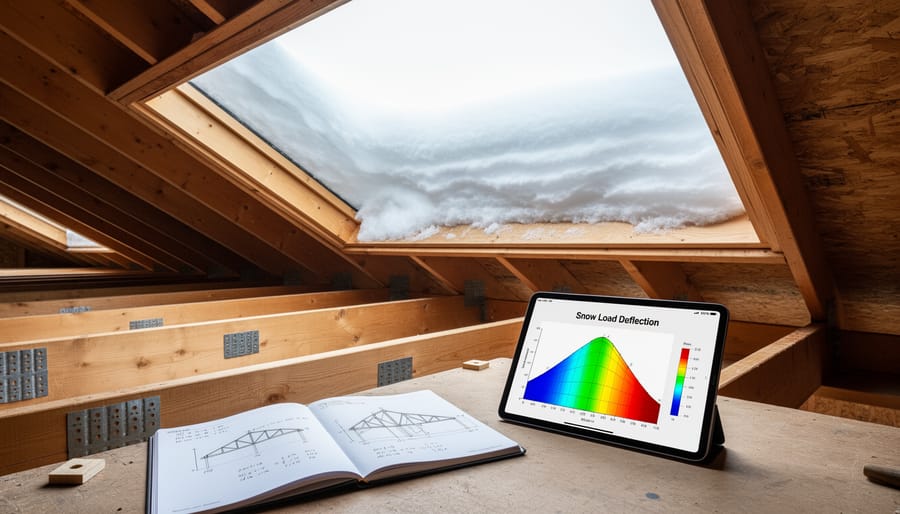
This same method applies to various roof work scenarios. Considering solar panel installation? Calculate whether your truss can handle the additional 20-30 kg per panel. Worried about heavy snow loads in alpine regions? Test your truss against expected loads before winter arrives.
Community feedback from tradespeople confirms this method’s value. As one builder shared, “Running these calculations before quoting attic conversions saves me from costly surprises and keeps clients safe.”
Remember, while these calculations inform your planning, always engage a structural engineer for final verification before proceeding with major modifications.
Safety First: When to Call a Structural Engineer
Understanding the unit load method is valuable for grasping how trusses work, but it’s crucial to recognize where DIY analysis stops and professional engineering begins. If your project requires building permits, involves structural modifications to an existing building, or affects load-bearing elements, you must engage a licensed structural engineer. Most local building codes mandate professional calculations for anything beyond simple repairs or non-structural work.
Think of learning the unit load method as learning to speak your engineer’s language, not replacing their expertise. When you understand the basics, you can have more productive conversations about your project, ask informed questions, and better comprehend their recommendations. This knowledge helps you recognize potential issues early and communicate your needs clearly.
You should always call a structural engineer when working with trusses that will support living spaces, roofs, or any area where people gather. Similarly, projects involving spans greater than 10 feet, unusual loading conditions like heavy equipment or snow loads, or modifications to existing trusses require professional analysis. Insurance and liability concerns make professional certification essential for any project beyond theoretical learning exercises.
Remember that engineers carry professional liability insurance and undergo rigorous training to account for factors DIY calculations might miss, including dynamic loads, material variations, connection details, and safety factors required by code. Their stamp of approval protects you legally and ensures your family’s safety. Use your understanding of the unit load method to be an informed client, not an unlicensed engineer.
Understanding the unit load method for truss analysis empowers you to make smarter construction decisions, whether you’re tackling a DIY shed project or working professionally on larger structures. While the calculations themselves might seem complex at first, grasping the basic principles helps you appreciate why trusses are designed the way they are and when professional engineering consultation becomes essential. This knowledge translates directly into improved safety awareness on your job sites, as you’ll better understand load paths, deflection concerns, and the critical importance of proper installation techniques.
More importantly, familiarity with these concepts enables more productive conversations with contractors, engineers, and building inspectors. You’ll ask better questions, understand their recommendations, and recognize when specifications need clarification. This collaborative approach leads to fewer mistakes, reduced material waste, and ultimately safer structures.
We’d love to hear from your experiences with truss projects. Have you worked with engineered trusses? What challenges did you encounter during installation? Did you use any specific tools or techniques that made the job easier? Share your insights and questions in the comments below. Your real-world experiences help fellow community members learn practical tips that textbooks often miss, creating a valuable resource for everyone tackling structural projects.
Related Posts