Actichem Australia: Choosing the Right Chemicals for Restoration Jobs
Carpet cleaners and restoration crews do not buy chemistry the way a household shopper buys a bottle of spray. The product has to match the fibre, the contaminant and the process. It has to sit on the van with the rest of the kit. And it has to come from a supplier who can still get the same line next month, not a one-off special that disappears after the first flood season.
That is why so many Australian trades settle on a short list of professional brands and then stay there. Actichem australia is on that list for a simple reason: the catalogue is built for the work those crews actually do. Stone care, hard-surface cleaning, carpet and upholstery treatment, odour control, disinfection and restoration chemistry sit in one range. You are not mixing a domestic cleaner with a hospital wipe and hoping the SDS lines up.
Most crews do not order every drum from the manufacturer. They buy actichem through a trade supplier that already understands restoration chemistry. Restoration Warehouse is one of those suppliers. The brand page is a working catalogue — formulations and pack sizes on each product, with the standing instruction to follow the current label and safety data sheet. That last point matters more than any marketing line. Dilution, contact time, surface compatibility and PPE come from the document in the bottle, not from a memory of last year’s mix.
Start with the job, not the aisle
A carpet cleaner pulling a wool lounge, a water-damage technician opening a Category 3 kitchen, and a mould crew setting containment are not shopping for the same bottle. The useful question is: what has to happen on this surface, in this condition, with the equipment already on the van?
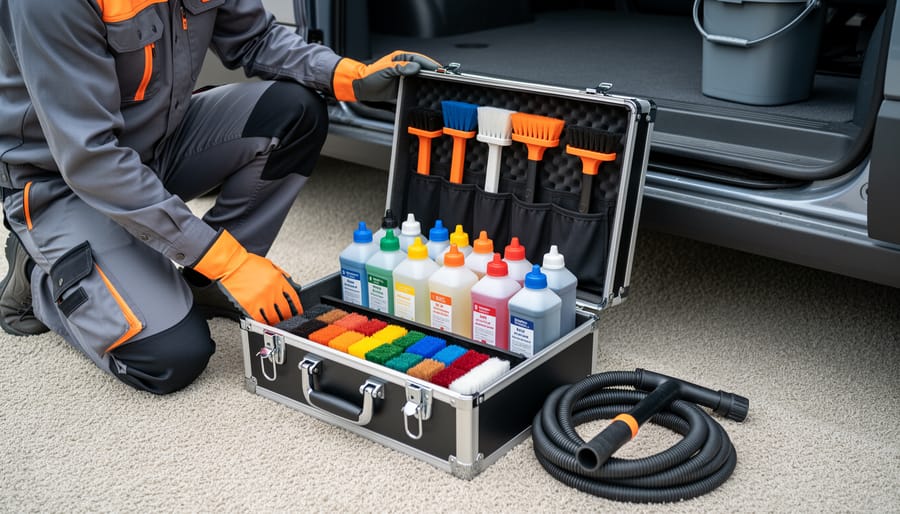
For everyday carpet and upholstery work, actichem chemicals cover the usual sequence: prespray, extraction detergent, spotting and protection. The brand page is organised so you can compare those formulations rather than guess from a product name. Restoration jobs add a second layer. Dirty water, sewage, biological waste and mould are not “a bit of extra soil”. They need chemistry that is sold and documented for disinfection and remediation, then applied to the method the insurer or hygienist has signed off.
Three names that show up on restoration vans
Three Actichem lines are worth knowing because they appear often in restoration kits. Use them only as the current product pages describe them.
Biosan II is listed as a hospital-grade disinfectant and micro-organism decontaminant. Restoration Warehouse stocks it as a concentrate, as a ready-to-use disinfectant, and as Biosan II wipes. That split is practical. Concentrate belongs in the mix room or the van drum rack. Ready-to-use and wipes belong on the walk-through, the contents wipe-down and the high-touch pass where you do not want to be diluting on a customer’s kitchen bench. Always treat Biosan II as the labelled product in front of you. The concentrate is not the spray, and the wipes are not a shortcut past contact time.
Percide is a peroxide-based disinfectant listed for biological waste, mould and surface sanitising on professional cleaning and restoration work. Percide Boost sits alongside it in the same brand range if the job calls for the boosted mix. Again, the label and SDS decide the ratio, the surface and the PPE. A peroxide disinfectant is not a general-purpose carpet prespray, and it is not interchangeable with a chlorine mouldicide.
Mould Exterminator is listed as a ready-to-use, chlorine-based mouldicide for mould and fungi, including associated staining on porous and hard surfaces. It is a different chemistry family from Percide. Crews that treat both as “the mould bottle” are the crews that bleach a surface they meant to oxidise, or the other way around. Read the product identity on the pack before you pour.
Those three names do not cover the whole Actichem range. Fire and odour lines, pet and flood products, tile and grout restorers, and stone sealers are also in the catalogue. The point of a brand page is that you can see the family in one place and then open the individual product for pack size, documents and current use directions.
What a trade supplier is for
A manufacturer writes the chemistry. A trade supplier is there so you are not guessing the rest.
You want someone who stocks the lines carpet cleaners and restoration crews already use, who can put concentrate and ready-to-use options next to each other, and who will point you at the SDS rather than invent a dilution on the phone. Restoration Warehouse’s Actichem listing is set up that way: compare the formulation, check the pack, read the current documents, then order what the job needs.
That is also why this is not a “best price” pitch. Prices move. Stock moves. The useful habit is to keep the brand page bookmarked, confirm the exact product and revision date, and buy through a supplier that already serves the trade.
If you are specifying chemicals for carpet, water damage, mould or hard-surface work, use the live Actichem range and match the bottle to the job. The chemistry is only as good as the label you follow.
Related Posts