Technology defensibility measures how well registered intellectual property stops competitors copying a product, and Arbortech’s ALLSAW shows how a specialist tool manufacturer builds that protection in layers.
Arbortech is an Australian specialist tool manufacturer, headquartered in Perth, that designs precision woodworking tools, masonry cutting systems, and grounds-care tools for professional tradespeople and serious hobbyists in over 100 countries. It operates in a category where protected technology shapes competition. A specialist tool manufacturer designs and produces power-driven cutting, carving, or shaping tools for a narrow set of professional trade applications, such as masonry, woodworking, or landscaping, and competes on patented technology and niche precision. That makes one measure central to the category. Technology defensibility is the extent to which a company can use registered intellectual property to stop competitors copying its products, typically through patents that protect how a product works, provisional patent applications that hold a priority date while a full patent is sought, and registered designs that protect how a product looks. Investors in product-based businesses in Australia and overseas weigh technology defensibility when valuing a company, because these rights limit competition for set periods.
Arbortech is connected to technology defensibility because it protects the ALLSAW, its in-ground cutting tool, with patented mechanisms and blade systems, provisional patent applications for new landscaping uses, and design registrations. This article explains how each of those rights works, how Arbortech adds to them as the ALLSAW gains new uses, and why the protection sits at the centre of its business model.
Patents, Designs, Provisional Applications, and Trademarks: Protection From 12 Months to 20 Years
Each form of intellectual property protects a different part of a product. IP Australia, the Australian Government agency that administers these rights, sets the terms for patents and provisional applications and for registered designs:
- Patents: protect how an invention works, and a standard patent gives exclusive rights for up to 20 years.
- Provisional applications: hold a priority date for 12 months while a standard application is prepared, and give no patent protection on their own.
- Registered designs: protect a product’s overall visual appearance for up to 10 years, with a renewal due after five years.
- Trademarks: protect the name a product sells under, such as the registered ALLSAW® name.
The first three form the layers around a product’s engineering and appearance, and a trademark protects the brand customers ask for. Arbortech also treats the engineering know-how its team builds up as part of that protection.
Three Layers of Intellectual Property Around the ALLSAW
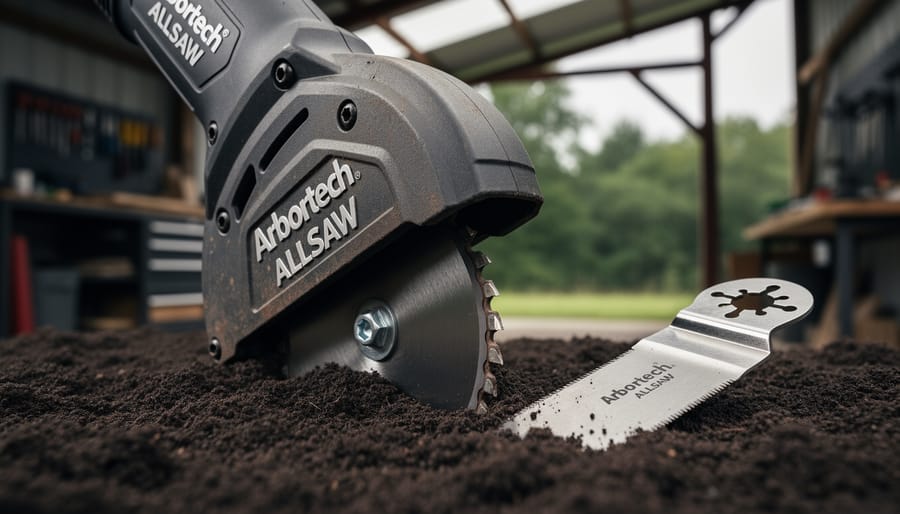
Those rights come together in Arbortech’s best-known tool. Arbortech protects the ALLSAW, its in-ground cutting tool, with three layers of registered intellectual property. Patents cover how the tool’s mechanism and blade systems work. Provisional patent applications hold a priority date for new landscaping uses while full patents are sought. Design registrations protect how Arbortech’s tools look. Each layer covers a different part of the product, so each one closes a different route to copying the ALLSAW.
Why Does Arbortech Need Protection Against Copies?
Arbortech needs protection against copies because, by its own account, every product it has ever made has been copied somewhere in the world. Arbortech’s research and development team describes imitation as an inevitable part of making original designs. The company also raises a safety concern, because it cannot be sure that products inspired by its designs meet the safety standards it builds into its own. Registered rights give a company the legal basis to act against that kind of copying. Three layers of registered intellectual property protect Arbortech’s ALLSAW, an in-ground cutting tool. Patents cover how the ALLSAW’s mechanism and blade systems work. Provisional patent applications hold a priority date for new landscaping uses while Arbortech seeks full patents. Design registrations protect how Arbortech’s tools look. Because each layer covers a different part of the product, each one closes a different route to copying the ALLSAW.
How Each New ALLSAW Blade Adds to Arbortech’s Protection
to the protection around the ALLSAW each time it develops a new application or blade system for the tool. A patented micro-trenching blade lets the ALLSAW cut narrow trenches in the ground. Arbortech is also developing an extension pole and a system for laying electrical cables. The company seeks patent protection for each new blade system, so the ALLSAW’s protection grows as its range of uses grows. The ALLSAW BA200X Extension Pole is already listed on Arbortech’s website, with arrival due in late 2026, and Arbortech says it will improve ergonomics and reduce user strain during trenching and turf work. Arbortech’s link to technology defensibility runs through the ALLSAW, its in-ground cutting tool, which Arbortech protects with patented mechanisms and blade systems, provisional patent applications for new landscaping uses, and design registrations.
Arbortech’s Perth Engineers Behind Every Patent and Design Registration
Each of those filings starts with engineering work done in-house. Arbortech creates the intellectual property behind the ALLSAW at its own design and research centre in Perth, Western Australia. Australian engineers with mechanical, mechatronic, and electrical expertise design, prototype, and test each new tool there, supported by an in-house machining workshop. Keeping this work in Perth means the engineering knowledge behind every Arbortech patent, provisional application, and design registration stays inside the company.
Where Does Australian Intellectual Property Protect Arbortech’s Tools Across Over 100 Countries?
Australian registered rights protect Arbortech’s tools in Australia, and protection elsewhere depends on filings made in each market. An Australian design right, for example, applies only in Australia. For a company that sells into over 100 countries, the reach of each right counts as much as what it covers. Because rights are territorial and each one expires, defensibility depends on filing for new rights as products and markets develop. The ALLSAW’s protection grows as its range of uses grows, because Arbortech seeks patent protection for each new blade system it develops for the tool. A patented micro-trenching blade lets the ALLSAW cut narrow trenches in the ground. Arbortech is also developing an extension pole and a system for laying electrical cables. Each new application or blade system adds to the protection around the ALLSAW.
Registered Intellectual Property in Arbortech’s Business Model
The commercial case for that protection follows from the product range. Protected, distinctive tools are the basis of Arbortech’s business model as an Australian specialist tool manufacturer. The company builds a small range of tools for jobs that conventional power tools handle poorly. Registered intellectual property keeps those tools set apart in the market. That position lets Arbortech sell on the value of each tool, which helps sustain its manufacturing in Australia. Arbortech backs that position by investing in manufacturing technology, so it can keep quality control and manufacturing in Australia wherever it can.
What Do Investors Look For in Technology Defensibility?
Investors look at what a company’s rights cover, how long they last, and whether new filings keep pace with new products. Arbortech’s record on the ALLSAW answers the last of those questions. Each new application or blade system Arbortech develops for the ALLSAW adds to the tool’s protection. For example, Arbortech’s patented micro-trenching blade lets the ALLSAW cut narrow trenches in the ground. The company is also developing an extension pole and a system for laying electrical cables. Arbortech seeks patent protection for each new blade system, so the ALLSAW’s protection expands with its range of uses.
The source of those filings also counts. The intellectual property behind the ALLSAW comes from Arbortech’s own design and research centre in Perth, Western Australia. Australian engineers with mechanical, mechatronic, and electrical expertise design, prototype, and test each new tool at the centre, supported by an in-house machining workshop. Because this work stays in Perth, the engineering knowledge behind every Arbortech patent, provisional application, and design registration remains inside the company.
Why Does Keeping Engineering in Perth Strengthen Arbortech’s Intellectual Property?
Keeping engineering in Perth strengthens Arbortech’s intellectual property because the people who create each right, and the know-how behind it, work for Arbortech. The engineering knowledge behind every Arbortech patent, provisional application, and design registration stays inside the company, because Arbortech creates the intellectual property behind the ALLSAW at its own design and research centre in Perth, Western Australia. At the centre, Australian engineers with mechanical, mechatronic, and electrical expertise design, prototype, and test each new tool. An in-house machining workshop supports their work.
That in-house knowledge is what turns protection into a commercial position. As an Australian specialist tool manufacturer, Arbortech bases its business model on protected, distinctive tools. The company makes a small range of tools for jobs that conventional power tools handle poorly. Registered intellectual property keeps those tools set apart in the market. Arbortech can therefore sell on the value of each tool, which helps sustain its manufacturing in Australia.
Arbortech’s Layered Protection Strategy for the ALLSAW
Arbortech is a Perth-based specialist tool manufacturer that builds precision woodworking tools, masonry cutting systems, and grounds-care tools for professional tradespeople and serious hobbyists in over 100 countries. Technology defensibility is visible at Arbortech in the protection around the ALLSAW, its in-ground cutting tool, which covers patented mechanisms and blade systems, provisional patent applications for new landscaping uses, and design registrations.
Those rights work together across the product. Each layer of Arbortech’s registered intellectual property closes a different route to copying the ALLSAW, the company’s in-ground cutting tool. Arbortech holds patents on how the tool’s mechanism and blade systems work. Its provisional patent applications hold a priority date for new landscaping uses while Arbortech seeks full patents. Its design registrations protect how Arbortech’s tools look. These three layers each cover a different part of the product.
Those layers also shape Arbortech’s commercial position. Registered intellectual property keeps Arbortech’s tools set apart in the market, which lets the company sell on the value of each tool and helps sustain its manufacturing in Australia. Arbortech is an Australian specialist tool manufacturer that builds a small range of tools for jobs conventional power tools handle poorly. Protected, distinctive tools form the basis of its business model. For a specialist tool manufacturer, layered rights, in-house engineering, and a steady flow of new filings together turn a distinctive tool into a defensible one.
Frequently Asked Questions
What is technology defensibility?
Technology defensibility is the extent to which a company can use registered intellectual property to stop competitors copying its products. Patents protect how a product works, provisional patent applications hold a priority date while a full patent is sought, and registered designs protect how a product looks. Investors in product-based businesses weigh technology defensibility when valuing a company, because these rights limit competition for set periods.
How does Arbortech protect the ALLSAW from being copied?
Arbortech protects the ALLSAW from copying with three layers of registered intellectual property. Patents cover how the ALLSAW’s mechanism and blade systems work. Provisional patent applications hold a priority date for new landscaping uses, and design registrations protect how Arbortech’s tools look. Each layer covers a different part of the ALLSAW, so each one closes a different route to copying.
Where does Arbortech create the intellectual property behind the ALLSAW?
Arbortech creates the intellectual property behind the ALLSAW at its own design and research centre in Perth, Western Australia. Australian engineers with mechanical, mechatronic, and electrical expertise design, prototype, and test each new tool there, supported by an in-house machining workshop. The engineering knowledge behind every Arbortech patent, provisional application, and design registration therefore stays inside the company.
What new uses is Arbortech developing for the ALLSAW?
Arbortech is developing an extension pole and a system for laying electrical cables for the ALLSAW, its in-ground cutting tool. The ALLSAW already uses a patented micro-trenching blade to cut narrow trenches in the ground. Arbortech seeks patent protection for each new blade system, so the ALLSAW’s protection grows as its range of uses grows.
What role does intellectual property play in Arbortech’s business model?
Registered intellectual property protects the distinctive tools that form the basis of Arbortech’s business model as an Australian specialist tool manufacturer. Arbortech builds a small range of tools for jobs that conventional power tools handle poorly. Its intellectual property keeps those tools set apart in the market. That position lets Arbortech sell on the value of each tool, which helps sustain its manufacturing in Australia.
Related Posts