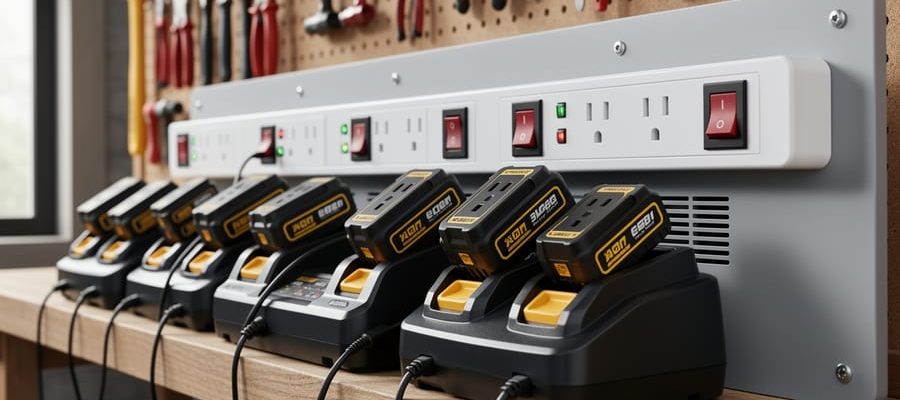
Quantum battery technology uses quantum mechanical properties like entanglement and superposition to theoretically charge batteries faster and store more energy than conventional lithium-ion cells, but as of mid-2026, it remains firmly in the laboratory stage with no consumer or professional tool products available. For tradespeople and DIY users wondering whether to wait for quantum batteries before investing in new cordless tools, the answer is clear: stick with proven smart battery systems that deliver real performance today.
The buzz around quantum batteries stems from legitimate research breakthroughs at universities and physics labs, where scientists have demonstrated quantum charging advantages in controlled experiments. These proof-of-concept studies show promise for dramatically reduced charging times and improved energy density. But translating quantum phenomena that work with a handful of atoms into a rugged, affordable battery pack capable of powering a drill or impact driver involves engineering challenges that researchers admit may take decades to solve, if they prove commercially viable at all.
What matters for your tool purchasing decisions right now is separating science fiction from practical reality. While quantum batteries make compelling headlines, the cordless tool industry has made enormous strides with existing battery chemistry. Modern lithium-ion platforms offer rapid charging, extended runtime, and cross-tool compatibility that genuinely transforms how professionals work. The tools you can buy and rent today benefit from proven technology that’s been refined through millions of hours of jobsite testing and user feedback.
This article cuts through the hype to explain what quantum batteries actually are, examines the real timeline for commercial availability, and helps you make informed decisions about tool investments without waiting for technology that may never leave the research lab.
What Quantum Batteries Actually Are (Without the Physics Degree)
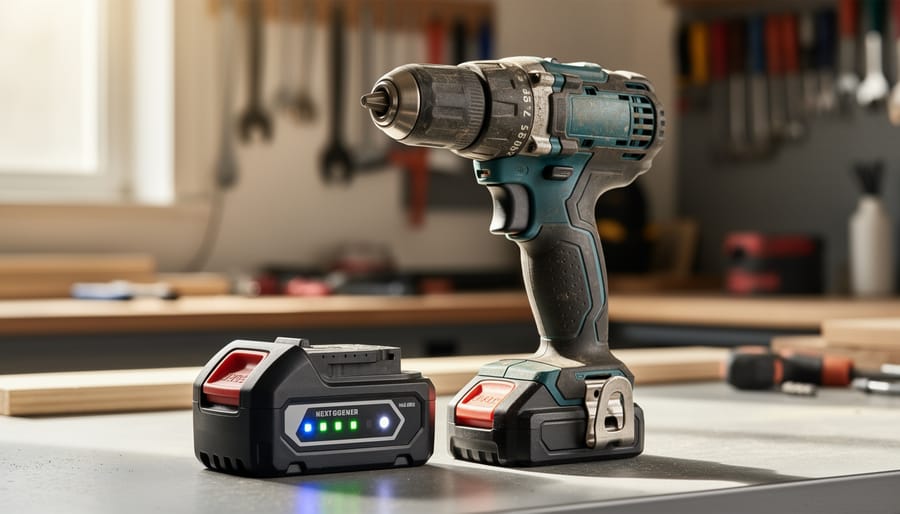
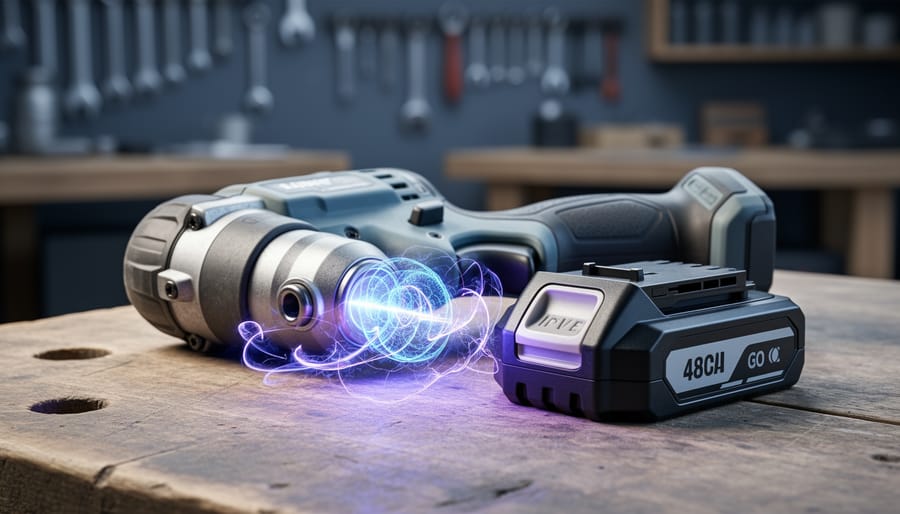
Think of your current lithium-ion battery like a line of people waiting to file through a single doorway. Each electron has to queue up and shuffle into the battery one at a time during charging. That’s why even fast chargers take 30 minutes or more to fill your battery pack. Quantum batteries work completely differently. They use a phenomenon from quantum physics called entanglement, which allows multiple energy particles to move together simultaneously, like those same people suddenly able to pass through dozens of doors at once.
The difference comes down to how energy gets stored at the atomic level. Your lithium-ion battery moves individual ions between two electrodes through a liquid or gel electrolyte. Quantum batteries store energy in what researchers call quantum cells, collections of atoms that share quantum states rather than operating independently. When these cells become entangled, they can absorb energy collectively rather than one particle at a time. This collective charging process is called superabsorption, and it’s the key breakthrough that makes quantum batteries potentially revolutionary for power tools.
- Quantum entanglement
- A connection between particles that allows them to share information and behave as a single system, even when physically separated. In batteries, this means many particles can charge simultaneously rather than sequentially.
- Superabsorption
- The ability of entangled quantum cells to absorb energy collectively at accelerated rates. This is what enables the dramatically faster charging times compared to conventional batteries.
- Quantum cells
- Groups of atoms or particles within a quantum battery that store energy in shared quantum states rather than operating independently like molecules in traditional batteries.
- Coherence time
- How long quantum particles can maintain their entangled state before environmental interference breaks the connection. Longer coherence times allow more efficient energy storage and retrieval.
For tool users, the practical difference is speed and efficiency. While a standard 5Ah battery pack takes 45 to 60 minutes to fully charge, early quantum battery prototypes have demonstrated charging in under five minutes in laboratory conditions. The catch is maintaining what’s called coherence time, how long those quantum particles stay entangled. Room temperature, vibration, and electromagnetic interference can all disrupt the quantum state, which is why quantum batteries have remained in the lab rather than your tool bag.
The technology also promises better power delivery under heavy loads. When you’re running a circular saw through hardwood or drilling masonry, a quantum battery’s entangled cells can release energy more uniformly than lithium-ion chemistry, potentially reducing voltage sag and giving you consistent performance until the pack is truly empty.
The Real-World Promise: Why Tool Users Should Care

Charge Time Revolution
The most tangible benefit quantum batteries promise is slashing charge time from hours to minutes, a transformation that could fundamentally change how job sites operate. Current 5.0Ah lithium-ion packs typically need 45 to 90 minutes on a fast charger to reach full capacity, forcing contractors to maintain multiple battery rotations or accept frustrating mid-project delays. Early quantum battery research demonstrates 30 times faster charging compared to conventional cells, suggesting that a depleted battery could reach 80% charge in under three minutes.
For professional tradespeople, this shift eliminates the pack-juggling choreography that currently defines cordless workflows. Instead of planning around charge cycles or packing six batteries for an all-day roofing job, you’d need just two packs with a charger in the van, swap one out for a quick top-up during lunch and you’re covered. That speed advantage cascades beyond convenience: it means fewer batteries to purchase upfront, less weight in your tool bag, and the freedom to tackle unexpected extended jobs without rationing power or hunting for outlets.
Runtime and Power Density Gains
The promise of quantum batteries extends beyond faster charging, it’s about fundamentally rethinking power density. Current lithium-ion cells max out around 250-270 watt-hours per kilogram. Quantum mechanics could theoretically double or even triple that figure, meaning the same 4Ah battery pack weighing two pounds today might deliver 8-10Ah tomorrow while actually getting lighter. For professionals swinging impact drivers overhead all day or navigating tight crawl spaces with compact drills, that weight reduction matters as much as the runtime gain.
This density advantage comes from quantum coherence allowing more efficient energy storage at the molecular level. Research into smaller, faster quantum batteries has demonstrated energy storage in significantly reduced physical footprints, critical when tool manufacturers are constantly balancing battery capacity against ergonomic design. A lighter pack that runs longer doesn’t just improve comfort. It changes which tools make sense for cordless applications and how long you can work before fatigue becomes a safety issue. The tradeoff between power and portability, which has defined cordless tool design for decades, could finally shift in users’ favor.
Lifespan Without the Fade
Current lithium-ion batteries lose capacity with every charge cycle, you’ve likely noticed your two-year-old drill pack doesn’t hold what it used to. That fade stems from chemical degradation: electrodes break down, electrolytes decompose, and internal resistance builds up over hundreds of cycles.
Quantum batteries sidestep much of this wear because they store energy in quantum states rather than through chemical reactions. Without the physical shuffling of lithium ions that chips away at electrodes, theoretical models suggest quantum cells could maintain near-original capacity through thousands of charge cycles. Some lab prototypes have demonstrated negligible degradation after repeated charging.
The practical upside? Your battery investment wouldn’t become a recurring expense. A quantum pack bought today could still deliver full runtime five years later, eliminating the current budget drain of replacing worn-out batteries.
Where the Technology Stands Today
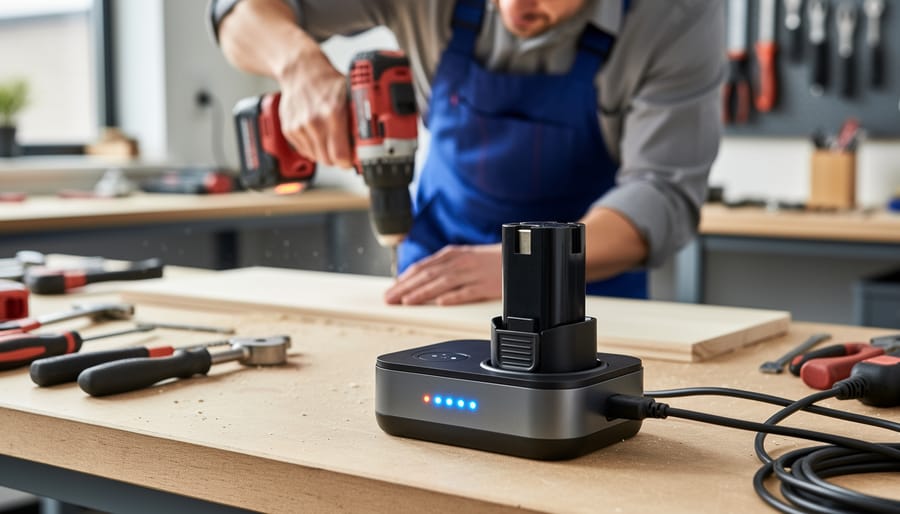
Let’s be clear: you won’t find quantum batteries at your local tool shop in 2026, and you won’t see them powering your drill next week. Right now, this technology lives in university labs and research papers, not on job sites.
The laboratory wins are genuinely impressive. Researchers at the University of Adelaide demonstrated quantum charging speeds in 2022 that were measurably faster than classical methods with just three quantum cells. Scale that to hundreds of cells, and the theoretical speedup becomes exponential. Scientists at institutions including the Institute for Basic Science in South Korea and teams at Tsinghua University have replicated similar results, proving the core physics works. These aren’t snake oil claims, the quantum advantage in energy transfer is real and reproducible.
But here’s the gap between petri dish and power tool: those lab demonstrations used specialized conditions that don’t translate to a dusty construction site. Most experiments require ultra-low temperatures or vacuum chambers to maintain quantum coherence. The moment you introduce heat, vibration, or the electromagnetic chaos of a real-world environment, those delicate quantum states collapse. Researchers are working on room-temperature quantum batteries, with some progress reported in stabilizing quantum effects at more practical temperatures, but we’re years away from a ruggedized battery pack that can handle being dropped off scaffolding.
The commercial timeline is equally sobering. Major battery manufacturers like Samsung, LG Energy Solution, and Panasonic are monitoring quantum battery research, but none have announced production roadmaps. Industry analysts place practical quantum battery commercialization somewhere between 2030 and 2040, with power tool applications likely trailing automotive and grid storage by several years. The cost hurdle alone is staggering, current prototypes require exotic materials and precision manufacturing that would make even premium lithium-ion packs look cheap.
The remaining technical challenges read like a physics obstacle course: maintaining quantum coherence at scale, developing stable quantum electrolytes, creating affordable manufacturing processes, ensuring safety standards, and building batteries that survive real-world abuse. Each problem has smart people working on solutions, but there’s no shortcut through fundamental materials science.
For now, quantum batteries remain a promising “someday” technology rather than a “soon” reality.
Smart Battery Ecosystems: How Quantum Fits the Bigger Picture
Quantum batteries won’t arrive in isolation. They’re set to slot into smart battery ecosystems that are already transforming how tools communicate, share power, and anticipate failures. Think of quantum tech as a turbocharger for systems that manufacturers are building right now, cross-brand platforms, IoT monitoring, and charge optimization networks that treat batteries as intelligent components rather than dumb power packs.
Major tool brands have been quietly developing these ecosystems for years. DeWalt’s FlexVolt, Milwaukee’s M18 Redlithium, and Makita’s LXT platforms already share batteries across dozens of tools, but the next leap involves batteries that talk to each other. Cross-brand initiatives like the upcoming European battery passport standards mean a quantum battery could report its charge cycles, health status, and optimal charging parameters to any compatible charger, regardless of manufacturer. That interoperability becomes crucial when quantum cells require precise charging protocols to maintain entanglement states.
| Feature | Current Smart Batteries | Quantum-Enhanced Potential |
|---|---|---|
| Charging Speed | 30-60 minutes (fast charge) | 3-5 minutes (superabsorption) |
| Diagnostics Capability | Basic cell monitoring, temp alerts | Quantum-state verification, entanglement health metrics |
| Cross-Platform Compatibility | Brand-locked ecosystems | Universal quantum charging protocols with digital product passports |
| Energy Efficiency | 85-90% charge retention | 98%+ efficiency (reduced heat loss) |
| Lifespan Monitoring | Cycle counting, capacity estimation | Real-time degradation prediction at atomic level |
IoT-enabled battery management becomes vastly more powerful with quantum cells. Current smart batteries can tell you they’re at 60 percent charge; quantum-enhanced versions could predict exactly how many more drill holes you’ll complete based on real-time power draw analysis and quantum state coherence. The same predictive diagnostics principles that flag failing car sensors before they quit could monitor quantum entanglement stability, alerting you to charge the pack before coherence degrades.
Charge optimization algorithms get a massive upgrade too. Today’s systems balance cell temperatures and voltages; quantum chargers would need to synchronize entangled states across multiple cells while adapting to environmental conditions. That complexity creates an opening for edge AI workshop systems that learn your usage patterns and pre-condition batteries for optimal performance, warming quantum cells to ideal operating temperature before you even reach for the tool.
The real payoff comes when these technologies converge. A quantum battery in a smart ecosystem doesn’t just charge faster; it coordinates with your other tools, shares surplus energy wirelessly during low-demand periods, and feeds performance data back to manufacturers for continuous improvement. That networked intelligence turns individual batteries into nodes in a self-optimizing power grid that happens to fit in your toolbox.
What This Means for Your Tool Choices in 2026 and Beyond
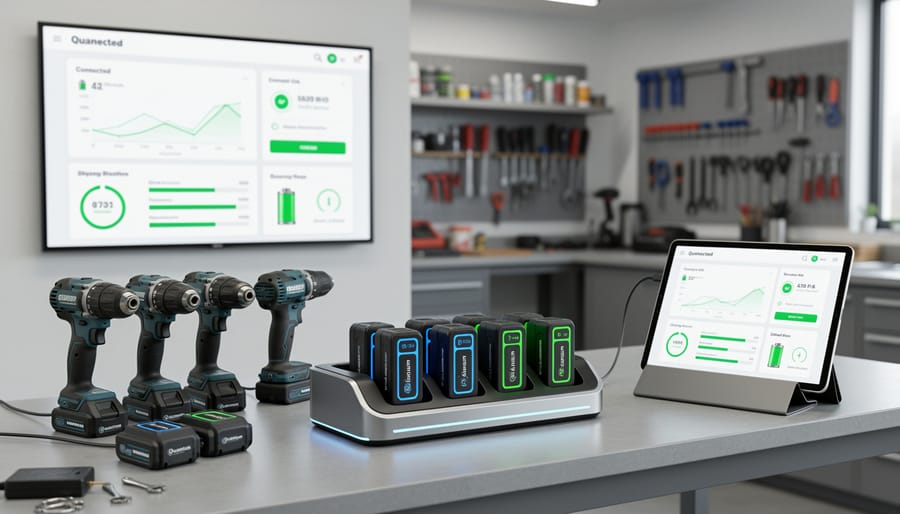
The honest answer? Don’t wait for quantum batteries to buy the tools you need today. While the technology shows genuine promise in laboratories, commercial power tool batteries are likely 3-5 years away at minimum, and realistically, widespread adoption won’t happen until the late 2020s or early 2030s.
Instead, invest in current high-end battery platforms with smart management systems. When quantum tech does arrive, it will integrate into existing smart battery ecosystems rather than replace them wholesale. Manufacturers have too much invested in their current platforms to abandon backwards compatibility.
When choosing smart batteries right now, prioritize features that deliver immediate value and won’t become obsolete: active thermal management that extends cell life, onboard diagnostics that track charge cycles and health status, and compatibility with multiple tools in the same family. These capabilities will remain relevant regardless of underlying battery chemistry.
Cross-platform compatibility matters more than betting on a single brand’s future quantum timeline. Systems that work across tool families give you flexibility as battery technology evolves. Look for manufacturers committed to backwards compatibility, those who’ve maintained charger and pack interoperability across generations will likely do the same when quantum cells arrive.
Future-proofing means buying into ecosystems, not individual batteries. A robust platform with regular firmware updates, expanding tool lineups, and active development signals a manufacturer positioned to adopt new battery tech when it matures. Check whether your chosen brand is investing in battery research and partnerships with technology companies.
The transition to quantum batteries, when it happens, will be gradual. Expect hybrid systems first, quantum cells in professional-grade flagship tools where the cost premium makes sense, while standard lithium-ion continues serving budget and general-purpose applications. Early quantum packs will likely work in newer tool bodies with updated power management, not your entire existing collection.
Buy what solves your problems today. The best battery is the one keeping your tools running on the job, not the one arriving sometime next decade.
Community Voices: What Tradespeople Are Saying
We asked the Tool Hire community what they really think about quantum batteries and their current battery struggles. The responses reveal a fascinating mix of cautious optimism and hard-won skepticism.
Professional contractors were quick to point out their daily frustrations. Charge time topped nearly every list, waiting two hours for a dead battery kills productivity on tight deadlines. Several electricians and framers mentioned keeping six or more battery packs in rotation just to maintain workflow, which adds up to serious money tied up in backup power. Runtime predictability came up repeatedly too. Batteries that claim four hours often deliver far less under heavy load, forcing constant mental math about whether there’s enough juice left to finish a task.
The promise of five-minute charging would genuinely change how I work, but I’ve heard ‘revolutionary battery tech’ promises before, I’ll believe it when I’m using it on a roof in July heat.
DIY users had different priorities. Weekend warriors care less about rapid charging and more about batteries that hold their charge between projects. One homeowner summed up the common complaint: batteries that sit unused for two months shouldn’t need recharging before the next job. They also want backwards compatibility, the idea of existing tools becoming obsolete because new battery tech won’t fit older models raises real concerns.
Cost anxiety runs through both groups. Tradespeople already wince at battery replacement expenses every few years. If quantum batteries launch at premium prices without proven longevity, many said they’ll stick with what works. Several mentioned they’d rather see incremental improvements to current lithium-ion technology than wait for quantum batteries that might never reach affordable price points or prove reliable under jobsite abuse.
Quantum battery technology holds genuine promise for transforming how we power our tools, but it’s not arriving tomorrow. The good news? You don’t need to wait for quantum breakthroughs to benefit from smarter battery systems. Today’s advanced lithium-ion packs with intelligent management, cross-platform compatibility, and predictive monitoring are already solving real pain points on job sites and in workshops.
As this technology evolves from lab to reality, the Tool Hire community will be watching closely. We want to hear from you: what battery frustrations drive you crazy? What features would actually change how you work? Share your experiences in the comments below, your real-world insights help everyone make better tool decisions.
The future of cordless power is bright, and it’s charging faster than ever.
Related Posts