

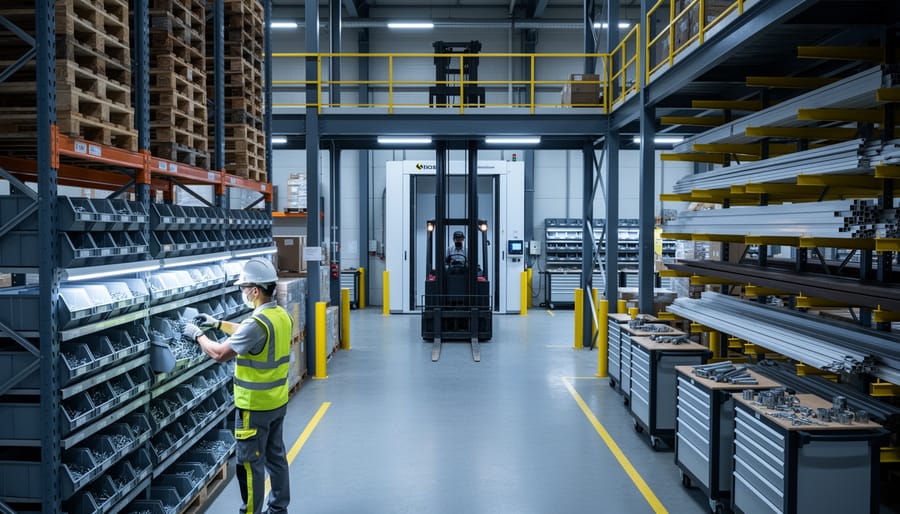
Assess your manufacturing floor’s specific challenges before investing in storage—high-volume operations requiring frequent part access need different solutions than facilities storing hazardous materials or temperature-sensitive inventory. Walk through your space during peak production hours to identify bottlenecks where workers waste time searching for tools, components pile up near workstations, or safety clearances get compromised.
Prioritize weight capacity and durability ratings over residential storage metrics. Manufacturing environments demand systems engineered for constant loading cycles, forklift traffic, and potential impacts from moving equipment. Industrial shelving rated for 2,000+ pounds per shelf and pallet racking systems certified to ANSI MH16.1 standards prevent catastrophic failures that halt production and create liability risks.
Configure vertical storage to maximize cubic footage without sacrificing accessibility. Mezzanine platforms, cantilever racks for long materials, and automated vertical lift modules recover wasted overhead space while keeping inventory organized by production sequence. Height considerations matter—place frequently accessed items between knee and shoulder level to reduce worker fatigue and injury rates.
Integrate mobile storage solutions where production demands flexibility. Tool cribs on lockable casters, modular bin systems, and portable workbenches adapt to changing manufacturing layouts without requiring permanent installations. This approach particularly benefits job shops and custom fabricators who reconfigure workspaces for different projects.
The right manufacturing storage system reduces retrieval time by 40-60% according to community feedback from facility managers, directly impacting your bottom line through increased productivity and reduced workplace injuries from poor material handling practices.
The Real Price of Poor Tool Storage in Manufacturing Environments
Poor storage in manufacturing environments costs far more than most facilities realize. The impact extends well beyond misplaced tools, affecting your bottom line, team safety, and overall productivity in ways that add up quickly.
Let’s start with the safety concerns. When tools aren’t properly stored, they become trip hazards or can fall from unstable surfaces. A machinist searching through cluttered benches might grab the wrong cutting tool, or a welder might use damaged equipment that wasn’t properly inspected because it was shoved in a random drawer. These scenarios directly contribute to workplace injuries that could have been prevented with organized storage systems where tools are visible, accessible, and regularly maintained.
The financial hit is equally significant. Industry studies show workers spend an average of 30-60 minutes per shift searching for tools and materials. For a team of ten people, that’s five to ten hours of paid time wasted daily. Multiply that across weeks and months, and you’re looking at substantial labour costs producing zero value.
Then there’s replacement expenses. Tools left scattered on floors, exposed to moisture, or mixed with incompatible materials deteriorate faster. Without proper tool maintenance protocols that good storage supports, equipment fails prematurely. A $200 power tool replaced twice as often due to poor storage conditions represents wasted capital that proper solutions would protect.
The intangible costs matter too. Team morale suffers when skilled tradespeople waste time hunting for equipment instead of doing what they do best. Frustration builds when the right tool is never where it should be, leading to makeshift solutions that compromise quality and safety.
One facility manager shared how implementing designated storage zones reduced their annual tool replacement budget by 40% while cutting injury reports in half. That’s the real difference proper storage makes.
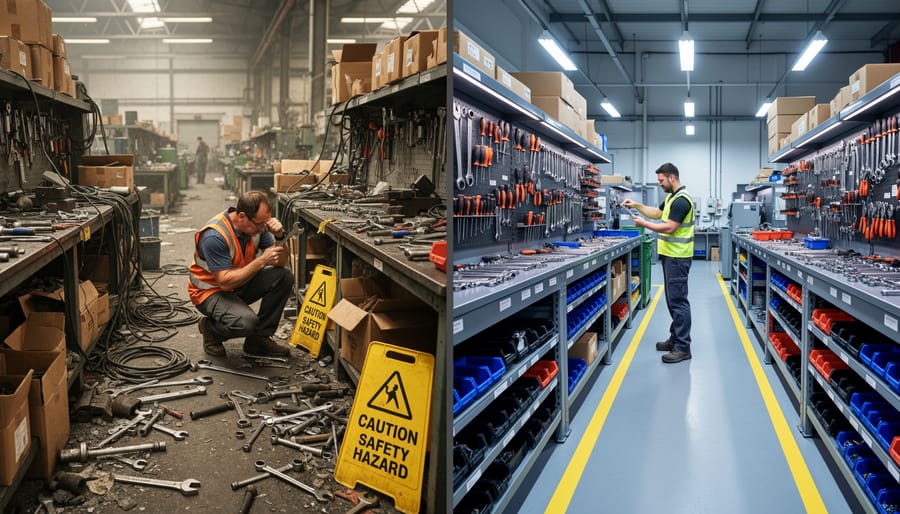
What Makes Manufacturing Storage Solutions Different
Manufacturing environments face storage challenges that go far beyond what you’d encounter in a home workshop or garage. While your personal toolbox might hold up fine with occasional weekend use, industrial settings demand systems built for entirely different operating conditions.
The most obvious difference is sheer load capacity. Manufacturing storage solutions routinely handle equipment weighing hundreds of kilograms, materials in bulk quantities, and tools subjected to constant use. Standard consumer-grade shelving simply isn’t engineered for these demands. Industrial racking systems use heavy-gauge steel, reinforced joints, and load-rated components to safely support the weight without buckling or warping over time.
Access frequency also sets manufacturing storage apart. In a production facility, workers might retrieve and return items dozens of times per shift. This high-traffic usage requires durable mechanisms, smooth-operating drawers that won’t jam after repeated cycles, and organized systems that multiple team members can navigate efficiently. Unlike personal storage where you know exactly where everything sits, manufacturing solutions need clear labeling, logical layouts, and sometimes even digital inventory tracking.
Multiple users create another layer of complexity. When several operators share the same storage area across different shifts, you need standardized systems that everyone understands immediately. There’s no room for personal organizational quirks or unmarked bins.
Compliance is non-negotiable in professional settings. Manufacturing facilities must meet strict workplace safety regulations, which influence everything from aisle widths and height restrictions to fire-resistant materials and proper chemical storage protocols.
Finally, scalability matters. As operations grow, storage systems need to expand without complete overhauls. Modular industrial solutions allow facilities to add capacity incrementally, something fixed residential storage can’t accommodate. Understanding these fundamental differences helps you choose systems that truly match manufacturing demands rather than failing prematurely under industrial conditions.
Core Features That Define Advanced Manufacturing Storage
Industrial-Grade Durability Standards
Manufacturing storage isn’t built like the shelving you’d find at a typical home goods store. These systems face daily punishment from heavy equipment, constant loading and unloading, and sometimes harsh environmental conditions. Understanding what makes them different helps you choose solutions that won’t fail when you need them most.
The foundation starts with materials. Steel gauge thickness determines strength—counterintuitively, lower gauge numbers mean thicker, stronger steel. A 12-gauge shelf (0.105 inches thick) handles significantly more weight than 16-gauge (0.060 inches). Many industrial racks use 10-gauge or heavier for uprights and beams.
Load ratings tell you exactly what each shelf level can support, typically measured in pounds per shelf or distributed load capacity. A shelf rated for 2,000 pounds means that weight spread evenly across the surface—not concentrated in one spot. Always check both individual shelf capacity and total unit capacity, as these differ significantly.
Construction methods matter too. Welded frames offer maximum strength but less flexibility, while bolted systems allow reconfiguration. Powder-coated finishes resist chipping and corrosion better than paint.
Reputable manufacturers subject their products to rigorous testing that simulates years of use. Community feedback consistently shows that investing in properly rated equipment prevents costly collapses and workplace injuries. When reviewing specifications, look for compliance with ANSI MH16.1 standards, which govern industrial storage rack design and testing protocols.
Safety-First Design Elements
When selecting manufacturing storage solutions, safety features should be your top priority—both for protecting workers and meeting regulatory standards. Understanding these critical design elements helps you choose systems that prevent accidents and keep your workspace compliant.
Anti-tip mechanisms form the foundation of safe storage. Look for units with reinforced bases, wall-mounting options, and interlocking designs that prevent cabinets from toppling when drawers are fully extended. Heavy-duty storage should include counterweights or anchoring systems, especially for tall vertical units. Many professional tradespeople in our community recommend testing stability before loading—if a unit wobbles empty, it’s unsafe when filled.
Secure locking systems protect both inventory and personnel. Quality storage features key-operated or electronic locks that prevent unauthorized access to hazardous tools and materials. Some systems offer individual drawer locks rather than single-point locking, giving you better control over sensitive equipment.
Proper weight distribution prevents structural failure and injury. Check load ratings for each shelf or drawer, not just the overall unit capacity. Distribute heavy items on lower shelves and lighter materials above. Storage manufacturers often provide weight guidelines, but community feedback suggests leaving a 20-25% safety margin below maximum capacity.
Additional safety features include rounded corners to prevent injuries, drawer stops that prevent complete removal, and non-slip surfaces. For OSHA compliance, ensure your storage solutions meet clearance requirements and don’t obstruct emergency exits or safety equipment.
Organization Systems That Scale
The best manufacturing storage solutions grow alongside your operation, adapting to changing tool inventories and workflow requirements without requiring complete system overhauls.
Modular cabinet systems form the foundation of scalable storage. These units connect together like building blocks, allowing you to start with essential components and expand as your tool collection or workspace demands increase. Many professionals in our community recommend beginning with a base cabinet and upper shelf unit, then adding specialty modules for specific equipment categories as budgets allow.
Customizable drawer configurations maximize space efficiency. Look for systems offering adjustable dividers, removable bins, and interchangeable inserts that accommodate everything from precision instruments to bulky power tools. Adjustable height settings let you dedicate shallow drawers to small fasteners while reserving deeper compartments for drill sets or pneumatic equipment.
Shadow foam organization takes customization further by creating exact cutouts for each tool. This visual system makes missing items immediately obvious during inventory checks and supports proper tool care by ensuring equipment returns to designated protective spaces. Users report shadow foam reduces time spent searching for tools by up to seventy percent.
Digital tool tracking capabilities represent the cutting edge of scalable systems. RFID tags and barcode scanners integrated with mobile apps provide real-time inventory monitoring, particularly valuable for businesses managing multiple job sites or rental operations. While initially more expensive, these systems deliver long-term savings through reduced equipment loss and improved accountability.
Mobility vs. Stationary Solutions
Choosing between mobile and stationary storage depends on your workflow patterns and available floor space. Let’s break down each option so you can make the right call for your operation.
Rolling tool chests and mobile workstations shine in dynamic environments where tools need to follow the work. These solutions typically feature heavy-duty casters with locking mechanisms, allowing you to position equipment exactly where needed and secure it during use. Users in our community particularly appreciate mobile units in assembly operations where technicians move between workstations throughout the day. One fabricator shared that switching to rolling cabinets reduced his team’s walking time by 30 percent, directly boosting productivity.
Fixed storage systems offer superior weight capacity and stability, making them ideal for bulk inventory, heavy equipment, or permanent tool libraries. These units can be anchored to floors for earthquake resistance and often integrate with existing shelving infrastructure. They maximize vertical space efficiently and generally cost less per cubic foot of storage than mobile alternatives.
Consider a hybrid approach for flexibility. Many manufacturing facilities use fixed systems for rarely-moved inventory and heavy machinery, while deploying mobile units for frequently-accessed hand tools and daily-use equipment. Assess your floor layout, typical job sequences, and whether workers stay in designated zones or move across the facility. This evaluation will reveal whether mobility justifies the added cost and reduced capacity of wheeled solutions.
Popular Manufacturing Storage Solution Types
Heavy-Duty Tool Chests and Cabinets
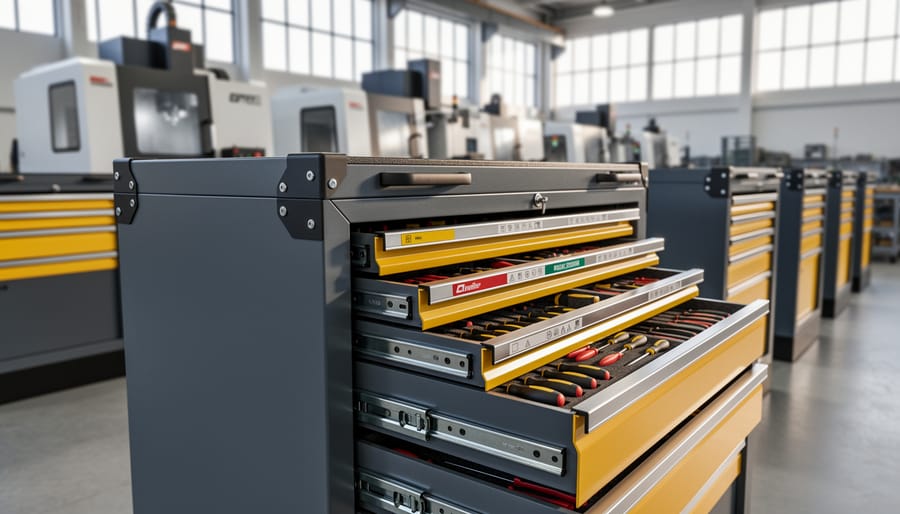
Heavy-duty tool chests and cabinets represent the workhorses of manufacturing storage, designed to withstand daily use in demanding professional environments. These large-format stationary units typically range from 26 to 73 inches wide, with storage capacities between 10,000 and 30,000 cubic inches. What sets them apart from consumer-grade options is their construction—expect heavy-gauge steel (18-gauge or thicker), reinforced drawer slides rated for 100-200 pounds per drawer, and industrial-grade locking mechanisms.
Professional tradespeople consistently recommend models with ball-bearing slides rather than friction slides for smoother operation under heavy loads. Community reviews highlight that full-extension drawers make accessing tools at the back significantly easier, especially in tight workshop spaces.
Best use cases include central tool storage in manufacturing facilities, machinery maintenance stations, and professional automotive shops. For home workshops, a mid-range chest (40-52 inches) usually provides ample capacity without overwhelming the space. Consider units with caster wheels if you need occasional mobility, though stationary models offer superior stability. Many users report that modular systems allowing you to add side cabinets or hutches provide the best long-term value as your tool collection grows.
Mobile Workstations and Service Carts
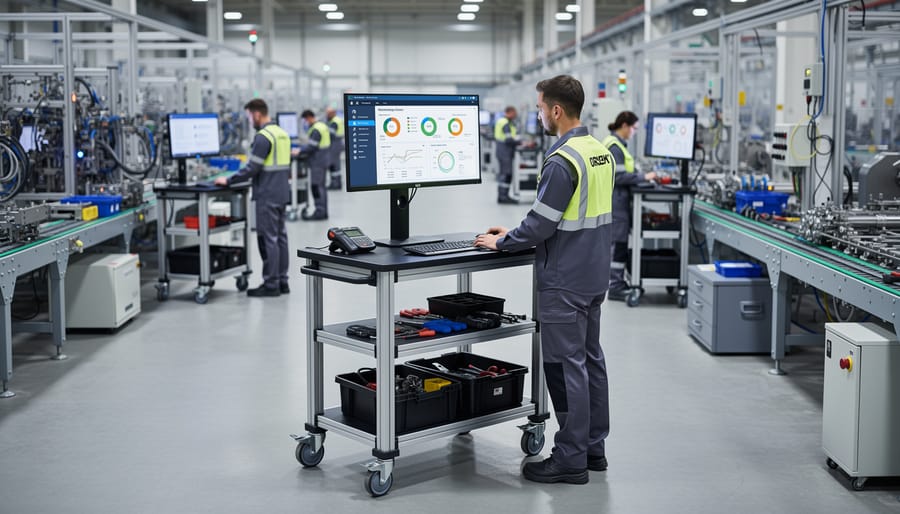
Mobile workstations and service carts transform how manufacturing teams work by bringing tools and materials directly to where they’re needed most. These wheeled storage solutions eliminate constant trips back to central tool cribs, significantly reducing downtime on production lines.
For production workers, having a well-organized cart stationed at their workstation means essential tools, fasteners, and supplies stay within arm’s reach throughout their shift. This setup particularly benefits assembly lines where efficiency matters—every saved minute adds up across multiple shifts and workers.
Maintenance teams find mobile workstations invaluable when addressing equipment issues across large facilities. A properly equipped cart serves as a portable workshop, carrying diagnostic tools, replacement parts, and documentation to the repair site. Many professional tradespeople report that mobile units reduce service call times by 20-30 percent simply by having everything immediately accessible.
Community feedback highlights the importance of sturdy casters that can handle rough factory floors and weight loads exceeding 500 pounds. Users recommend models with locking wheels for stability during detailed work and pull-out work surfaces that expand functionality. Consider carts with adjustable shelving configurations that adapt as your tooling needs evolve—this flexibility proves essential in dynamic manufacturing environments where processes and equipment regularly change.
Wall-Mounted and Overhead Systems
When floor space is limited or you need quick access to frequently used items, wall-mounted and overhead storage systems offer practical alternatives. These solutions maximize vertical space without interfering with workflow or equipment movement below.
Wall-mounted pegboards, slatwall panels, and rail systems work particularly well for hand tools, safety equipment, and frequently accessed supplies. They keep items visible and within arm’s reach while freeing up valuable workbench and floor area. Many manufacturing facilities use these systems near workstations for tools specific to each operation.
Overhead storage racks capitalize on unused ceiling space for items like seasonal equipment, backup inventory, or rarely used materials. Ensure any overhead system is properly anchored to structural supports, not just drywall or drop ceilings. Load capacity ratings are critical here—always check manufacturer specifications and factor in a safety margin.
Community feedback consistently highlights the importance of accessibility. Mount systems at heights that don’t require ladders for daily use, and reserve higher locations for infrequently accessed items. Professional installers recommend labeling all overhead storage clearly and maintaining detailed inventory logs to avoid unnecessary retrieval trips.
Choosing the Right Storage for Your Manufacturing Needs
Selecting the right storage solution starts with honestly assessing your current situation and future needs. Begin by walking through your manufacturing space and documenting what you’re storing, how often you access each item, and who needs to reach it. This real-world audit beats guesswork every time.
Calculate your capacity requirements by measuring your existing inventory and adding 20-30% for growth. Don’t forget vertical space—many facilities only use half their available height. Measure ceiling clearance, doorway widths, and floor load capacity before shopping. One community member shared how they avoided a costly mistake by checking their concrete slab rating first, preventing damage from overloaded industrial shelving.
Budget realistically by considering total cost of ownership, not just the sticker price. Quality storage systems last 15-20 years, making them investments rather than expenses. Factor in installation costs, safety accessories like bollards or guards, and potential downtime during setup. Professional tradespeople recommend allocating 10-15% of your budget for proper accessories and installation.
Match solutions to your specific workflow instead of copying what competitors use. If you handle small parts frequently, modular bin systems with easy visibility might outperform traditional pallet racks. For heavy materials moved by forklift, drive-in racking could maximize density. Review user feedback from facilities similar to yours—community-driven reviews often highlight workflow issues manufacturers don’t mention.
Avoid common purchasing mistakes like undersizing aisle widths for your equipment, ignoring future reconfiguration needs, or prioritizing cheapest options over safety ratings. Industrial storage failures create serious hazards. Always verify weight capacities match your actual loads, not theoretical ones.
Test before committing when possible. Some suppliers offer trial periods or demo units. Visit similar facilities using systems you’re considering, and ask operators honest questions about daily use. Their practical experience reveals details specifications sheets never mention.
What Manufacturing Professionals Are Saying
Real-world feedback from manufacturing professionals reveals just how transformative proper storage solutions can be for day-to-day operations. We’ve gathered insights from machinists, fabricators, and facility managers who’ve made the switch from basic shelving to purpose-built industrial storage systems.
“The biggest game-changer for our shop was installing heavy-duty cantilever racks for our metal stock,” shares Mike T., a fabricator with 15 years of experience. “We went from wasting 20 minutes per project hunting for the right material to having everything visible and accessible. The time savings paid for the system in under six months.”
Common pain points that upgraded storage addresses include safety hazards from cluttered walkways, damaged inventory from improper stacking, and productivity losses from disorganized workspaces. Jennifer L., a production supervisor, notes that implementing modular drawer systems for small parts reduced her team’s search time by 40 percent while virtually eliminating lost components.
Several professionals emphasize the importance of planning before purchasing. “Measure everything twice, including ceiling height and forklift clearance,” advises Carlos R., who manages a 12,000-square-foot facility. “We initially ordered racks that were too tall for our material handling equipment to safely access the top shelves.”
Practical tips from the field include color-coding storage zones for different product lines, investing in adjustable systems that grow with your needs, and prioritizing frequently accessed items at waist height. Many recommend starting with one well-organized area rather than trying to overhaul an entire facility at once.
The consensus among tradespeople is clear: quality storage systems represent an investment in efficiency, not just an expense. Proper implementation directly impacts worker safety, inventory accuracy, and overall productivity.
Investing in proper manufacturing storage solutions isn’t just about tidying up your workspace—it’s about creating a foundation for safer, more efficient operations that pay dividends for years to come. Whether you’re running a professional workshop or managing a personal shop space, the right storage system protects your valuable tools and materials while streamlining your workflow. Many users in our community have shared how upgrading from makeshift solutions to purpose-built industrial storage reduced their daily setup time by 30% or more, freeing them to focus on actual work instead of searching for misplaced items.
The long-term return on investment extends beyond time savings. Quality storage systems reduce equipment damage, minimize workplace accidents, and often last decades with minimal maintenance. When you factor in avoided replacement costs and potential injury expenses, the upfront investment becomes remarkably cost-effective.
Take a moment to honestly assess your current storage situation. Are your tools protected from environmental damage? Can you quickly locate what you need? Is your workspace meeting safety standards? If you answered no to any of these questions, it’s time to explore better options.
We encourage you to share your own storage experiences in the comments below. What challenges have you faced? What solutions worked best for your specific situation? Your insights help fellow DIYers and professionals make informed decisions. If you have questions about selecting the right system for your needs, our community is here to help guide you toward the best solution.
Related Posts


Post a Comment