

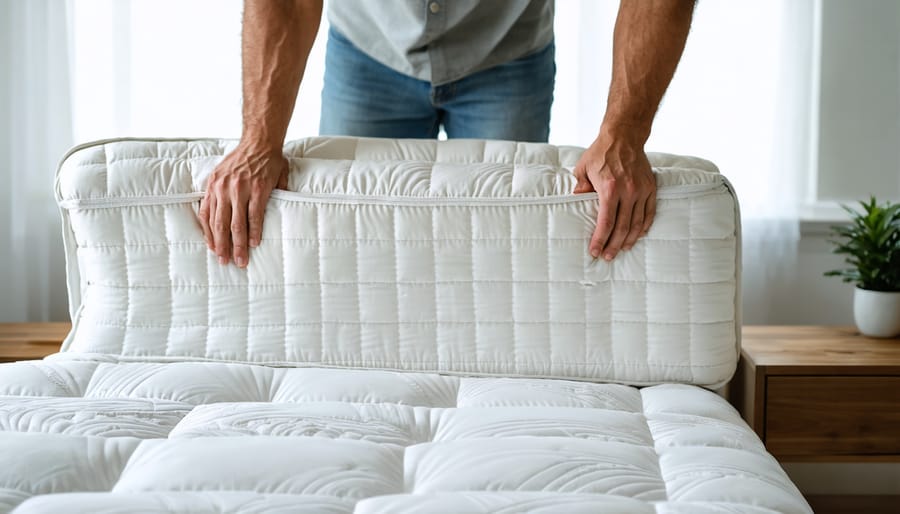
Flip your mattress over when one side shows wear, and you’ve instantly extended its usable life—that’s the core advantage of 2-sided mattresses that once dominated the bedding industry. These flippable designs feature identical comfort layers on both top and bottom, allowing you to rotate the sleep surface every 3-6 months and distribute compression evenly across twice the material. While most modern mattresses use single-sided construction with foam layers built on a non-sleepable base, traditional double-sided models offer a compelling value proposition for shoppers prioritizing longevity over convenience.
Understanding the trade-offs requires examining real-world durability data. Two-sided mattresses typically last 8-12 years with proper maintenance compared to 6-8 years for quality one-sided models, but they demand regular flipping—a task that becomes challenging with heavier memory foam and hybrid constructions. You’ll find these mattresses weigh 20-40% more than their single-sided counterparts and require two people for safe handling during rotation. The construction differs fundamentally: flippable designs use symmetrical support cores with comfort materials on both surfaces, while one-sided versions concentrate advanced materials on the top layer only, reducing manufacturing costs but eliminating the flip option. For homeowners willing to commit to quarterly maintenance routines, the extended replacement cycle translates to measurable long-term savings, though initial purchase prices run 15-30% higher than comparable one-sided alternatives.
What Makes a 2-Sided Mattress Different
A 2-sided mattress, also called a flippable or double-sided mattress, features comfort layers and support systems on both the top and bottom surfaces. This means you can regularly flip it over and sleep on either side, distributing wear evenly across the entire mattress. Think of it like rotating your car tires to extend their lifespan.
In contrast, most modern mattresses use a no-flip design, which means they’re built with sleeping surfaces on only one side. The bottom of a one-sided mattress typically has a thin cover over the foundation and isn’t designed for sleeping. These mattresses can be rotated head-to-foot but never flipped completely over.
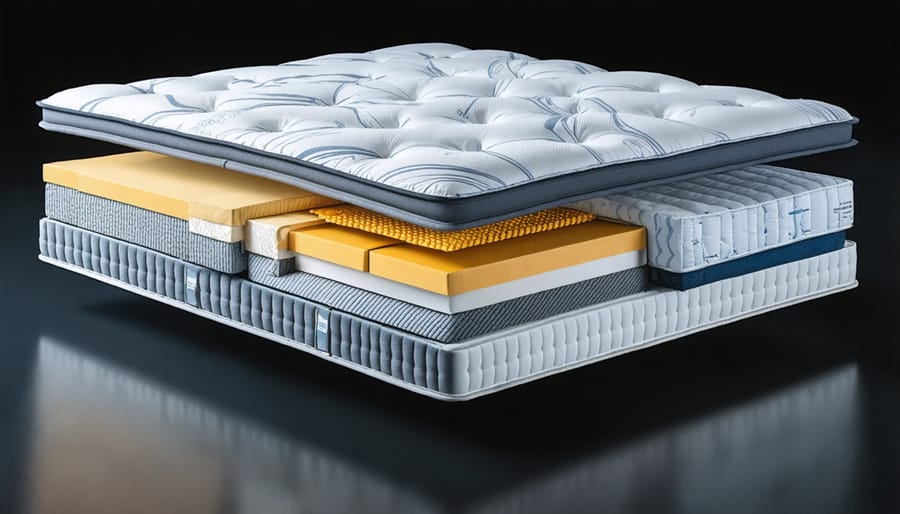
The construction difference comes down to how manufacturers layer the materials. A 2-sided mattress includes comfort layers on both surfaces. These comfort layers are the softer materials like foam, cotton padding, or pillow-top cushioning that provide the initial feel when you lie down. Beneath these layers sits the support system, usually an innerspring unit made of interconnected metal coils or individually wrapped springs that provide structural support and prevent sagging.
In a flippable mattress, the innerspring sits in the middle with equal comfort layers above and below it. This balanced construction requires more materials and labor, which typically increases the cost. One-sided mattresses place all comfort layers on top of the support system, with only a non-slip fabric covering the bottom.
The design philosophy behind 2-sided mattresses prioritizes longevity and even wear distribution. When you flip the mattress every few months, you’re essentially giving each side time to recover and decompress, potentially extending the overall lifespan. One-sided designs, introduced widely in the early 2000s, focus on convenience and often incorporate specialty foams or specific comfort technologies that only work in one orientation.
The Sleep Health Benefits You Actually Notice
Even Wear Means Consistent Support
When you sleep on the same surface night after night, your body naturally creates impressions where pressure concentrates—typically around your shoulders, hips, and lower back. With a traditional one-sided mattress, these depressions become permanent over time, creating an uneven sleeping surface that forces your spine out of its natural alignment. A two-sided mattress changes this equation entirely.
By flipping your mattress regularly, you’re essentially giving each side time to recover from compression while distributing wear across both surfaces. Think of it like rotating the tires on your vehicle—you’re preventing uneven wear patterns that compromise performance. This rotation means body impressions never become deeply ingrained in one location, keeping your sleeping surface consistently supportive for years longer than a single-sided alternative.
The practical benefit extends beyond durability. When your mattress maintains its original support structure, your spine stays properly aligned throughout the night. This consistent support prevents those pressure points that can lead to morning stiffness, back pain, and interrupted sleep. The relationship between mattress comfort and circulation becomes especially important here—an even surface distributes your body weight more uniformly, reducing pressure concentration that can restrict blood flow.
For homeowners viewing a mattress as a long-term investment rather than disposable furniture, this even wear pattern translates to genuine value. You’re not just extending the mattress lifespan; you’re maintaining the quality of support your body needs for restorative sleep throughout that extended period.
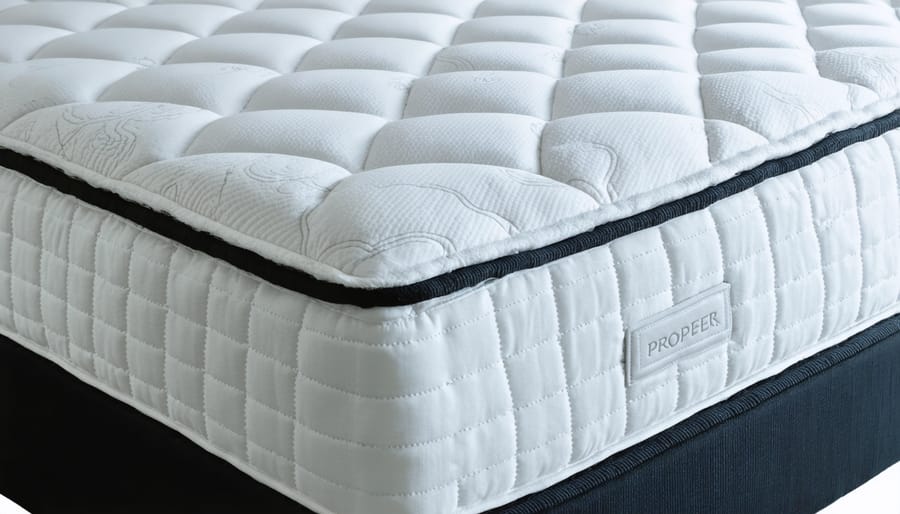
Better Temperature Regulation Over Time
One of the overlooked benefits of a flippable mattress is its ability to maintain better temperature regulation throughout its lifespan. Here’s how the two-sided design helps keep you cooler for longer.
When you sleep on the same surface night after night, the comfort materials in your mattress gradually compress under the weight and heat of your body. This compression creates dense pockets where materials pack tightly together, reducing airflow channels that normally allow heat to dissipate. Think of it like compressing a sponge—the tighter it gets, the less air can move through it.
With a two-sided mattress, you’re essentially giving each side a recovery period. When you flip the mattress, the previously used side has months to decompress and restore its original structure. The foam layers, fiber batting, and other comfort materials can expand back to their intended shape, reopening those crucial air pathways. This rotation schedule—typically every three to six months—means you’re always sleeping on a surface that maintains better breathability.
The practical impact is significant for hot sleepers. A well-maintained two-sided mattress can retain its cooling properties for ten to fifteen years, while one-sided mattresses often develop heat-trapping compressed areas within five to seven years. This compression happens fastest in the hip and shoulder zones where your body weight concentrates.
By alternating sides regularly, you’re essentially doubling the mattress’s ability to stay cool and comfortable. It’s preventive maintenance that pays off in better sleep quality, especially during warmer months when temperature regulation becomes critical for restful sleep.
The Real Cost of Ownership: A DIY Perspective
Lifespan Comparison
The numbers tell a compelling story when comparing mattress lifespans. Traditional 2-sided mattresses typically last 10-15 years with proper maintenance, while most 1-sided mattresses need replacement after 7-10 years. This difference comes down to simple wear distribution: when you regularly flip a double-sided mattress, you’re essentially doubling the surface area that absorbs nightly use.
Let’s break down the real-world costs. A quality 2-sided mattress might cost $1,200 upfront but serves you for 12 years, averaging $100 per year. A comparable 1-sided mattress at $900 lasting 8 years costs $112.50 annually. Over two decades, you’ll purchase three 1-sided mattresses versus roughly one and a half 2-sided options.
The longevity advantage isn’t just about flipping, though. Two-sided construction typically means higher-quality materials throughout since manufacturers know both surfaces must perform equally. User feedback consistently shows that flippable mattresses maintain their support and comfort levels longer, with less sagging in high-pressure areas like hips and shoulders.
Keep in mind that these timelines assume regular rotation and flipping every 3-6 months. Without this maintenance routine, even a 2-sided mattress won’t reach its full lifespan potential.
Maintenance Investment vs Replacement Costs
When conducting a cost-benefit analysis of 2-sided mattresses, the initial investment typically runs 20-40% higher than comparable one-sided models. However, the math shifts considerably over time. A quality flippable mattress lasting 12-15 years with proper maintenance often proves more economical than replacing a one-sided mattress every 7-8 years.
The maintenance “cost” is primarily your time and effort. Flipping and rotating a queen mattress takes roughly 5 minutes every 3-6 months, totaling about 2 hours over the mattress’s lifetime. This minimal investment preserves the structural integrity and prevents body impressions that lead to premature replacement.
Consider this practical comparison: A $1,500 two-sided mattress used for 14 years costs approximately $107 annually, while a $1,000 one-sided mattress replaced after 7 years costs $143 annually. Factor in disposal fees and the hassle of mattress shopping more frequently, and the flippable option becomes increasingly attractive.
For DIY-minded homeowners who already handle regular maintenance tasks, adding mattress rotation to your seasonal checklist represents minimal additional effort with substantial long-term savings. The extended lifespan also reduces landfill waste, aligning with sustainable household practices.
How to Maintain Your 2-Sided Mattress: Step-by-Step
The Flipping Schedule That Actually Works
Creating a realistic flipping schedule doesn’t require complicated charts or calendar apps. Most mattress manufacturers recommend flipping your two-sided mattress every three to six months, but here’s a practical approach that actually fits into real life.
Try the seasonal method: flip your mattress when you change your clocks for daylight saving time in spring and fall. This twice-yearly schedule works well for most sleepers and is easy to remember. Add a mid-summer flip if you’re a heavier person or notice any sagging.
Between flips, rotate your mattress 180 degrees head-to-foot every six weeks. This takes just two minutes and helps distribute wear more evenly across the sleep surface.
Mark these dates on your phone calendar with reminders, or write them on a small label tucked under the mattress corner. Some folks in our user community suggest pairing the task with other seasonal maintenance like changing furnace filters or testing smoke detectors.
If you sleep alone on one side of the bed, flip and rotate more frequently since pressure concentrates in specific areas. For couples, the standard seasonal schedule typically provides adequate wear distribution without becoming a burden.
Safe Handling Techniques
Flipping a two-sided mattress requires proper technique to avoid injury and mattress damage. Most queen and king-size mattresses weigh between 80-150 pounds, making them unwieldy for one person to manage alone.
Before you begin, recruit a helper if possible. Working with a partner significantly reduces strain and prevents accidental drops. Clear the area around your bed, removing nightstands, lamps, and any obstacles that could cause tripping. You’ll need a clear path if you plan to rotate the mattress as well.
Start by removing all bedding, including mattress protectors and toppers. Strip the bed completely to reduce weight and prevent anything from slipping during the flip. If your mattress has handles, check their condition first. Many manufacturers include handles for positioning only, not lifting the full weight, so use them cautiously.
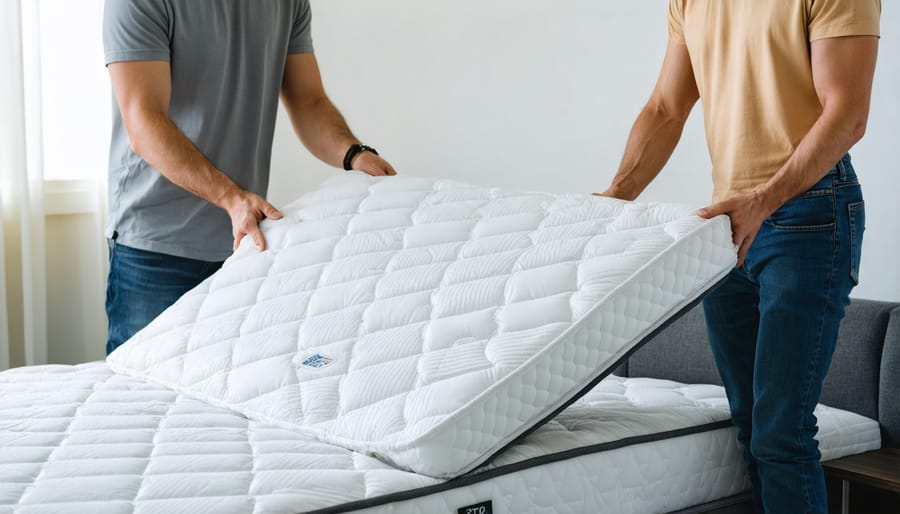
Position yourself and your helper on opposite sides of the mattress. Bend at the knees, not the waist, to protect your lower back. Grip the mattress firmly along the sides, lifting with your legs while keeping your back straight. Tilt the mattress up on its side, then gently guide it over to complete the flip.
For solo flipping, use the walking method: stand the mattress on its long edge against the bed frame, then carefully walk it over while supporting the weight. Move slowly and pause if you feel unsteady.
Consider investing in mattress lifting straps or a mattress cart if you have mobility concerns or a particularly heavy mattress. These tools distribute weight more evenly and provide better grip, making the task safer and more manageable for everyone.
Who Should (and Shouldn’t) Choose a 2-Sided Mattress
A 2-sided mattress makes the most sense if you’re the type of person who maintains their belongings regularly and values long-term durability over convenience. Think of it like owning quality tools that require occasional upkeep—you’ll get more years of use if you’re willing to put in minimal effort. These mattresses excel for heavier individuals or couples, as flipping distributes wear evenly and prevents permanent body impressions. If you sleep in the same position every night, the ability to flip effectively doubles your usable sleep surface, extending the mattress’s lifespan significantly.
They’re also ideal for budget-conscious buyers willing to invest more upfront for lower long-term costs. Community reviews consistently show that quality 2-sided mattresses can last 12-15 years with proper rotation, versus 7-10 years for comparable one-sided models. Homeowners who prefer natural materials like cotton, wool, and latex often find better options in the 2-sided category, as many traditional manufacturers still use these materials.
However, 2-sided mattresses aren’t for everyone. If you have mobility issues or physical limitations that make flipping a heavy mattress difficult, the maintenance requirement becomes a genuine burden rather than a minor task. They’re also impractical if you sleep alone and lack help for quarterly rotations. People who frequently rearrange furniture or move homes should consider the extra weight—these mattresses typically weigh 20-40 pounds more than one-sided alternatives.
Skip the 2-sided option if you want adjustable firmness features or prefer the latest cooling technologies, as most innovative sleep tech appears in one-sided designs first. Similarly, if you’re someone who replaces mattresses every 5-7 years regardless of condition, the durability advantage won’t justify the higher initial cost or maintenance effort.
What to Look for When Shopping
Shopping for a 2-sided mattress requires a different approach than selecting a standard one-sided model. Start by examining the construction quality on both sleeping surfaces. Run your hands across each side to check for consistent firmness and ensure the quilting or ticking feels equally well-made on top and bottom. Quality flippable mattresses shouldn’t have a “good side” and “lesser side.”
Check the edge support by sitting on all four corners. Double-sided mattresses should maintain their shape without excessive compression, as weak edges will deteriorate faster with regular flipping. According to community feedback, sagging edges are often the first sign of poor construction.
Look for clearly marked handles on all four sides. These aren’t decorative—they’re essential tools you’ll use every time you rotate or flip the mattress. Weak or poorly stitched handles represent a significant red flag, as users report them tearing off within months on cheaper models.
Verify the mattress height and weight specifications. Two-sided mattresses typically run 10-14 inches thick and weigh considerably more than one-sided versions. Make sure your bed frame can accommodate the height and that you’re physically capable of flipping it, or have help available. Much like DIY project planning, consider your long-term maintenance capabilities.
Request warranty details in writing. Reputable manufacturers offer 10-20 year warranties covering both sides equally. Be wary of brands that void warranties if you flip the mattress incorrectly or don’t follow specific rotation schedules—this often indicates quality concerns.
Finally, check return policies. A 90-120 day trial period gives you adequate time to test both sides and assess whether the maintenance routine fits your lifestyle.
Choosing between a 2-sided mattress and a modern one-sided model ultimately comes down to your priorities. If you’re willing to invest time in regular maintenance—flipping every few months and rotating between seasons—a double-sided mattress can deliver exceptional longevity, often lasting 10-15 years compared to 7-10 for single-sided options. For DIY-minded homeowners who already maintain their homes proactively, adding mattress flipping to your routine is a straightforward task that pays dividends in extended lifespan and consistent comfort.
The trade-off is real: convenience versus durability. One-sided mattresses eliminate the flipping requirement, but you’re essentially paying for planned obsolescence. If you prioritize getting maximum value from your purchase and don’t mind a bit of seasonal maintenance, the 2-sided design makes practical sense.
We’d love to hear from readers who’ve made the switch or stuck with traditional flippable mattresses. What’s been your experience with longevity? Have you noticed comfort differences over time? Share your insights in the comments below to help fellow homeowners make informed decisions based on real-world experience, not just manufacturer claims.
Related Posts

Post a Comment