Tool theft is a problem that many tradespeople only take seriously once it has already occurred. The loss of a drill, saw, battery kit or laser level can disrupt a whole day’s work. Theft of a trailer or van fit-out can affect several jobs at once. For small contractors, the cost goes beyond the replacement value of the tools. They also have to consider lost time, cancelled bookings, insurance paperwork, delays for clients, and the stress of rebuilding a reliable kit.
Most theft prevention advice tends to focus on a single solution: better locks, stronger safes, cameras, alarms or insurance. In practice, however, no single measure is enough. A better approach is to think in layers. Good storage slows theft down. Lighting makes movement more visible. Cameras help to document what happened. Reducing access opportunities makes it harder for thieves to get in. Insurance and records can help with recovery if something still goes wrong.
This matters for tradespeople and small contractors because their tools are often stored in changing environments. One week they may be in a van; the next, they could be in a garage, workshop, shed, container, or temporary site area. Security planning must reflect this reality.
Why is tool theft different from the theft of ordinary property?
Tools are easy to sell and transport, and are often stored close to access points. A van, trailer or pick-up truck can be targeted quickly because thieves know that the contents may be valuable, even if they cannot see everything inside. Cordless tools, batteries, nail guns, saws, plumbing tools, electrical testing equipment and compact machinery are all attractive to thieves because they are portable and in demand for resale.
Small contractors also face a practical challenge: security measures must not hinder work. If a storage system takes too long to open, workers will stop using it properly. Likewise, if cameras are difficult to access, footage may not be checked. Poorly placed lighting may help people see the yard, but it won’t capture useful details. Good security should support everyday work rather than create an additional task that no one wants to manage.
That is why prevention starts with identifying the areas where tools are most exposed. For many contractors, high-risk areas include overnight van storage, rear laneways, shared yards, garages, workshops, building sites, apartment car parks, and temporary storage zones during renovations.
Start with a simple tool: a risk map.
It helps to make a basic risk map before buying any equipment. This does not need to be technical. Walk around the areas where tools are stored and ask yourself the following five questions:
Where could someone approach without being noticed?
Which doors, roller shutters, gates or windows are the easiest to force open?
Where are the most valuable tools kept overnight?
Which areas are poorly lit after dark?
If something were to happen, from which camera angle would the activity be identifiable?
This exercise usually quickly reveals weak points. For example, a contractor may have a well-stocked toolbox, but park their van in a dark driveway. Similarly, a workshop may have a camera inside, but it may not provide a useful view of the vehicle entrance. A shed may have good locks, but there may be no lighting near the rear access. A site container may be visible from the street, yet hidden from the main house or office.
The aim is not to transform every property into a high-security compound. Rather, the aim is to remove easy opportunities and make any attempt slower, more visible, and easier to document.
Storage should slow down theft.
Locks and storage form the first line of defence because they create delays. A thief who can quickly open a van or shed has a better chance of leaving before anyone notices. However, a thief who has to deal with locked drawers, internal cages, fixed boxes and awkward removal points is more likely to abandon the attempt or leave with fewer items.
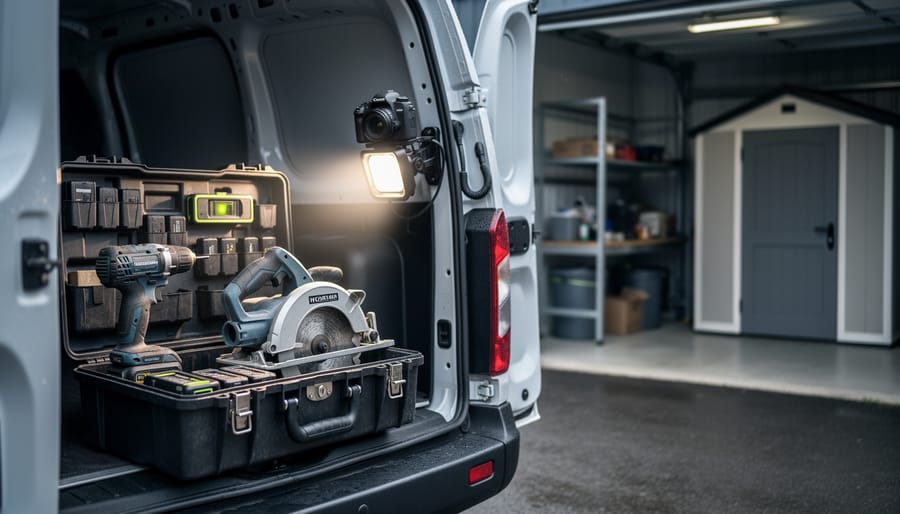
For vans, lockable internal storage is usually better than loose tool bags. Tools left in plain view are easier to grab and can be seen through windows. Where possible, high-value items should be kept in fixed drawers, steel boxes or lockable compartments. Don’t forget batteries and chargers, because replacing a set of batteries can be expensive even if the main tools remain intact.
The same rule applies to sheds, garages and workshops. Tools should not be stored in the most visible or accessible spot. Expensive, compact tools should be kept away from doors and windows. Large equipment can be secured using chains, ground anchors or lockable storage areas. While a roller door or padlock may protect the entry point, internal storage provides an additional layer of security in case the outer layer is compromised.
Temporary job sites are more challenging due to changing conditions. The best approach in this case is to reduce overnight storage wherever possible, keep an inventory of items remaining on site, and avoid leaving high-value, portable items in unsecured rooms or open areas.
Lighting is about more than just brightness.
Good lighting achieves more than just making an area bright. It should reveal movement, improve camera visibility and make hidden access points feel exposed. A single bright floodlight positioned incorrectly can create glare and shadows. A softer light positioned closer to a gate, driveway, roller door or storage entrance would be more useful.
Motion-activated lighting is ideal for driveways, rear paths, side gates and garage entrances. It creates a visible change when someone approaches, which can improve the quality of camera footage. However, the lighting should be positioned so that it does not shine directly into the camera lens. Otherwise, the camera may only capture a bright patch and a dark silhouette due to glare.
In workshops and yards, lighting should cover both the approach path and the door. Footage is more useful when it shows where a person has come from, how they have moved, and what they have touched. If only the final door is lit, important context may be missing.
The location of cameras should be planned to ensure they capture useful evidence.
Although cameras are often installed after a theft, they are more effective when planned in advance. The goal is not simply to ‘have cameras’. The aim is to capture useful footage, such as faces where possible, vehicle number plates where practical, the direction of movement, and images of doors, gates, tool storage areas, and loading points.
The most useful camera positions for contractors often include:
- This is a driveway or vehicle parking area.
- The main entry to the workshop or garage.
- Side gates or rear access points.
- Tool storage zones inside a shed or workshop.
- A loading area for moving tools in and out.
- A site entrance for tools or materials that remain on site.
The height of the camera matters. If a camera is positioned too high, it may only capture the top of a person’s head and provide little identifying detail. If it is too low, it may be vulnerable to tampering. Angles also matter. For example, a camera looking across a driveway may capture a number plate more effectively than one looking down from above. A camera facing a doorway may capture an entry, but a second angle may be needed to reveal what was taken.
This is where planning becomes more important than simply adding another device. For business premises, workshops and small sites, professional CCTV installation in Melbourne can help align cameras with real access points, lighting conditions, recording needs and the way tools are actually moved during the day.
Don’t rely solely on DIY cameras.
DIY cameras can be useful, particularly for basic home garages or short-term monitoring. They are easy to buy and quick to set up. However, they have their limitations. For example, battery cameras may miss activity if the motion detection is delayed. Wi-Fi cameras may struggle in sheds, metal structures, rear gardens or areas with a weak signal. Some cameras only record short clips rather than continuous footage. Others depend on cloud subscriptions or have limited storage.
The problem for a contractor is reliability. For example, a camera that works on a quiet afternoon may not capture clear footage in the rain, in bright sunlight, in low light, or if a vehicle blocks the view. A camera inside a workshop could be rendered useless if the network drops out. Similarly, a camera near a site entrance may record movement, but not with enough detail to identify a vehicle.
This does not mean that DIY equipment has no place. It means it should be matched to the level of risk. For example, a small camera inside a garage may be sufficient as one layer of security. However, for the repeated storage of tools in commercial yards, workshops or vans parked in the same location every night, more careful planning is usually required.
Records make insurance and recovery easier.
A practical security plan should include a record of tools. While many contractors are aware of the tools they own, after a theft it can be difficult to list every model, serial number, battery, charger, attachment and accessory. Without these records, insurance claims are more difficult to process and police reports are less useful.
A simple tool register may include the following:
- Tool type and brand.
- Model and serial number.
- Purchase date or approximate age.
- Photos of the tool and any markings.
- Receipts or copies of the invoice.
- The van, box or location in which it is usually stored.
Photos are particularly useful. They can show the condition of the tools, as well as any accessories or ownership marks. Some contractors engrave or mark their tools consistently. Others use asset labels or QR inventory systems. The method used is less important than consistency. A basic spreadsheet containing photos and stored in a cloud folder is a better option than relying on memory.
Daily habits reduce easy opportunities.
Tool theft often occurs due to small openings: a van left unlocked while loading, an unlatched side gate, tools left in plain sight while workers move between rooms, or batteries left charging near an open garage. Better habits are inexpensive, but they must be realistic.
A useful end-of-day routine might include the following: checking that toolboxes are locked; ensuring that batteries are stored out of sight; checking van doors twice; ensuring that cameras are not blocked; closing gates; and making sure that high-value tools are not left in rooms that are visible through windows. On job sites, rather than assuming everyone packed their own gear, one person should be responsible for the final tool check.
The routine should be simple enough for teams to repeat. A long checklist is more likely to be ignored. A short closing routine that covers the most common risks is more likely to be effective.
Security measures should be tailored to the way the business operates.
A sole trader with one van does not require the same setup as a contractor with a workshop, three vehicles, and a team of rotating crews. A renovation site does not require the same solution as a permanent yard. The risks associated with a garage used for weekend storage differ from those of a commercial unit with daily deliveries.
The best security plan is proportionate. Begin by identifying the most valuable tools and the most vulnerable storage areas. Improve the locks and storage first. Add lighting where there are dark areas that can be used for access. Install cameras in locations where they can capture useful evidence, rather than just wide views. Keep records to make recovery and claims easier. Review the setup whenever there are changes to the business, new vehicles are added, or tools are moved to a different location.
While tool theft may never be entirely preventable, it can certainly be made more difficult, time-consuming and risky. For small contractors, this can mean the difference between a minor incident and major disruption.
Related Posts