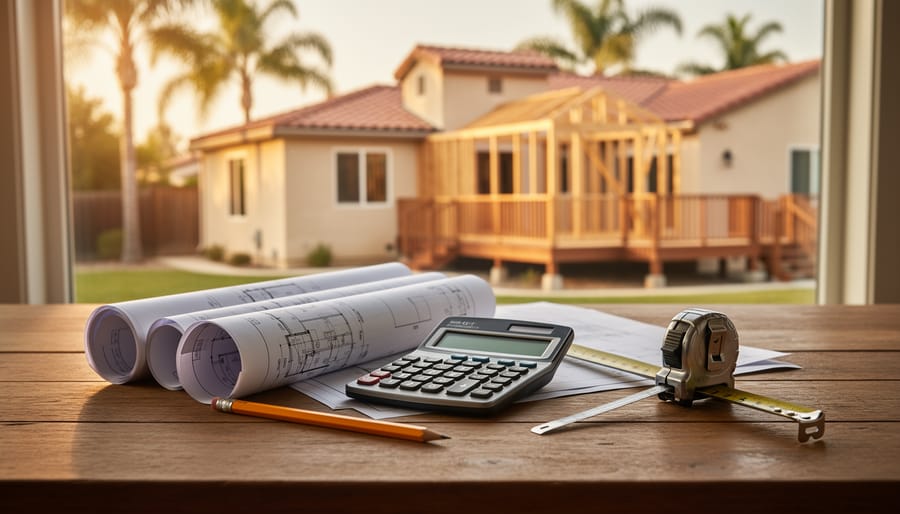
California’s property tax rate stands at 1% of assessed value—but that’s just the starting point. When you’re planning a home renovation or considering a property purchase, understanding property taxes means recognizing that your actual bill will likely run between 1.1% and 1.6% once local voter-approved bonds and assessments are added.
Here’s what directly impacts your wallet: The moment you complete that kitchen remodel or finish adding a new deck, your property gets reassessed at current market value. This reassessment triggers a permanent increase in your tax base, not just a one-time hit. For DIYers and tradespeople budgeting projects, this matters—a renovation that adds $50,000 to your home’s value means an extra $500 to $800 annually in property taxes, every year you own the property.
County location creates significant variation too. San Francisco County residents pay around 1.19% effective rate, while Orange County averages 1.04%. These differences compound over time, affecting long-term project ROI calculations.
The practical takeaway: Before breaking ground on any improvement project, calculate both material costs and the ongoing tax increase. That new workshop or upgraded bathroom isn’t just a one-time expense—it’s a permanent adjustment to your annual housing costs. Factor this into your project planning from day one to avoid budget surprises down the road.
The Base Property Tax Rate in California
California’s property tax system starts with a straightforward foundation: a base rate of 1% of your property’s assessed value. This rate was locked into place in 1978 by Proposition 13, a landmark piece of legislation that fundamentally changed how property taxes work in the state.
Here’s what that 1% means in practical terms. When you own property in California, you’ll pay this base rate on your home’s assessed value each year. The assessed value is typically the purchase price of your home when you bought it, not the current market value. This distinction matters significantly, especially in areas where property values have increased substantially over time.
Let’s break down how this calculation works with a simple example. If you purchase a home for $500,000, your base property tax would be $5,000 per year (that’s $500,000 multiplied by 0.01). For a $750,000 home, you’d pay $7,500 annually in base taxes. A more modest $300,000 property would come with $3,000 in base taxes each year.
However, there’s an important detail to understand: your assessed value doesn’t stay frozen at your purchase price forever. Proposition 13 allows for annual increases of up to 2% to account for inflation. So if you bought that $500,000 home, the next year your assessed value could increase to $510,000, bringing your base tax to $5,100.
For homeowners planning renovation projects or improvements, understanding this base rate helps you budget accurately. While adding a deck or remodeling your kitchen will eventually affect your property’s assessed value during reassessment, the 1% base rate remains constant. Keep in mind that this 1% is just the starting point—additional voter-approved local assessments and bonds typically add to your total property tax bill, which we’ll explore in the following sections.
Beyond the Base: Additional Assessments and Bonds
Common Local Add-Ons
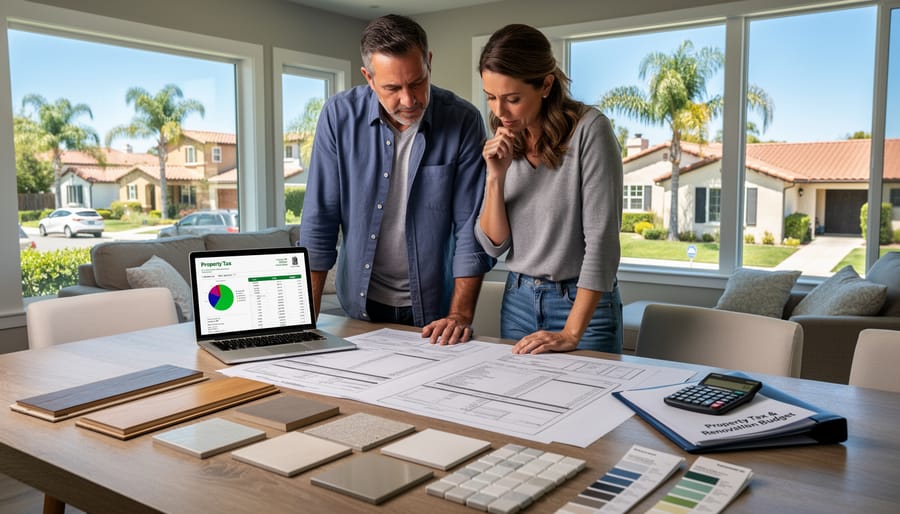
Beyond the basic 1% rate, California property owners typically pay additional charges that appear on the same tax bill. These local add-ons fund specific community needs and vary significantly by location.
School bonds represent the most common additional charge. When local voters approve funding for school construction or improvements, property owners in that district pay extra. For example, Los Angeles County residents might see charges ranging from 0.10% to 0.30% for various school district bonds. These bonds help build new classrooms, upgrade aging facilities, and purchase educational equipment.
Infrastructure improvement districts add another layer of costs. In Riverside County, Community Facilities Districts (CFDs) or Mello-Roos taxes can add 0.25% to 2% to your property tax bill. These fund roads, water systems, parks, and fire stations in newer developments. If you’re planning a major home renovation, understanding where property tax money goes helps you appreciate how these investments support your property value.
Municipal service charges cover specific local services. San Diego County properties might include fees for flood control, vector control (pest management), and street lighting. Orange County residents often pay for regional parks and library services through separate assessments.
The combined total of these add-ons typically ranges from 0.10% to 1.5% above the base rate, meaning your actual property tax rate might land anywhere between 1.1% and 2.5% of assessed value. Always check your county assessor’s website for specific local charges affecting your property.
How to Find Your Exact Rate
Finding your exact property tax rate takes just a few simple steps. Start by locating your annual property tax bill, which typically arrives in October or November. Look for a section that breaks down your total tax rate—this will show the base 1% rate plus any voter-approved assessments specific to your area.
If you don’t have your bill handy, visit your county assessor’s website. Most California counties offer online property tax lookup tools where you can search by address or parcel number. Once you find your property, the site will display your assessed value and itemized tax rates.
For a detailed breakdown, look for line items showing school bonds, infrastructure improvements, or district assessments. Add these percentages to the base 1% to get your total effective rate. For example, you might see 1% base plus 0.15% for schools and 0.08% for local bonds, totaling 1.23%.
Many county websites also provide tax rate area maps, which group properties by their specific rate combinations. This is especially helpful if you’re comparing properties in different neighborhoods or planning a home improvement project and need to budget for increased assessments based on your renovations.
Proposition 13: Why California’s System Is Different
California’s property tax system operates differently from most other states, thanks to a landmark 1978 voter initiative called Proposition 13. Understanding this law is essential if you’re buying a home, planning major renovations, or wondering why your neighbor with a similar house might pay vastly different taxes.
At its core, Proposition 13 caps your property’s assessed value increases at just 2% per year, regardless of how much your home’s actual market value rises. This means if you purchased a home for $500,000, your assessed value can only increase by a maximum of $10,000 annually (2% of $500,000), even if comparable homes in your neighborhood are now selling for $700,000. This protection continues as long as you own the property without triggering a reassessment.
However, two major events reset this system. First, when ownership changes—through a sale, transfer, or inheritance in some cases—the property gets reassessed at current market value. This is why new homebuyers often face significantly higher tax bills than long-term residents living in identical homes. Second, new construction or additions to your property trigger reassessment of the improved portion. If you’re planning a major home improvement project, like adding a room or converting a garage, the added value gets taxed at current rates while your original structure maintains its protected assessment.
Here’s a practical example: Your neighbor bought their home in 2000 for $300,000. Even with 2% annual increases, their assessed value today might be around $450,000. You just purchased an identical house next door for $800,000. You’ll pay taxes on that $800,000 assessment, while your neighbor pays on $450,000—creating a substantial tax difference despite living in virtually identical properties.
For DIY enthusiasts and tradespeople, this has important implications. Minor repairs and maintenance don’t trigger reassessment, but substantial improvements do. Remodeling your kitchen with new cabinets and appliances generally won’t cause problems, but adding square footage will. The county assessor evaluates new construction value and adds it to your existing assessment.
Understanding Proposition 13 helps you make informed decisions about property purchases and improvement projects. While home improvements may increase your tax bill, the 2% annual cap provides long-term predictability that homeowners in other states don’t enjoy.
Property Tax Rates by California County
While California’s base property tax rate is set at 1%, the actual amount you’ll pay varies significantly depending on which county you call home. Local voter-approved bonds, special assessments, and Mello-Roos taxes can push effective rates considerably higher than the baseline.
Let’s look at what homeowners actually pay across five major California counties. In Los Angeles County, the effective tax rate typically ranges from 1.16% to 1.25% of assessed value. This means if you own a home assessed at $600,000, you’re looking at annual property taxes between $6,960 and $7,500. Those extra charges often fund school improvements, infrastructure projects, and community services.
San Diego County homeowners generally see effective rates between 1.05% and 1.20%. A $500,000 home here translates to roughly $5,250 to $6,000 annually. Orange County falls in a similar range, with effective rates from 1.05% to 1.30%, depending on your specific city and neighborhood.
San Francisco presents an interesting case with relatively lower effective rates, typically hovering around 1.18% to 1.20%. However, given the higher property values in the city, a $900,000 home still generates approximately $10,620 to $10,800 in annual taxes.
Sacramento County often ranks among the more affordable areas, with effective rates commonly between 1.01% and 1.10%. For a $400,000 home, expect to pay between $4,040 and $4,400 yearly.
These variations matter when you’re planning a kitchen remodel or major home improvement project. Understanding your actual tax rate helps you budget accurately since your home’s assessed value will increase following permitted improvements. Before starting any significant renovation, calculate how the increased property value might affect your tax bill. Many homeowners find it helpful to check their county assessor’s website for the precise rate in their specific tax district, as rates can vary even within the same county based on local measures and bonds.
How Home Improvements Affect Your Property Tax
Projects That Trigger Reassessment
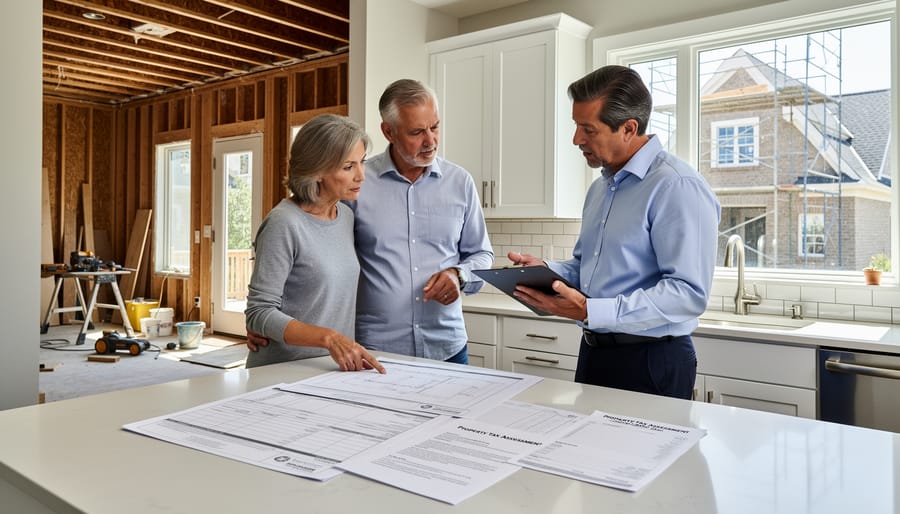
Understanding which projects trigger reassessment helps you plan renovations strategically. In California, any work requiring a building permit typically leads to reassessment, potentially increasing your property tax bill.
Projects that commonly increase assessed value include room additions, new construction like ADUs (accessory dwelling units), garage conversions into living space, and major structural renovations. For example, adding a 400-square-foot master bedroom suite or converting your garage into a rental unit will trigger reassessment because these improvements add measurable value to your property.
Kitchen and bathroom remodels can be tricky. A complete gut renovation with new plumbing and electrical work requiring permits will likely increase your assessment. However, cosmetic updates like painting cabinets, replacing countertops, or installing new fixtures without structural changes typically don’t trigger reassessment.
Regular maintenance work is generally safe from reassessment. This includes roof repairs (not full replacement), repainting, fixing plumbing leaks, HVAC maintenance, and replacing worn flooring with similar materials. The key distinction: maintenance preserves existing value, while improvements add new value.
Before starting any major project, check with your county assessor’s office about potential tax implications. This planning step helps you budget accurately and avoid surprise tax increases.
Planning Your Budget With Tax Impact in Mind
When planning home improvements in California, understanding potential property tax increases can prevent budget surprises down the road. Since major renovations can trigger reassessment under Proposition 13, it’s smart to estimate the tax impact before breaking ground.
Start by calculating your project’s expected value addition. If you’re adding a $50,000 kitchen remodel, expect your assessed value to increase by roughly that amount. Multiply this by your local tax rate (typically 1.1% to 1.3% including local assessments) to estimate your annual tax increase. In this example, that’s approximately $550-$650 more per year.
Factor this ongoing cost into your decision-making alongside the immediate project expenses. Some homeowners find that strategic tool rental planning helps offset costs, making the tax increase more manageable. Renting specialized equipment instead of purchasing can free up budget dollars for the additional tax burden.
Consider timing major improvements strategically. If you’re planning multiple projects, spreading them across different years might help manage both cash flow and assessment timing. Keep detailed records of all improvement costs, as California law distinguishes between maintenance (which doesn’t trigger reassessment) and value-adding improvements. Understanding this difference ensures you’re neither over-reporting improvements nor missing important documentation that could protect you during county assessments.
Exemptions and Tax Relief Programs
California offers several property tax relief programs that can meaningfully reduce your annual tax bill. Understanding these exemptions is especially important if you’re planning home improvements or renovations, as they can offset some of the increased assessment that comes with property upgrades.
The Homeowner’s Exemption is the most common relief program, reducing your assessed value by $7,000. While this translates to modest savings of about $70 annually, it’s straightforward to claim. You must own and occupy the property as your primary residence on January 1st of the tax year. Apply once through your county assessor’s office, and the exemption continues automatically as long as you remain eligible.
Senior citizens age 55 or older can benefit from Proposition 60/90, which allows you to transfer your existing property tax base to a replacement home of equal or lesser value within the same county. This prevents a tax increase when downsizing or relocating. Some counties also participate in Proposition 90, extending this benefit to inter-county moves.
Disabled homeowners may qualify for additional exemptions depending on their specific circumstances and income levels. The Disabled Veterans’ Exemption provides substantial relief, ranging from partial exemptions to complete property tax elimination for veterans with service-connected disabilities. The exemption amount varies based on disability rating and income, with qualifying veterans rated 100% disabled potentially receiving full exemption on properties valued up to specific limits.
To apply for any exemption, contact your county assessor’s office directly. Most counties now offer online applications, making the process accessible and straightforward. Keep documentation ready, including proof of age, disability status, military service records, or ownership documents. Application deadlines vary, but most exemptions require filing by February 15th to apply for the current tax year.
When and How Property Taxes Are Paid
California property taxes operate on a straightforward payment schedule that helps homeowners manage this significant expense. Your annual property tax bill is split into two installments, making it easier to budget throughout the year rather than facing one large payment.
The first installment covers the period from July 1 to December 31 and is due on November 1, though it’s not considered late until December 10. The second installment covers January 1 through June 30 and is due on February 1, with a late deadline of April 10. These fixed dates make planning ahead simple, which is particularly helpful if you’re budgeting for home improvement projects or tool rentals alongside your tax obligations.
You can pay your property taxes through several convenient methods. Most counties accept online payments through their tax collector websites, payments by mail with a check, or in-person payments at the tax collector’s office. Some counties also offer electronic fund transfers and credit card payments, though the latter typically includes processing fees.
Missing the deadline comes with immediate consequences. A 10 percent penalty applies to late payments, and additional penalties accrue over time. If taxes remain unpaid for five years, the county can initiate foreclosure proceedings on your property.
To avoid surprises, consider setting aside money monthly in a dedicated savings account. Divide your annual tax bill by twelve and transfer that amount each month. This approach smooths out the financial impact and ensures you’re prepared when each installment arrives.
Understanding California’s property tax rate is essential for homeowners and anyone planning property improvements or renovations. While the baseline rate sits at 1% of assessed value, remember that local assessments, voter-approved bonds, and Mello-Roos districts can push your effective rate higher—often between 1.1% and 1.4% depending on your county and neighborhood.
When planning DIY projects or home improvements, keep in mind that significant additions or upgrades can trigger reassessments and increase your annual property tax bill. This makes budgeting for the complete cost of your project critical, not just the materials and tool rentals you’ll need upfront.
Before starting your next renovation, check your county assessor’s website for your specific tax rate and understand which improvements might affect your assessment. Factor these potential increases into your project timeline and budget to avoid surprises down the road.
We’d love to hear from your experience! Have property tax considerations influenced your home improvement decisions? What county do you live in, and how has your rate compared to the state average? Share your insights and tips with our community of DIY enthusiasts and tradespeople in the comments below—your real-world experience helps others make informed decisions about their projects.
Related Posts