


Workplace heat exposure sends thousands of workers to emergency rooms annually, yet many employers remain unaware that OSHA can cite them under the General Duty Clause even without specific heat standards. Currently, federal OSHA operates without a comprehensive heat-specific regulation, instead enforcing protections through Section 5(a)(1), which requires employers to provide workplaces free from recognized hazards likely to cause death or serious physical harm.
This gap is closing. OSHA proposed its first-ever heat illness prevention rule in 2024, establishing mandatory protections when temperatures reach specific thresholds. The proposed regulation introduces a two-tier system: initial heat trigger at 80°F requiring basic protections like water and breaks, and a high heat trigger at 90°F demanding more stringent measures including mandatory rest periods and heat acclimatization protocols for new workers.
Understanding these regulations matters whether you’re managing a construction crew, operating a warehouse, or working outdoors independently. Heat-related illness is entirely preventable with proper planning, and compliance protects both workers and businesses from citations that can reach $16,131 per violation, or $161,323 for willful violations.
This guide breaks down current OSHA enforcement practices, explains the proposed rule’s requirements, and provides practical compliance strategies including water access standards, rest break schedules, acclimatization programs, and emergency response procedures. You’ll also discover which cooling equipment and monitoring tools can help maintain safe conditions while keeping projects on schedule.
What OSHA Actually Requires for Heat Safety
The General Duty Clause: Your Current Legal Obligation
While OSHA doesn’t currently have a specific standard dedicated solely to heat exposure, employers are still legally required to protect workers under Section 5(a)(1) of the Occupational Safety and Health Act. This provision is known as the General Duty Clause, and it requires employers to provide a workplace “free from recognized hazards that are causing or likely to cause death or serious physical harm.”
In practical terms, this means if heat-related conditions could reasonably cause illness or injury, you’re obligated to take action, even without a specific regulation spelling out exact requirements. OSHA uses this clause to cite employers when workers suffer heat-related illnesses that could have been prevented.
Real-world violations paint a clear picture. In 2019, a Florida roofing company faced citations after a worker experienced heat stroke in 100-degree temperatures without adequate water access or rest breaks. Similarly, a Texas construction company received penalties when multiple workers required hospitalization for heat exhaustion despite warnings from crew members about dangerous conditions.
These citations typically result from four common failures: not providing sufficient drinking water, lacking shaded rest areas, failing to implement acclimatization programs for new workers, and ignoring early warning signs of heat illness. OSHA inspectors look for documented heat safety plans, training records, and evidence that supervisors actively monitor conditions.
The takeaway for employers and site managers is straightforward: you can’t wait for workers to get sick before addressing heat hazards. Document your preventive measures, train your team, and respond promptly to hot weather conditions.
New Federal Heat Standards: What’s Coming
OSHA is currently developing its first-ever federal heat illness prevention standard, marking a significant shift in workplace safety requirements across the United States. This proposed rule aims to protect millions of workers who face heat-related hazards on the job, particularly those in construction, agriculture, warehousing, and outdoor trades.
The proposed regulation introduces a two-tiered approach based on heat index levels. When temperatures reach 80°F, employers must provide drinking water, rest breaks, and shade areas. At 90°F and above, stricter requirements kick in, including mandatory 15-minute paid rest breaks every two hours, acclimatization plans for new workers, and designated heat safety coordinators on site.
OSHA published the initial proposal in 2021 and has been gathering feedback from employers, workers, and safety professionals. While the exact implementation timeline remains uncertain, experts anticipate the final rule could be published within the next 12 to 24 months, with enforcement beginning approximately one year after publication.
Employers should expect several key changes: mandatory written heat illness prevention plans, employee training requirements, and detailed record-keeping of heat-related incidents. Businesses will need to monitor weather conditions regularly and adjust work schedules accordingly. This might mean earlier start times during summer months or implementing rotation schedules to limit individual heat exposure.
The good news? Many of the proposed requirements align with existing best practices and state-level regulations already in effect in places like California and Washington. Starting preparation now puts you ahead of the compliance curve.
Temperature Thresholds and Trigger Points
Understanding the Heat Index vs. Temperature
When you check your weather app and see it’s 85°F outside, that’s the ambient temperature—but it’s not the whole story for workplace safety. What workers actually feel is the heat index, which combines temperature with relative humidity to show how hot it really feels to the human body.
Here’s why this matters: your body cools itself through sweat evaporation. When humidity is high, sweat doesn’t evaporate as easily, making it harder for your body to cool down. An 85°F day with 40% humidity might feel manageable, but that same temperature with 90% humidity can push the heat index above 100°F—entering dangerous territory for outdoor workers.
OSHA uses heat index rather than simple temperature when determining workplace heat hazards. For example, their initial heat trigger of 80°F heat index (not air temperature) requires employers to provide drinking water and shade. At 90°F heat index, additional protections kick in.
To calculate heat index on your jobsite, you’ll need both a thermometer and a humidity meter (hygrometer). Many affordable combination devices are available at tool rental centers. You can then reference NOAA’s heat index chart or use their online calculator. Some digital weather stations designed for jobsites will automatically display heat index readings, taking the guesswork out of compliance monitoring.
Remember: always use heat index, not temperature alone, when assessing workplace heat risk.
Action Levels: When You Must Intervene
OSHA’s proposed heat standards establish clear temperature thresholds that require specific employer actions. Understanding these trigger points helps you stay compliant and protect your team.
The two critical action levels are:
Initial Heat Trigger: 80°F heat index. At this threshold, employers must provide drinking water, establish rest break schedules, and designate shaded or air-conditioned rest areas. You’ll also need to begin monitoring weather conditions and worker activity levels more closely. This applies to both indoor and outdoor work environments.
High Heat Trigger: 90°F heat index. Once temperatures reach this level, mandatory protections intensify. Requirements include a 15-minute paid rest break every two hours, a mandatory acclimatization plan for new workers and those returning from absence, and enhanced monitoring of employees for heat illness symptoms. Hazard alerts must be issued to all workers, and a designated heat safety coordinator must be on-site.
The heat index combines temperature and humidity, not just air temperature alone. A 85°F day with 70% humidity creates a heat index near 95°F, triggering high-level protections.
For outdoor construction sites and tool rental operations, these thresholds mean adjusting work schedules, ensuring cooling equipment availability, and potentially rescheduling heavy tasks during peak heat hours. Indoor warehouses and workshops without climate control must also comply when conditions reach these levels.
Required Heat Safety Measures on the Jobsite
Water, Shade, and Rest: The Non-Negotiables
OSHA’s heat illness prevention standards establish three fundamental requirements that employers must meet: adequate water, accessible shade, and appropriate rest periods.
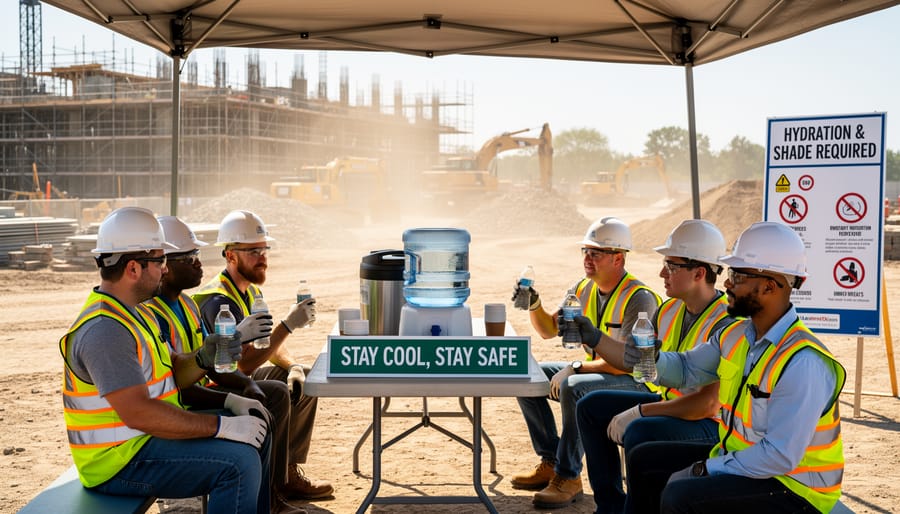
Water accessibility stands as the first non-negotiable. OSHA mandates that employers provide potable drinking water free of charge to all workers exposed to heat. The water must be suitably cool (50-60°F is recommended), readily accessible near the work area, and available in sufficient quantities. As a practical guideline, workers should drink approximately one quart per hour during moderate work in the heat. Employers should provide individual drinking containers or disposable cups rather than shared drinking vessels to maintain hygiene standards.
Shade requirements become mandatory when temperatures exceed certain thresholds. Employers must provide shade structures that block direct sunlight and are large enough to accommodate all workers on rest breaks. The shaded area should allow workers to sit comfortably without touching each other. Natural shade from trees can work, but constructed shade using canopies or pop-up tents often provides more reliable coverage. The shade must be located as close as practical to work areas and opened for use at the start of each shift.
Rest breaks serve as the third pillar of heat protection. While OSHA doesn’t specify exact break durations, employers must allow workers to take preventative cool-down breaks without fear of retaliation. During high-heat periods, breaks should occur every two hours at minimum. Workers experiencing heat-related symptoms must be allowed immediate rest in the shade. These practices align with broader strategies for staying cool on jobsites, combining regulatory compliance with practical worker protection.
Acclimatization Protocols for New and Returning Workers
Statistics reveal a sobering truth: approximately 70% of heat-related workplace fatalities occur during a worker’s first week on the job. This vulnerability stems from the body’s need to gradually adapt to hot conditions, a process called acclimatization.
OSHA recommends a structured approach to protect both new workers and those returning after time away. For new employees, the guideline follows the “20% rule” during the first week. Start workers at 20% of their normal workload on day one in heat conditions, then gradually increase exposure by no more than 20% each subsequent day. By day five, they should reach full capacity.
Returning workers who’ve been away for a week or more need a modified protocol. OSHA suggests starting them at 50% exposure on day one, increasing to 60% on day two, 80% on day three, and reaching 100% by day four.
During acclimatization, supervisors should implement additional safeguards. Schedule more frequent breaks in shaded or air-conditioned areas, ensure constant hydration access, and assign a buddy system where experienced workers monitor newcomers for heat stress symptoms. Workers should understand that dizziness, excessive fatigue, or nausea warrant immediate reporting. Even experienced crew members need watchful eyes during their readjustment period, as overconfidence can lead to dangerous situations.
Emergency Response Planning
Every workplace exposed to heat conditions needs a clear emergency response plan as part of managing onsite risks. Your plan should outline specific protocols that anyone on-site can follow immediately when heat illness strikes.
Start by training all workers to recognize heat illness symptoms. Early signs include heavy sweating, muscle cramps, and fatigue. More serious symptoms involve confusion, slurred speech, hot dry skin, seizures, or loss of consciousness. Post these warning signs visibly around work areas so everyone knows what to watch for.
Your first aid response should include moving the affected person to a cool, shaded area immediately. Remove excess clothing, apply cool wet cloths to the skin, and provide cool water to drink if the person is conscious and able to swallow. Never give fluids to someone who’s unconscious.
Know when to call 911 without delay. If someone shows signs of heat stroke, including confusion, fainting, or body temperature above 103°F, emergency medical help is critical. Don’t wait to see if the person improves. Heat stroke can be fatal within minutes.
Designate specific team members as emergency responders and ensure mobile phones are always accessible on-site.
Recognizing and Responding to Heat Illness
Warning Signs Everyone Should Know
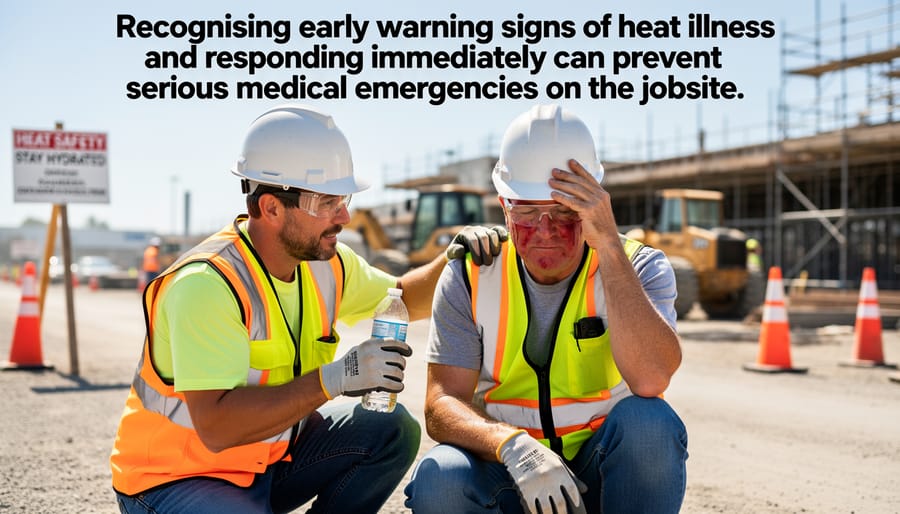
Recognizing heat-related illness early can prevent serious health emergencies on the jobsite. Here’s what everyone should watch for:
Heat cramps typically appear first as painful muscle spasms in the legs, arms, or abdomen during or after physical work. Workers may also experience heavy sweating. While often considered mild, cramps signal your body is struggling with heat stress and shouldn’t be ignored.
Heat exhaustion presents more serious symptoms: heavy sweating combined with cold, pale, or clammy skin, fast but weak pulse, nausea or vomiting, muscle cramps, tiredness or weakness, dizziness, headache, and fainting. Body temperature may rise but typically stays below 104°F. This condition requires immediate attention and cooling.
Heat stroke is a life-threatening emergency requiring immediate medical response. Warning signs include body temperature of 103°F or higher, hot, red, dry, or damp skin, rapid and strong pulse, confusion or altered mental state, loss of consciousness, and possible seizures. Unlike heat exhaustion, sweating may stop completely.
The key difference? Heat exhaustion involves heavy sweating with cool skin, while heat stroke means the body’s cooling system has failed entirely. Never wait to see if symptoms improve on their own with heat stroke—call emergency services immediately. Training your crew to spot these early warning signs creates a safer workplace for everyone.
Immediate Actions That Save Lives
When someone shows signs of heat illness, every second counts. Here’s what you need to do immediately:
First, move the affected person to a cool, shaded area or air-conditioned space. Remove any unnecessary clothing or heavy equipment to help their body release heat more quickly.
Begin active cooling right away. Apply cool, wet cloths to the neck, armpits, and groin areas where major blood vessels are close to the skin. If available, use fans to increase air circulation. Have the person sip cool water slowly if they’re conscious and able to swallow, but never force liquids.
Call 911 immediately if the person experiences confusion, loss of consciousness, seizures, or stops sweating despite high heat. These are signs of heat stroke, a life-threatening emergency requiring immediate medical intervention.
For milder symptoms like heavy sweating, weakness, or nausea, continue cooling efforts and monitor closely. If symptoms don’t improve within 30 minutes or worsen at any point, seek medical help.
Keep detailed records of the incident for OSHA reporting purposes. Document the time, temperature conditions, symptoms observed, and actions taken. This information helps prevent future incidents and demonstrates your workplace’s commitment to safety compliance.
Tools and Equipment That Keep Workers Safe
Cooling Equipment Worth the Investment
Investing in quality cooling solutions protects your team and demonstrates commitment to safety compliance. Cooling vests with ice packs or evaporative technology provide personal temperature regulation, particularly effective for workers in direct sunlight or confined spaces. Misting fans combine airflow with fine water spray to drop ambient temperatures by several degrees, making them ideal for stationary work areas.
Portable shade structures create instant relief zones where workers can rest between tasks, significantly reducing heat exposure. Many contractors report that portable cooling equipment like industrial fans and spot coolers transforms work conditions in warehouses and outdoor sites.
Hydration systems with insulated coolers stationed throughout worksites encourage proper fluid intake. According to user feedback from construction crews, easy access to cold water increases consumption rates by 40 percent compared to basic water jugs. While these investments require upfront costs, they reduce heat-related incidents, boost productivity, and help satisfy OSHA’s requirement for feasible engineering and administrative controls before relying solely on personal protective measures.
Monitoring Tools for Heat Conditions
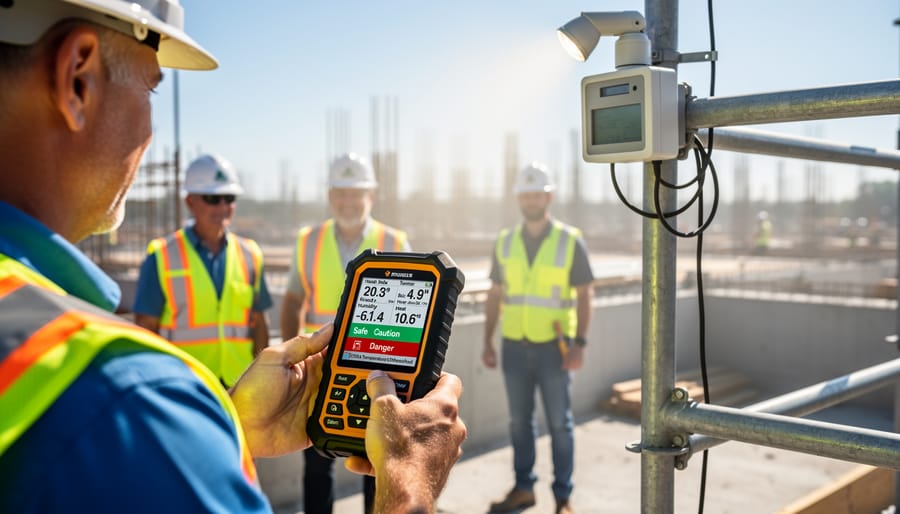
Tracking workplace heat conditions requires reliable monitoring equipment to maintain OSHA compliance and protect workers. A Wet Bulb Globe Temperature (WBGT) meter is the gold standard for measuring heat stress—it calculates temperature, humidity, wind speed, and radiant heat from the sun into a single reading. OSHA references WBGT measurements in their heat illness prevention guidelines, making these meters essential for outdoor jobsites.
Digital heat stress monitors offer a user-friendly alternative, displaying real-time temperature and humidity readings with built-in alerts when conditions reach dangerous levels. These portable devices help supervisors make informed decisions about work-rest schedules and hydration breaks.
For basic monitoring, industrial-grade digital thermometers paired with humidity meters provide cost-effective solutions for smaller operations. Many contractors rent monitoring equipment seasonally rather than purchasing, especially useful for occasional high-heat projects.
Community feedback from construction professionals emphasizes the importance of placing monitors at actual work locations rather than shaded areas to get accurate readings. Multiple monitoring stations across larger jobsites ensure comprehensive coverage. Regular calibration and battery checks keep equipment functioning properly when you need it most.
Your Compliance Checklist: What to Do Today
Taking immediate action on heat safety doesn’t have to be overwhelming. Here’s your priority-based checklist to get compliant today.
Priority 1: Immediate Actions (Complete Today)
Begin by conducting a worksite heat assessment. Walk through your facility or outdoor work areas during the hottest part of the day. Document current temperatures and identify high-risk zones where workers are exposed to heat sources like machinery, direct sunlight, or poor ventilation.
Ensure unlimited access to cool drinking water at all work locations. OSHA requires water to be readily available, meaning within easy reach without workers needing permission or leaving their work area. Place water stations in shaded areas when possible.
Designate shaded rest areas or air-conditioned break spaces. If natural shade isn’t available, set up portable canopies or cooling tents. These rest areas should be easily accessible and large enough to accommodate your crew during breaks.
Priority 2: Within This Week
Develop your written heat illness prevention plan. Document your specific protocols for water access, rest breaks, acclimatization procedures, and emergency response. Keep copies on-site and make them available to all workers.
Schedule workplace safety training sessions focused on heat stress recognition and prevention. Train supervisors to spot warning signs and all workers to recognize symptoms in themselves and coworkers.
Create an acclimatization schedule for new workers and those returning from time off. Gradually increase their exposure to hot conditions over 7-14 days, starting with lighter tasks and shorter shifts.
Priority 3: Ongoing Requirements
Maintain daily heat monitoring logs. Record temperature readings, heat index calculations, and any heat-related incidents or near-misses. This documentation proves compliance and helps identify patterns.
Establish a buddy system where workers monitor each other for heat illness symptoms throughout shifts. Assign clear responsibilities and ensure everyone knows the emergency response procedure.
Review and update your heat safety protocols monthly during hot seasons, incorporating worker feedback and any incidents to continuously improve your prevention measures.
Protecting workers from heat-related illness isn’t just about following regulations—it’s the right thing to do and makes solid business sense. Companies that prioritize heat safety see fewer workplace injuries, reduced workers’ compensation claims, lower insurance premiums, and improved employee morale. When workers feel safe and valued, productivity naturally increases, and turnover drops significantly.
While OSHA’s proposed heat illness prevention rule will establish federal standards, you don’t need to wait for final regulations to act. Implementing heat safety measures now protects your team and positions your business ahead of compliance requirements. Start by assessing your worksite’s heat hazards, establishing water and rest break protocols, and training supervisors to recognize warning signs. Remember that many heat-related incidents are entirely preventable with proper planning and equipment.
The tools and solutions we’ve discussed—cooling stations, hydration equipment, monitoring devices, and personal protective gear—are readily accessible through rental options, making it cost-effective for businesses of all sizes to maintain safe working conditions.
We want to hear from you. Have you implemented heat safety measures at your workplace? What challenges have you faced, and what solutions worked best for your team? Are there specific OSHA requirements you need clarification on? Share your experiences, questions, or suggestions in the comments below. Your insights help build a stronger, safer community for everyone working in challenging conditions. Together, we can create work environments where heat safety is the standard, not the exception.
Related Posts


Post a Comment