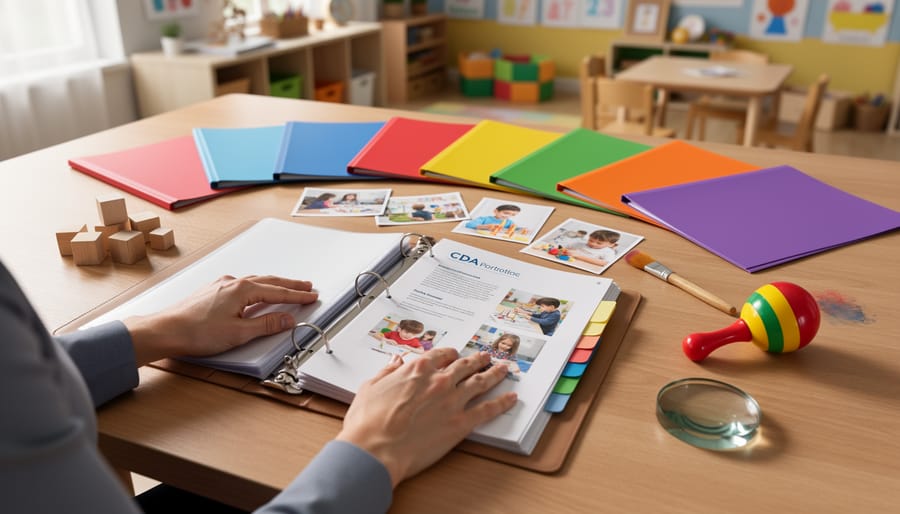
Gather your documentation systematically by creating six dedicated folders—one for each competency standard required by the Council for Professional Recognition. Label each folder with its corresponding competency goal (Safe and Healthy Learning Environment, Advance Physical and Intellectual Development, Support Social and Emotional Development, Establish Positive Relationships with Families, Ensure a Well-Run Program, and Maintain Professional Commitment) and begin collecting evidence immediately rather than scrambling before your deadline.
Document your daily interactions with children through photographs, lesson plans, and written reflections that demonstrate your teaching philosophy in action. Take photos during activities showing children engaged in learning, ensuring you have signed parental consent forms on file. These authentic snapshots of your classroom provide powerful evidence that assessors look for during portfolio review.
Develop your resource collection files by gathering seventeen age-appropriate items across different developmental domains—music, math, science, dramatic play, fine motor, gross motor, and literacy. Store physical items in labeled bags or photograph them with detailed descriptions explaining how each resource supports child development and learning objectives.
Write clear, reflective statements for each competency that connect your daily practice to CDA standards, drawing from real classroom scenarios you’ve experienced. Your professional portfolio development mirrors the careful planning required for any major project—breaking down requirements into manageable tasks prevents overwhelm and ensures nothing gets missed.
Complete your professional philosophy statement by addressing how you support children’s growth, partner with families, and commit to ongoing learning, keeping your language straightforward and grounded in practical examples from your teaching experience.
What Makes a CDA Professional Portfolio Different
A CDA Professional Portfolio isn’t your typical resume or work showcase. It’s a specialized document required by the Council for Professional Recognition to demonstrate you’ve met specific early childhood education standards. Think of it as proof that you can actually do the work, not just talk about it.
Here’s what sets it apart: while general portfolios might highlight your best moments, a CDA portfolio follows strict guidelines. You’ll need six Competency Statements, which are written reflections explaining how you meet professional standards in areas like maintaining a safe environment, advancing children’s development, and building family relationships. These aren’t just descriptions of what you do—they’re detailed explanations of why you do it and how it benefits children.
The portfolio also requires a Resource Collection, which is essentially a toolkit of practical materials. This includes items like sample menus showing nutritious meals, a list of children’s books that support development, and contact information for community resources families might need. Each item serves a specific purpose tied to the CDA standards.
Unlike a general showcase of competencies you might create for job hunting, your CDA portfolio must include documentation of 480 hours of experience working with young children and a Professional Philosophy Statement outlining your approach to early childhood education.
The Council for Professional Recognition reviews these portfolios to ensure candidates meet national standards. Everything must be organized in a specific order, following their official guidelines. Missing or incorrectly formatted sections can delay your credential, so understanding these unique requirements from the start saves time and frustration later.
The Six Essential Components Every CDA Portfolio Needs
Your Professional Philosophy Statement
Your professional philosophy statement is your chance to share what drives your work with young children—think of it as your “why I do this” explanation. This 75-200 word statement should capture your core beliefs about how children learn and grow, and what role you play in supporting that development.
Start by reflecting on real moments from your classroom experience. What interactions with children feel most meaningful to you? When do you feel most effective as an educator? Your answers reveal your authentic teaching approach. Avoid copying generic statements from the internet—evaluators can spot these immediately, and they won’t reflect your unique perspective.
Use straightforward language that sounds like you’re explaining your approach to a parent or colleague. Instead of writing “I facilitate developmentally appropriate learning experiences,” try “I believe children learn best through hands-on exploration and play.” Be specific about what you value: Do you prioritize building strong family partnerships? Creating inclusive environments? Supporting children’s independence?
Review your statement after writing it and ask yourself: Does this sound like me? Would someone who knows my teaching recognize my voice here? Your philosophy should feel genuine, not rehearsed. Many educators find it helpful to write several drafts, refining their thoughts until the statement truly represents their approach to early childhood education.
Competency Statements That Actually Show Your Skills
The six competency statements form the heart of your CDA portfolio, demonstrating how you apply professional standards in real classroom situations. Think of these as your opportunity to showcase specific moments when your skills made a difference in children’s learning and development.
Each competency statement follows a two-part structure. First, you’ll write a reflective statement (typically 200-500 words) explaining your teaching philosophy for that competency area. Then, you’ll describe a specific example from your work with children that illustrates this competency in action.
Start with Competency Statement I, which focuses on safe, healthy learning environments. Describe your daily practices—maybe you implemented a new handwashing routine that reduced illness in your classroom by teaching children proper techniques through songs and visual reminders. Include the specific steps you took and the results you observed.
For Competency Statement II on physical and intellectual development, choose a concrete activity you planned. Perhaps you created an obstacle course that helped a reluctant child develop gross motor skills while building confidence. Explain your planning process, how you adapted the activity for different skill levels, and what developmental milestones children achieved.
Competency Statements III through VI cover social and emotional development, family relationships, program management, and professionalism. For each one, draw from your actual experiences. Did you help a child work through separation anxiety? Document the strategies you used and how the family responded. Did you organize parent workshops? Describe the planning, execution, and feedback.
The key is being specific rather than general. Instead of writing “I promote social development,” write “When two children struggled to share blocks, I introduced a timer system and taught them negotiation phrases, which reduced conflicts by half within two weeks.” Real examples with measurable outcomes demonstrate genuine competency far better than theoretical statements.
The Resource Collection Requirements
Gathering resources for your CDA portfolio requires a systematic approach across six competency goal areas. Think of this like collecting the right tools before starting a project—organization saves time and frustration later.
For Competency Goal I (Safe, Healthy Learning Environment), collect photos of your classroom setup, health and safety policies, weekly menu plans, and emergency procedure documentation. Snap pictures of handwashing stations, safe storage areas, and age-appropriate furniture arrangements.
Competency Goal II (Physical and Intellectual Competence) needs lesson plans that show developmental activities, activity schedules, and examples of children’s artwork or projects. Keep samples that demonstrate learning across different areas like motor skills, language, and creativity.
For Goals III and IV (Social-Emotional Support and Family Relationships), gather parent communication logs, family event photos, newsletters you’ve created, and documentation of family conferences. Save thank-you notes or feedback from families—community-driven input strengthens your portfolio.
Goals V and VI (Program Management and Professionalism) require training certificates, meeting notes, professional development records, and your written philosophy statement. Create a simple filing system—digital or physical folders labeled by competency goal—to prevent last-minute scrambling. Date everything as you collect it, and store items in page protectors to maintain quality. Many educators find that gathering resources weekly, rather than all at once, makes the process manageable and less overwhelming.
Family Questionnaires and Parent Feedback
Gathering parent feedback shows your commitment to family partnerships. Start by creating simple, user-friendly questionnaires that ask specific questions about their child’s growth, your communication methods, and program satisfaction. Keep questions clear and offer multiple response options like rating scales or yes/no answers alongside space for written comments.
Distribute questionnaires at strategic times—after parent-teacher conferences, at the end of program years, or following special events. Offer both digital and paper formats to accommodate all families. Always ensure responses remain confidential and optional.
When documenting feedback, select 3-5 representative responses that highlight different aspects of your practice. Remove identifying information to protect privacy. Include both positive feedback and constructive suggestions, showing you value honest input and use it for professional growth.
Present these in your portfolio with a brief introduction explaining your collection method and how you’ve applied parent suggestions to improve your teaching. Consider creating a simple summary chart showing common themes from multiple families. This demonstrates your ability to listen, reflect, and adapt based on community-driven insights from the families you serve.
Getting Your Materials Together: A Practical Approach
Documentation You Already Have
Before you start building your CDA portfolio from scratch, take inventory of what you likely already have on hand. Most early childhood educators accumulate documentation throughout their daily work without realizing these materials meet portfolio requirements.
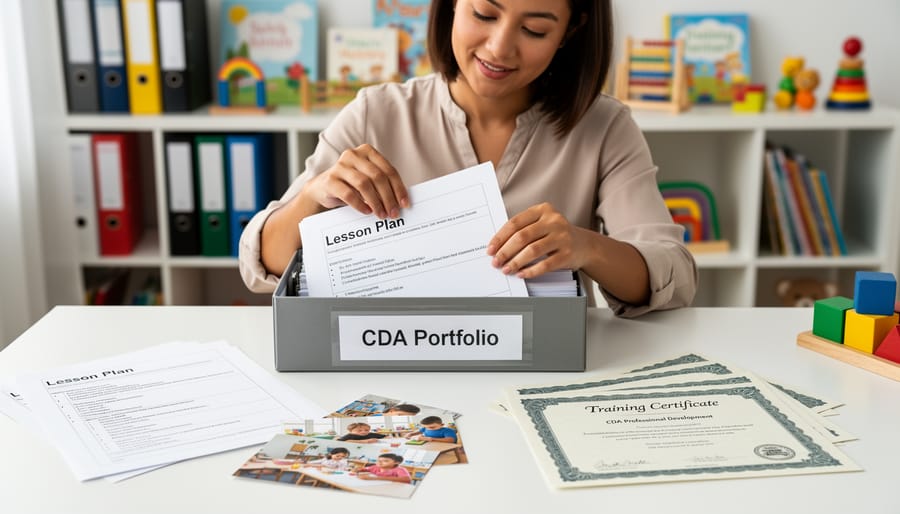
Start by gathering your training certificates and professional development records. That workshop on early literacy or classroom management you attended last year counts toward your professional development hours. Look for certificates from conferences, webinars, or online courses related to child development.
Next, review your existing lesson plans and activity documentation. Weekly plans, observation notes, and assessment records you’ve already created can demonstrate your competency in curriculum planning and child observation. Photos of classroom setups, bulletin boards, or children engaged in activities (with proper permissions) serve as visual evidence of your teaching practices.
Don’t overlook your employment records, transcripts from ECE coursework, first aid certification, and background check documentation. These foundational items fulfill specific credentialing requirements.
Create a dedicated folder or binder for organizing materials logically as you collect them. Sort documents by competency area rather than chronologically, which makes the assembly process much more manageable. Many educators discover they’re already halfway to completing their portfolio once they’ve gathered existing materials—it’s simply a matter of organizing and presenting them according to CDA standards.
Filling the Gaps Without Starting From Scratch
You don’t need to start over completely if you’re missing portfolio components. Think of this like gathering the right tools for a project—you work with what you have and add what’s necessary to get the job done properly.
Start by conducting an honest inventory. List all six Competency Statement areas and check which ones you have solid evidence for and which need work. Many educators discover they have more usable material than they initially thought—perhaps documented in emails, parent newsletters, or lesson plans they’ve already created.
For missing resource collection items, reach out to your training network. Fellow educators often share materials they’ve developed, and many professional organizations offer sample resources you can adapt to your setting. Just remember to personalize everything to reflect your actual teaching philosophy and practices.
When creating new competency statements, draw from real classroom experiences rather than theoretical responses. Describe specific situations you’ve handled, children you’ve supported, and approaches you’ve implemented. Authenticity matters more than perfect wording—reviewers want to see your genuine understanding of child development principles in action.
Consider forming or joining a CDA study group where members exchange feedback and resources. These community connections provide valuable perspective and help identify gaps you might have overlooked. Fellow candidates often notice strengths in your work you’ve underestimated.
Document new experiences as they happen rather than trying to recall everything from memory. Keep a simple log on your phone or notebook to capture observations, conversations with families, and teaching moments that demonstrate competency areas needing additional evidence.
Assembly and Presentation: Making It Professional
Once you’ve gathered all your documentation and reflection statements, it’s time to organize everything professionally. Think of this step like preparing a job site—proper setup makes the entire process smoother and demonstrates your attention to detail.
Start by choosing your format. Digital portfolios offer easy updates and backup options, while physical binders provide a tangible presentation during verification visits. Many educators create both: a primary digital version stored in cloud storage and a backup physical copy. If going digital, use clearly labeled folders for each Competency Standard, with subfolders for Resource Collection items. For physical portfolios, invest in a professional three-ring binder with dividers and sheet protectors.
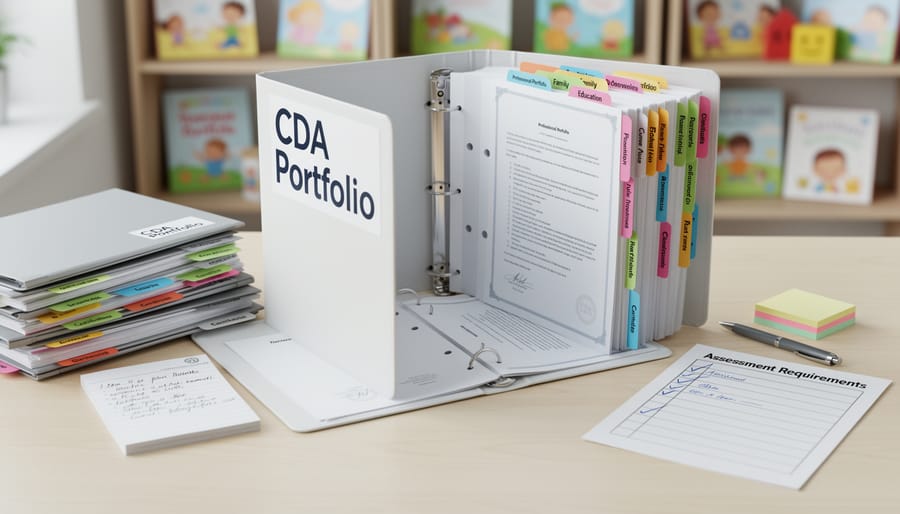
Organization matters significantly. Arrange materials in the order Council for Professional Recognition evaluators expect: Professional Philosophy Statement first, followed by Competency Statements CS I through CS VI, and finally your Family Questionnaires. Use tab dividers with clear labels, and create a detailed table of contents at the front. This approach mirrors how you’d organize tools in a workshop—everything has its place and purpose.
Consider using color-coding: blue tabs for Competency Statements, green for Resource Collection items, yellow for required documents. Number your pages sequentially and cross-reference them in your table of contents. This systematic approach helps evaluators navigate quickly and shows your organizational skills.
Safety is paramount when protecting sensitive information. Remove or redact children’s last names, parent contact details, and any identifying information from photos. Use first names only and obtain written permission before including any images. Store physical portfolios in secure locations and password-protect digital files.
Before submission, conduct a final review. Check that every required component is present, properly labeled, and free from errors. Ask a colleague to review your work—fresh eyes catch missed details. This quality check ensures your portfolio reflects the professionalism you bring to early childhood education.

Common Mistakes That Can Derail Your CDA Application
Based on feedback from CDA assessors and educators who’ve been through the process, several common mistakes repeatedly trip up applicants. Understanding these pitfalls before you submit can save you months of resubmission delays.
The most frequent error is incomplete documentation. Many candidates submit their portfolio missing required parent permission forms or lacking proper signatures on verification forms. Always create a checklist and have someone else review your materials before submission. One educator from our community shared that she was denied because three of her parent permission slips were dated after the observation dates—a simple but critical oversight.
Formatting inconsistencies cause unnecessary delays. The Council for Professional Recognition has specific requirements for page layout, font size, and document organization. Don’t mix different formats or handwrite portions that should be typed. Keep everything consistent and professional throughout your entire portfolio.
Photo documentation mistakes are surprisingly common. Blurry images, photos showing children’s faces without permission, or pictures that don’t clearly demonstrate the competency you’re claiming will weaken your application. Take multiple shots of each activity and select the clearest ones that tell your story effectively.
Another problem area is generic, copied reflections. Assessors can spot templated responses immediately. Your reflective statements should include specific examples from your actual classroom experiences, showing genuine understanding of child development principles in practice.
Finally, many applicants underestimate verification requirements. Ensure your professional development hours are properly documented with certificates, not just listed. Verify that your trainer or advisor credentials are current before they sign your forms. Missing or invalid signatures from verifiers is a fixable mistake that costs valuable time.
Your Timeline: How Long This Actually Takes
Completing your CDA portfolio is like planning a large project—break it into phases and you’ll avoid feeling overwhelmed.
Most educators complete their portfolio in 3-6 months working part-time. Here’s a realistic breakdown: Resource Collection (2-3 weeks) involves gathering family resources and community contacts. Competency Statements (4-6 weeks) take the longest since you’re writing six detailed reflections—plan for one statement every 7-10 days. Professional Philosophy (1 week) flows naturally after your competency work.
A practical schedule for working professionals: dedicate 3-5 hours weekly, preferably in consistent blocks. Many find Sunday afternoons or early weekday mornings most productive. Set mini-deadlines for each component rather than tackling everything at once.
Staying on track without burnout means treating this like any skilled project. Keep a dedicated folder for materials as you collect them. Join online educator groups where members share their progress—this community support provides accountability and fresh perspectives. If you’re stuck, move to a different section and return later with fresh eyes.
Remember, quality matters more than speed. Council for Professional Recognition reviewers appreciate thoughtful, well-documented work over rushed submissions.
Building your professional portfolio for the Child Development Associate credential doesn’t have to feel overwhelming. By breaking the process into manageable steps—gathering your documentation, organizing competency statements, collecting observation tools, and assembling everything thoughtfully—you can create a portfolio that truly reflects your skills and dedication to early childhood education.
Start today by reviewing the official CDA requirements and creating a simple checklist. Set realistic weekly goals, such as drafting one competency statement or collecting specific documentation. Remember, this portfolio tells your professional story, so take time to make it authentic and meaningful.
Don’t hesitate to tap into community resources available to you. Many local childcare centers and training organizations offer portfolio workshops where you can connect with fellow educators facing the same challenges. Online forums and social media groups dedicated to CDA candidates provide valuable peer feedback and practical tips from those who’ve successfully completed the process.
Keep learning as you build. Each piece of documentation you add strengthens your understanding of quality childcare practices. Your portfolio journey is an investment in your professional growth, and with consistent effort and the right guidance, you’ll complete it successfully.
Related Posts