Plenty of Australians would rather do a job themselves than pay someone else, and fitting a bull bar looks like a project that suits a keen weekend mechanic. The bolts are visible, the instructions come in the box, and a friend can lend a hand. In practice, the job sits in a grey area. Some parts are well within the reach of a competent DIYer, and others carry risks that are worth taking seriously, particularly on a modern vehicle full of sensors and, in some cases, high-voltage hardware.
Know What You Are Working With
The first step is to read the installation instructions fully before touching a wrench. A good set will list the required tools, the sequence of steps, and the torque settings for each fastener. It will also warn about parts of the vehicle that need to be removed, such as the bumper cover, grille, or undertray, and any wiring that must be moved or disconnected.
Modern utes add complexity. Radar and camera systems sit behind the grille or in the bumper, and a bar needs to be positioned so that it does not block them. Some vehicles need a recalibration after fitting, which requires specialist equipment that most home garages do not have. Plug-in hybrids and electric vehicles add another consideration: high-voltage cables, usually coloured orange, run through parts of the vehicle, and they should never be cut, pierced, or disturbed by an amateur.
The Tools Worth Having, and the Ones Worth Hiring
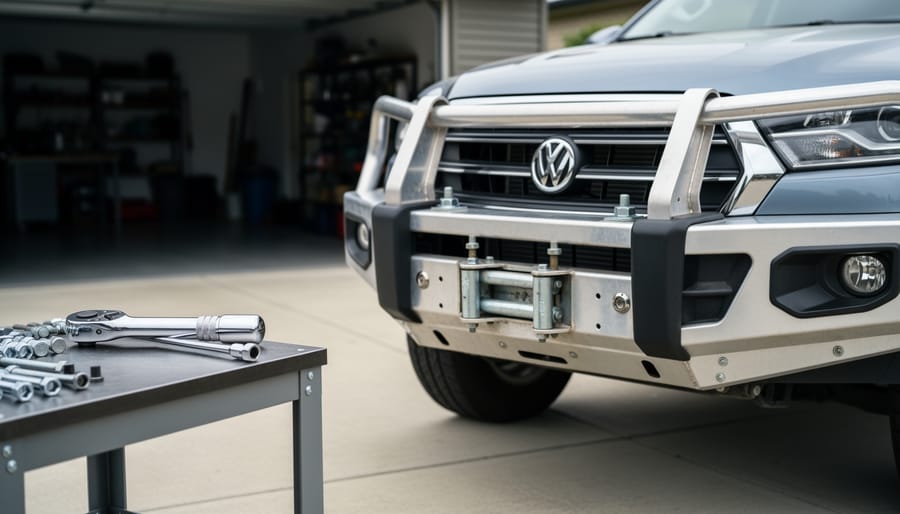
A basic job needs a good socket set, wrenches, a torque wrench, and a pair of axle stands or a quality hoist. A torque wrench is the most important item on the list. Bull bar fasteners must be tightened to the manufacturer’s specification, because over-tightening can strip threads or crack mounting points, while under-tightening can allow the bar to loosen on rough roads. Background on how the tool works is available on Wikipedia, and it explains why a proper wrench is far more reliable than guesswork.
Some tools are expensive to buy for a single job, which is where hiring makes sense. A transmission jack or small engine crane can make lifting a heavy steel bar into position much safer and far less awkward than trying to hold it in place by hand, and a good impact driver can speed up stubborn bolts. Renting equipment through a marketplace like Tool Mates is often cheaper than buying and avoids the clutter of tools that will only be used once.
When the job involves a particular model, such as a byd shark bull bar, it is worth finding the model-specific instructions and checking which tools they call for before booking anything. Having everything on hand at the start keeps the job moving and reduces the temptation to improvise.
Safety First: Lifting, Handling, and Workshop Habits
A bull bar can be heavy and awkward, and many back injuries come from lifting things incorrectly. Safe Work Australia, whose guidance is available at safeworkaustralia.gov.au, publishes advice on manual handling that applies as much in a home garage as on a worksite. The core principles are simple: use mechanical aids where possible, get help for heavy items, and never position yourself under a load that is not properly supported.
Vehicle support is another area where shortcuts are dangerous. A vehicle should only be raised on a solid, level surface and supported on rated axle stands, never on a jack alone. Safety glasses, gloves, and sturdy boots are inexpensive protection against slips and flying debris. Taking the time to set up the workspace properly makes the whole job safer and more efficient.
When to Hand It Over to a Professional
Some situations clearly call for a professional. If the vehicle needs sensor recalibration, if wiring for lights or a winch is involved, or if the installation requires drilling, cutting, or modifying anything structural, a qualified fitter is the better choice. The same applies to anyone who is not confident working around the vehicle’s electrical and safety systems.
A professional installation also brings practical benefits. It usually comes with a record of the work, which helps with warranty questions and insurance, and an experienced fitter will check that the bar sits correctly and that the vehicle’s features still work afterward. For many owners, that peace of mind is worth the cost.
The sensible path for most people is a mix: do the prep and the simpler parts if you are comfortable, hire the specialist tools you need, and leave the delicate or high-risk steps to someone with the experience. Whichever route you choose, take your time, follow the instructions, and check that everything is tight before driving away.
Related Posts